Growing up inside a mansion with twenty-two rooms sounds like privilege to outsiders.
To me, it felt like exile with chandeliers.
Every hallway echoed with a lesson I didn’t ask to learn: that love in my family was not unconditional—it was distributed, measured, and withheld like currency. My father, Richard, had only enough affection for one of his children. And he made sure we never forgot who had been chosen.
That child was my twin brother, Mason.
And I was the remainder.
Mason lived like inheritance had already arrived. New cars appeared in the driveway before he was old enough to understand their value. Tailored suits replaced school uniforms before graduation even happened. He was spoken to with pride, guided with patience, and introduced to people as “the future of the family.”
I, on the other hand, learned early that being noticed often came with a cost.
If Mason was the spotlight, I was everything the light refused to reach.
Even the staff in the house adjusted to it. Doors opened differently for him. Conversations softened when he entered. My presence, by contrast, created a subtle tightening in the room—like people were remembering something they weren’t supposed to acknowledge.
The only person who broke that pattern was my grandfather, Walter.
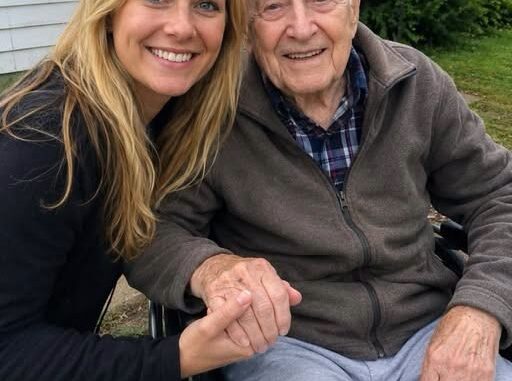
Walter never treated the house like a kingdom. He treated it like a place he was visiting, not serving. Every Tuesday, he arrived with a paper bag of oranges and worn books tucked under his arm. He would sit with me in the far corner of the library while I studied, as if I mattered enough to occupy space in the same world as the rest of them.
He never asked why I wasn’t invited to certain dinners. He never commented on Mason’s privileges. He simply showed up, placed an orange in my hand, and asked me what I was learning.
Those Tuesdays became my only proof that I existed outside of neglect.
My father hated those visits.
Not openly. Not in a way that could be pointed to directly. But in the way silence sharpens itself into something sharp enough to cut through a room. Whenever Walter entered, Richard would find a reason to leave. A call. A meeting. Anything.
Once, I heard him mutter as he passed the hallway:
“That old man knows too much.”
I didn’t understand what he meant then.
But I remembered it.
When Walter died, the mansion didn’t feel emptier.
It felt exposed.
The attorney’s office was too clean, too bright for what was about to happen inside it. Richard arrived late, as always, wearing the expression of a man who believed disappointment was something reserved for other people.
Mason sat beside him like a reflection that had never questioned its source.
And I sat across from them, unnoticed until I wasn’t.
The attorney began calmly, reading the distribution of the will. A small cabin and modest savings were left to me. Richard laughed before the sentence even finished.
“A shack and pocket change,” he said, leaning back like the matter was already beneath him.
But then the attorney placed a cream-colored envelope on the table.
“It is instructed that this be opened in the presence of all three of you,” he said.
And for the first time that day, Richard didn’t look bored.
The moment he opened it, the room changed temperature.
It wasn’t dramatic at first—just a pause. A stillness that doesn’t belong in normal air.
Then I saw his hands.
They weren’t steady anymore.
The paper trembled like it suddenly weighed too much.
“No,” he said quietly. Not to us. To the document. To the possibility of what it contained.
Mason leaned forward. “What is it?”
Richard didn’t answer.
He stood up so quickly his chair scraped backward. Folded the letter. Put it in his pocket. And left the room without another word.
The attorney didn’t stop him.
Neither did I.
But something irreversible had already begun.
The next three days revealed what the letter had done.
Richard called me constantly. At first, he spoke carefully—controlled, almost polite. Then came the offers. Money. Property. Anything I wanted in exchange for the cabin.
When I refused, the tone changed.
The mask slipped.
Threats replaced negotiation. He spoke about Mason’s future, his education, his opportunities—things he now revealed were never guarantees, only leverage.
That was when I understood something fundamental:
My father had never been generous.
He had always been transactional.
And I had simply been the part of the equation he thought he could ignore.
I went to the cabin.
It smelled like memory—pine, dust, and something faintly familiar that I couldn’t name until I realized it was Walter’s coat. His presence lingered in a way people like Richard never could erase.
Under the floorboards, I found a locked tin box.
Inside it was not treasure.
It was evidence.
Bank records. Forged signatures. Financial transfers tied to accounts that had once belonged to my grandmother. My father hadn’t just been cruel.
He had been stealing.
And then I found the letter.
My mother’s handwriting.
What she wrote did not excuse her.
It revealed her fear.
Her loneliness.
A marriage that had become something she survived rather than lived. And buried within it was the truth she had never spoken aloud: a paternity test, hidden away, confirming what she could not say in life.
Richard was not my biological father.
I wasn’t his daughter.
I was the result of a truth he had tried to bury in control, silence, and favoritism.
And Walter had known.
All along.
That was the part that broke something open in me.
Walter hadn’t been visiting a granddaughter he pitied.
He had been protecting a child he had no obligation to claim—but chose to anyway.
He didn’t expose Richard.
He didn’t destroy the family.
He simply made sure that if the truth ever surfaced, I would not be left without it.
Love, in his form, was not loud.
It was archival.
When Mason came to the cabin and saw everything, he didn’t defend our father.
He didn’t question it.
He just went still, like someone finally realizing the story he had been living inside was never stable to begin with.
Together, we sent everything to the attorney.
Every document. Every record. Every hidden truth.
And then we went back to the mansion.
Richard tried to speak first.
He always did.
But this time, no words came out cleanly enough to matter.
Mason stood beside me—not behind me, not in conflict with me, but aligned in a way that had never happened before.
And for the first time, Richard looked at both of us without hierarchy.
Just consequence.
What followed wasn’t dramatic collapse.
It was erosion.
Connections withdrew. Reputation fractured. Financial structures he had built on silence began to crack under exposure. The mansion remained standing—but it no longer held power. Only emptiness.
Twenty-two rooms.
And no one left to control inside them.
I didn’t stay to watch the final version of him fall apart.
I left.
The cabin became mine—not as inheritance, but as reclamation.
For the first time in my life, silence didn’t feel like punishment. It felt like space.
Mason visits sometimes now. Not as the golden child. Not as the forgotten twin.
Just as someone trying, like me, to understand what remains when a family myth finally dissolves.
Walter didn’t leave me wealth.
He left me truth.
And truth, once finally allowed to exist, does something no amount of favoritism or control can undo:
It frees you from needing permission to become who you were before you were denied.
Leave a Reply