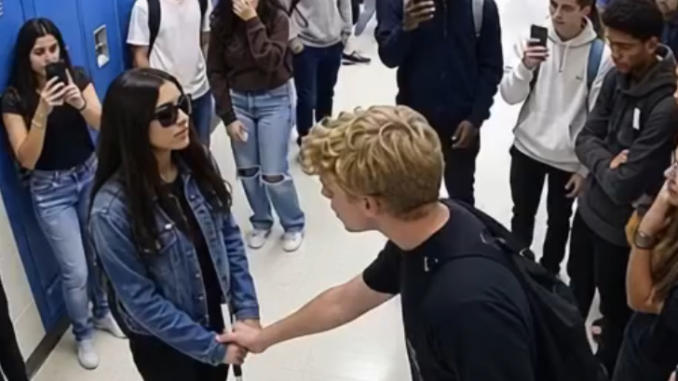
The Girl Everyone Underestimated
People often assume that losing your sight means losing your independence.
I learned long ago that those assumptions reveal far more about others than they ever do about me.
My name is Claire, and I have been blind since I was seven years old.
The accident that changed my vision also changed the direction of my life, though not in the way most people imagine. While many expected me to become dependent on others, I gradually discovered that determination, patience, and the right guidance could become stronger than fear.
When I received a full academic scholarship to Ridgewood Academy, one of the state’s most respected private schools, everyone in my hometown celebrated.
My teachers believed I belonged there.
My neighbors organized a small farewell gathering.
Even the local newspaper wrote a short article about the girl who had earned a place among students whose families could easily afford opportunities that mine never could.
I arrived believing hard work would matter more than anything else.
I couldn’t have been more mistaken.
The campus was beautiful.
Ancient brick buildings stood beneath towering oak trees.
Neatly trimmed gardens surrounded quiet walkways.
The library alone was larger than my entire middle school.
Everything sounded welcoming.
Everything felt impressive.
But beautiful places can still hide unkind hearts.
During my first week, I noticed something unusual.
Students spoke politely to teachers but very differently among themselves.
Popularity seemed more important than kindness.
Status mattered more than character.
And wealth often determined who belonged.
I simply wanted to attend class, earn good grades, and prepare for college.
Unfortunately, staying unnoticed proved impossible.
Everyone recognized the white mobility cane.
Some students offered genuine assistance.
Others stared.
A few whispered.
Most simply didn’t know how to interact with someone who experienced the world differently.
Then there was Trent Carrington.
Trent came from one of the wealthiest families connected to the school.
Teachers admired his academic achievements.
Athletic coaches praised his leadership.
Many students wanted his approval.
He had the confidence of someone who had rarely been told no.
At first, his comments were subtle.
“You don’t need directions?”
“How do you know where you’re going?”
“Can you really memorize every classroom?”
I answered each question politely.
Curiosity deserves patience.
Mockery does not.
Over time, his questions changed.
“So someone always helps you?”
“I guess life is easier when everyone feels sorry for you.”
His friends laughed.
I ignored them.
My grandmother had always told me that not every opinion deserved a response.
“Save your energy,” she would say.
“People eventually reveal who they truly are.”
My grandmother wasn’t actually my biological grandmother.
She had adopted me several years after I lost my sight.
To everyone else, she was simply Eleanor Harper.
A quiet retired woman who enjoyed gardening, classical music, and solving crossword puzzles.
Very few people knew anything about her life before retirement.
She preferred it that way.
Whenever I asked about her younger years, she smiled.
“We all have chapters we choose not to reread,” she’d say.
Instead of talking about the past, she focused on preparing me for the future.
She taught me orientation and mobility skills until walking unfamiliar streets became second nature.
She encouraged music lessons because she believed listening carefully sharpened every other skill.
She introduced me to chess, explaining that strategy begins with imagination rather than sight.
Most importantly, she refused to let anyone convince me that blindness defined my limits.
“You’ll meet people who underestimate you,” she often reminded me.
“Don’t spend your life trying to prove them wrong. Simply keep growing.”
Those words stayed with me every day.
Especially at Ridgewood.
Months passed.
Academically, everything went well.
I earned excellent grades.
Teachers appreciated my work ethic.
The school librarian even helped expand the collection of accessible learning materials after noticing how much I enjoyed reading.
Outside the classroom, however, life remained complicated.
One afternoon, classes ended earlier than usual because of a faculty meeting.
Students filled the hallways.
Lockers slammed shut.
Conversations echoed throughout the building.
I carefully made my way toward the front entrance.
Suddenly, someone stepped directly into my path.
“Leaving already?”
I recognized Trent’s voice immediately.
“I have tutoring,” I answered calmly.
He laughed.
“So organized.”
Several others gathered nearby.
Their footsteps told me I wasn’t alone.
Before I could continue walking, my cane disappeared from my hand.
“Interesting little gadget,” another student joked.
“It’s my mobility cane,” I replied evenly.
“I’d appreciate having it back.”
For a brief moment, no one spoke.
Then came the unmistakable sound of fiberglass cracking.
A sharp snap echoed through the hallway.
The laughter that followed was louder than the sound itself.
Someone gasped.
Another student whispered, “That wasn’t funny.”
I stood perfectly still.
Not because I was frightened.
Because becoming angry would only give the moment more power than it deserved.
Around us, the hallway gradually became quiet.
Even those who had laughed moments earlier seemed uncomfortable.
Breaking someone’s mobility aid wasn’t harmless.
It wasn’t a joke.
It crossed a line.
A teacher’s footsteps approached quickly.
“What happened here?”
No one answered immediately.
Finally, one student quietly admitted the truth.
“He broke her cane.”
The teacher took a slow breath.
“Everyone involved will remain here.”
Within minutes, the administration had been notified.
I was escorted to the nurse’s office while arrangements were made to replace my damaged mobility cane.
The principal personally apologized for what had happened.
Although I appreciated the concern, I wasn’t thinking about the broken cane.
I was thinking about something Eleanor had once told me.
“Character isn’t revealed during easy days,” she’d said.
“It’s revealed when people believe no one important is watching.”
That evening I returned home.
Eleanor greeted me at the front door before I even spoke.
“You sound unusually quiet.”
I smiled.
“You always know.”
She laughed softly.
“I’ve had years of practice.”
As we shared dinner, I told her everything.
Not dramatically.
Just honestly.
She listened without interrupting.
When I finished, she poured another cup of tea.
“You know,” she said thoughtfully, “many years ago I worked in a profession where people believed strength meant intimidating others.”
I leaned forward.
“You’ve hinted about your past before.”
She smiled.
“Perhaps one day I’ll tell you the whole story.”
“Was it dangerous?”
“It required discipline.”
“Were you afraid?”
“Often.”
“So what kept you going?”
She reached across the table and gently squeezed my hand.
“I eventually learned that the strongest people aren’t the ones who win every confrontation.”
“They’re the ones who remain true to themselves even when others choose a different path.”
Her answer wasn’t dramatic.
It didn’t satisfy my curiosity.
But somehow it gave me exactly what I needed.
The following week, I returned to school with a new mobility cane provided by the academy.
Something unexpected had changed.
Students who had witnessed the hallway incident began speaking to me differently.
Not because they pitied me.
Because they respected how calmly I had handled an unfair situation.
Several classmates invited me to study with them.
One volunteered to help convert class notes into accessible formats.
Another asked if I’d consider joining the debate team.
For the first time, I realized something important.
Kindness often begins with one person choosing not to remain silent.
As for Trent, the administration required him to participate in restorative meetings and community service connected to disability awareness.
Months later, he approached me after school.
“I owe you an apology,” he said quietly.
“I thought I understood what you dealt with.”
“I didn’t.”
People can change.
Not always quickly.
Not always perfectly.
But sometimes a difficult moment becomes the beginning of genuine growth.
Looking back now, I understand that the most extraordinary part of my story was never the scholarship, the academy, or even the challenges I faced.
It was the remarkable woman who raised me.
She never taught me to seek revenge.
She taught me resilience.
She never encouraged me to defeat people.
She encouraged me to understand them without allowing them to define my worth.
Years later, when I finally learned the full truth about Eleanor’s remarkable past and the remarkable career she had quietly left behind, I understood why she valued compassion over conflict.
Some secrets aren’t meant to make us fear the people who carry them.
They’re meant to remind us that wisdom is often hidden beneath the quietest lives.
And that lesson changed my future far more than any act of retaliation ever could.
Leave a Reply