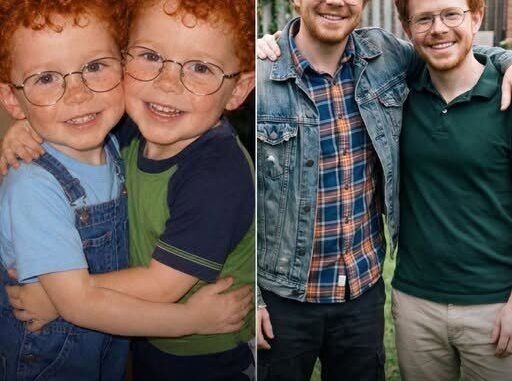
Growing up, my twin brother Noah and I believed we understood where our story began.
It wasn’t a happy story, but it was the only one we had ever known.
We were told that we had been adopted when we were three years old after spending our earliest years in an orphanage. According to the explanation we heard throughout childhood, our biological mother had been unable to raise us, and we had eventually been given the opportunity to start over with a new family.
As children, we accepted that version of events without question.
Why wouldn’t we?
When you’re young, you trust the adults who raise you. Their words become your history, their memories become your own, and the story they tell becomes the foundation upon which you build your identity.
For many years, that foundation seemed solid.
Looking back now, I realize there were always small cracks.
I just didn’t know enough to recognize them.
Noah and I were inseparable from the beginning.
People often joked that we finished each other’s sentences, ordered the same meals without discussing them, and somehow always knew when the other needed encouragement.
Being twins meant never facing life completely alone.
Whenever one of us struggled, the other was there.
Whenever one celebrated, both celebrated.
That bond became even more important because our childhood wasn’t always easy.
Our adoptive father, Richard, was a gentle and patient man.
He attended every school concert.
He never forgot birthdays.
He spent Saturday mornings teaching us how to ride bicycles, fix small things around the house, and appreciate simple acts of kindness.
He believed every child deserved to feel valued.
More than once he reminded us that families are built through love, consistency, and shared experiences rather than biology alone.
Those lessons stayed with us.
Our adoptive mother, Clara, was very different.
She wasn’t openly cruel, but warmth rarely came naturally to her.
She often reminded us how fortunate we were to have been adopted.
“You’ve been given opportunities many children only dream about,” she would say.
Although gratitude is an important value, hearing similar reminders repeatedly made us feel as though we constantly needed to earn our place in the family.
Richard usually softened those conversations.
“They’re children,” he would gently remind her.
“They don’t need to carry the weight of adult decisions.”
His calm voice always restored peace.
Then everything changed.
When Noah and I were ten years old, Richard passed away after a brief illness.
His absence transformed the entire household.
Without his steady presence, the home became quieter.
More formal.
Less welcoming.
Clara withdrew emotionally.
Instead of family dinners filled with conversation, evenings became silent.
Instead of encouragement, interactions often focused on responsibilities, expectations, and practical matters.
Noah and I learned to depend on one another more than ever.
School became our safe place.
Teachers encouraged us.
Friends welcomed us.
Sports, music, and after-school activities gave us opportunities to build confidence outside the home.
Those experiences helped us realize that kindness could still be found in many places.
Despite the challenges, we worked hard academically.
Education became our shared goal.
We believed it offered the best path toward independence.
Years passed.
Eventually graduation arrived.
It felt like the beginning of an exciting new chapter.
Family members filled the auditorium.
Parents proudly held cameras.
Students celebrated together.
Although Clara wished us well before we left that morning, she chose not to attend the ceremony.
At the time, we accepted her decision.
People express emotions differently.
That was the explanation we gave ourselves.
Soon afterward, Noah and I moved into a small apartment near the university.
Life wasn’t always easy.
Money was limited.
We worked part-time jobs while attending classes.
Some weeks required careful budgeting.
Other weeks demanded late-night study sessions followed by early morning work shifts.
Yet for the first time, we felt fully responsible for our own future.
Over the years, both of us gradually built successful careers.
Noah entered engineering.
I pursued architecture.
We remained close, speaking several times each week despite increasingly busy schedules.
Our relationship with Clara became distant but polite.
Holiday cards.
Occasional phone calls.
Brief birthday messages.
Nothing more.
Then, one autumn afternoon, everything changed.
It happened almost by accident.
Clara’s birthday had arrived.
Despite the emotional distance between us, I decided to stop by with flowers and a small cake from her favorite bakery.
I wasn’t expecting a long visit.
Simply a chance to wish her well.
When I arrived, I noticed the front door standing slightly open.
I assumed family members had already arrived.
Not wanting to interrupt, I stepped inside quietly.
Voices drifted from the kitchen.
Clara was speaking with her elderly mother.
I smiled, preparing to announce myself.
Then I heard Clara laugh.
“You know,” she said, “they never questioned the story.”
Her mother responded too quietly for me to hear.
Clara continued.
“They accepted everything exactly as we expected.”
I stopped walking.
My heart began beating faster.
There was something unusual about the conversation.
Not angry.
Not dramatic.
Simply… unfamiliar.
Her mother asked another question.
Clara answered thoughtfully.
“We believed it was the best decision at the time.”
The flowers suddenly felt heavier in my hands.
Every instinct told me to leave.
Instead, I remained where I was.
Their conversation continued.
They spoke about legal paperwork.
Old records.
Meetings that had taken place decades earlier.
Names I didn’t recognize.
For the first time in my life, I realized there might be chapters of our family history I had never been told.
I quietly stepped back outside before they noticed me.
I sat in my car for nearly twenty minutes.
Questions filled my mind.
Had I misunderstood the conversation?
Were they discussing someone else entirely?
Or had everything I believed about our adoption been incomplete?
That evening I called Noah.
“I think we need to talk.”
He immediately recognized something was wrong.
The following weekend we met for breakfast.
I shared everything I had heard.
He remained silent for several moments.
Finally he spoke.
“Have you ever noticed how little documentation we’ve actually seen?”
He was right.
We had accepted every explanation without asking for records.
Without requesting adoption files.
Without exploring official documents.
Not because we lacked curiosity.
Because we trusted the people who raised us.
Together we decided to begin researching our history.
Not to assign blame.
Not to reopen old wounds.
Simply to understand the truth.
Over the following weeks we contacted public agencies, searched available records, and requested access to historical adoption documents where legally permitted.
The process required patience.
Some information remained confidential.
Other records had been archived decades earlier.
Slowly, however, pieces began coming together.
We discovered that many parts of our childhood story had been simplified.
Certain details had been omitted.
Others had been presented without important context.
Rather than one dramatic revelation, the truth emerged gradually through documents, conversations, and careful research.
Most importantly, we realized that real family histories are often far more complex than the stories children receive.
Adults sometimes simplify difficult circumstances because they believe they are protecting young minds.
Sometimes those choices are made with good intentions.
Other times they leave lasting questions that deserve thoughtful answers.
The experience changed both of us.
Not because it erased our childhood.
But because it reminded us that identity is built not only from the stories we’re told but also from the courage to seek understanding for ourselves.
Today, Noah and I remain grateful for the people who encouraged us, the teachers who believed in us, the friends who stood beside us, and the father whose kindness shaped the adults we became.
His lessons about compassion, integrity, and honesty continue guiding us every day.
Looking back, I understand something I couldn’t have appreciated as a child.
Families are rarely perfect.
Memories are rarely complete.
And the truth often contains far more nuance than the simple explanations we receive when we’re young.
The conversation I accidentally overheard didn’t instantly answer every question.
Instead, it opened a door.
A door leading toward understanding, healing, and a deeper appreciation of where we came from.
Sometimes the greatest discoveries aren’t about uncovering secrets.
They’re about finding the courage to keep searching until every missing piece finally finds its place.
Leave a Reply