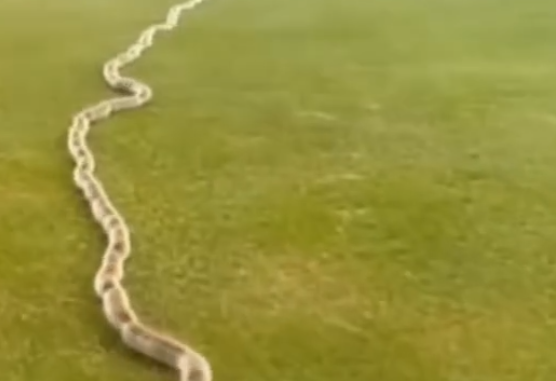
Everyday environments often conceal remarkable natural phenomena that go unnoticed by most passersby. A simple patch of grass, commonly regarded as mundane or unremarkable, can sometimes unveil intricate behaviors that highlight the complexity and adaptability of the natural world. One such phenomenon is the procession of caterpillars, a coordinated movement that reveals fascinating insights into collective animal behavior and survival tactics.
Observing Nature’s Subtle Complexity
In many outdoor spaces—gardens, parks, or even roadside verges—small insects and larvae carry out activities vital to their life cycles. Among these, certain species of caterpillars exhibit a unique behavior known as processionary movement, where individuals travel in long, organized lines. From a distance, this phenomenon can easily be mistaken for an inanimate object such as a rope or strip of fabric. However, a closer look reveals that this is a living, dynamic formation.
The processionary caterpillars move in a tightly linked chain, their bodies rising and falling in a rhythmic pattern as they follow chemical trails left by the lead members. This behavior is guided by pheromones—chemical markers that help maintain group cohesion and direction. The coordination seen in these groups is an evolutionary adaptation that enhances their survival chances during vulnerable stages of development.
Understanding the Purpose Behind the Procession
Processionary behavior serves multiple survival functions. First, traveling in groups offers protection against predators. A moving line of caterpillars can confuse potential threats by making it difficult to single out an individual. The collective movement may also simulate a larger organism, deterring some predators from attacking.
Second, the procession facilitates efficient navigation. Rather than each caterpillar searching independently for food or shelter, the group follows a shared path established by the leaders. This reduces the risk of getting lost and ensures that the collective moves toward resources or safer habitats effectively.
Third, the strength in numbers provides safety. The continuous movement and visual complexity of the procession make it harder for predators to strike effectively. This communal strategy exemplifies how even simple organisms utilize cooperation to enhance survival.
Biological and Ecological Context
Processionary caterpillars are found in various regions worldwide and are part of the larger moth or butterfly life cycle. Their processionary behavior is most commonly associated with species such as the pine processionary moth, which is notable for its distinctive larval movements. These caterpillars are often studied by entomologists to better understand collective behavior and pest management, as some species can impact forestry and agriculture.
From an ecological perspective, these processions are integral to the balance of ecosystems. Caterpillars serve as food sources for birds and other predators, while also contributing to plant dynamics through their feeding habits. Their behaviors reflect a complex interaction between survival instincts and environmental pressures.
The Experience of Witnessing a Caterpillar Procession
Encountering a procession of caterpillars in nature can evoke a range of reactions—from curiosity to awe. The slow, wave-like progression across the grass creates an almost hypnotic effect, inviting observers to pause and reflect on the subtle intricacies of life often overlooked.
Such moments encourage mindfulness and a deeper appreciation for the natural world. They remind us that even the smallest creatures engage in behaviors shaped by millions of years of evolution, demonstrating adaptation and cooperation.
Implications for Environmental Awareness
Recognizing these small-scale natural events fosters greater environmental awareness. It highlights the importance of preserving habitats that support diverse life forms, including insects whose roles are critical yet frequently underestimated.
By paying attention to these understated processes, individuals can develop a stronger connection to their surroundings and a better understanding of biodiversity. This awareness can inspire conservation efforts and promote respect for all forms of life.
Scientific and Educational Value
The study of processionary caterpillars offers valuable insights for science and education. Their collective movement is a model for understanding animal communication, group dynamics, and survival strategies. Educational programs often use such examples to teach students about ecology, biology, and the importance of observation in science.
Moreover, understanding the life cycles and behaviors of these insects can aid in managing their populations, especially when they impact human activities. This balance between curiosity-driven research and practical applications exemplifies the multifaceted importance of studying natural phenomena.
Conclusion: Embracing Nature’s Hidden Wonders
What appears as a simple patch of grass may conceal extraordinary natural behaviors that exemplify the complexity of life. The procession of caterpillars is one such example—an elegant demonstration of coordination, survival, and adaptation in the insect world.
Observing and appreciating these subtle natural events enriches our understanding of the environment and reminds us that nature’s intelligence is often quiet and unassuming. It encourages us to slow down, look closer, and recognize the interconnectedness of all living things.
In a fast-paced world, these moments of discovery offer a chance to reconnect with the rhythms of the natural world and acknowledge the sophistication present even in the smallest forms of life.
The Role of Pheromones in Caterpillar Processions
One of the most fascinating aspects of caterpillar processions is the role played by pheromones in maintaining the cohesion and direction of the group. Pheromones are chemical signals secreted by animals that trigger behavioral responses in other members of the same species. In processionary caterpillars, the leading individual emits a trail pheromone that others detect and follow. This chemical communication ensures that each caterpillar stays on the correct path and that the group moves in an organized fashion.
Research has shown that when the pheromone trail is disrupted or removed, the procession can break down, causing the caterpillars to scatter or move erratically. This dependency on chemical cues highlights the complexity of insect communication and coordination. It also reflects an evolutionary advantage: by following a reliable chemical trail, the caterpillars minimize the risk of losing their way, which could expose them to predators or leave them without food.
The use of pheromones is not unique to caterpillars but is widespread across many insect species, including ants, bees, and termites. In these groups, pheromones facilitate everything from foraging to defense, underscoring the importance of chemical signaling in the insect world.
Impact of Caterpillar Processions on Human Activities
While caterpillar processions are a natural phenomenon, they can sometimes intersect with human interests in ways that require attention. Certain processionary species, such as the pine processionary moth caterpillars, are known to be pests affecting forestry and agriculture. Their feeding habits can cause significant defoliation of trees, impacting timber production and forest health.
Additionally, some processionary caterpillars possess urticating hairs—tiny, barbed bristles that can cause allergic reactions or skin irritation in humans and animals. This has implications for public health, particularly in areas where these caterpillars are common. Awareness and education about these risks help communities take appropriate precautions, such as avoiding direct contact and managing infestations responsibly.
Despite these challenges, it is important to approach such interactions with a balanced perspective. Caterpillar processions are part of broader ecosystems, and their presence can also indicate environmental conditions. Managing their impact involves integrating scientific understanding with conservation principles to protect both human interests and biodiversity.
Caterpillar Processions as a Window into Collective Behavior
The processionary movement of caterpillars offers valuable insights into collective behavior—a field of study that examines how individual agents interact to produce coordinated group actions without centralized control. This phenomenon is of interest not only to biologists but also to researchers in robotics, computer science, and social sciences.
In the natural world, collective behavior can be observed in flocks of birds, schools of fish, and swarms of insects. Caterpillar processions are a striking example of this, where simple behavioral rules followed by each individual lead to complex group dynamics. Understanding these mechanisms can inform the design of algorithms for autonomous vehicles, improve crowd management strategies, and inspire new approaches in distributed systems.
Educational programs often highlight processionary caterpillars to illustrate these concepts, demonstrating how nature can inspire technological and scientific advancements. Such interdisciplinary connections enrich our appreciation of natural phenomena and their broader relevance.
Cultural and Symbolic Perspectives on Caterpillar Processions
In some cultures, the sight of a caterpillar procession holds symbolic meaning. Caterpillars themselves are often associated with transformation and growth, given their role as the larval stage of butterflies and moths. The collective movement of processionary caterpillars can be seen as a metaphor for cooperation, persistence, and the journey toward change.
While these symbolic interpretations vary across regions and traditions, they contribute to a deeper human connection with the natural world. Stories, art, and folklore inspired by such natural occurrences help foster respect and curiosity for the environment, encouraging people to observe and protect the living systems around them.
Promoting Observation and Citizen Science
Encounters with caterpillar processions present an excellent opportunity to engage in citizen science—the practice of public participation and collaboration in scientific research. Observers can document sightings, note behaviors, and contribute data to studies on species distribution, population health, and environmental changes.
Citizen science initiatives related to insects and biodiversity help fill gaps in scientific knowledge, especially in areas where professional monitoring is limited. By reporting observations through apps or online platforms, individuals join a global effort to understand and conserve ecosystems.
Encouraging careful and respectful observation, without disturbing the caterpillars or their habitat, ensures that these natural events can continue to be studied and appreciated for generations to come.
Future Directions in Research on Processionary Caterpillars
Ongoing research seeks to deepen understanding of processionary caterpillars’ behavior, ecology, and interactions with their environment. Areas of interest include the genetic basis of collective movement, responses to environmental stressors such as climate change, and the development of sustainable management strategies for species that impact human activities.
Advances in technology, including high-resolution imaging, chemical analysis, and computational modeling, enable scientists to explore these questions with greater precision. Collaborative efforts across disciplines are expanding the scope of knowledge about these intriguing insects.
Such research contributes not only to entomology but also to broader fields concerned with adaptation, resilience, and the complexity of life systems.
Takeaways for the Curious Observer
For those fortunate enough to witness a caterpillar procession, several key takeaways can enrich the experience:
- Patience and attentiveness reveal hidden details of natural behavior often missed in hurried observations.
- Understanding the biological and ecological context enhances appreciation for the survival strategies of even the smallest creatures.
- Recognizing the interconnectedness of species fosters a sense of stewardship toward the environment.
- Sharing observations and knowledge supports community engagement and scientific discovery.
In embracing these moments, individuals contribute to a culture of curiosity and respect that benefits both people and the planet.
The Evolutionary Origins of Processionary Behavior
The processionary behavior exhibited by certain caterpillar species is a remarkable example of evolutionary adaptation. Scientists believe that this collective movement evolved as a response to environmental pressures such as predation risk and the need for efficient resource location. Over millions of years, natural selection favored individuals that could better coordinate their movements, enhancing group survival. This evolutionary perspective helps explain why such behaviors are conserved across various species and geographic regions.
Studying the genetic and neurological mechanisms behind this behavior is an active area of research. Insights into how simple neural circuits enable complex group dynamics may also shed light on the evolution of social behavior in other animals.
Interactions with Other Species in the Ecosystem
Processionary caterpillars do not exist in isolation; they interact with numerous other species within their ecosystems. Predators such as birds, small mammals, and parasitic wasps often target these caterpillars as food sources. The processionary behavior itself can influence predator-prey dynamics by making it harder for predators to single out individuals, but it also concentrates prey in a way that can attract attention.
Additionally, these caterpillars impact plant communities through their feeding habits. By consuming leaves in large numbers, they can affect the growth and health of host plants, influencing plant competition and succession. This interaction underscores the role of caterpillars as both consumers and contributors to ecosystem balance.
Conservation Considerations
While some processionary caterpillars are considered pests, many species play important roles in maintaining biodiversity. Habitat loss, pesticide use, and climate change can threaten their populations, potentially disrupting ecological relationships. Conservation efforts aimed at preserving natural habitats benefit not only processionary caterpillars but also the broader communities they are part of.
Promoting habitat diversity, minimizing chemical interventions, and supporting native plant growth are strategies that help sustain healthy insect populations. Educating the public about the ecological importance of insects fosters a more balanced view that recognizes their contributions beyond immediate economic impacts.
Technological Innovations Inspired by Caterpillar Movement
The synchronized movement of processionary caterpillars has inspired research in robotics and engineering. Scientists and engineers study these natural systems to develop algorithms for swarm robotics, where multiple robots coordinate without centralized control. Such technologies have applications ranging from environmental monitoring to search-and-rescue missions.
By mimicking the simple behavioral rules and chemical communication used by caterpillars, researchers aim to create efficient, adaptable robotic systems capable of collective problem-solving. This biomimicry exemplifies how studying nature’s solutions can lead to innovative technologies.
Encouraging Ethical Wildlife Observation
For those interested in observing processionary caterpillars or other wildlife, ethical considerations are important. Observers should avoid disturbing the animals or their habitats, as interference can cause stress or disrupt natural behaviors. Maintaining a respectful distance, minimizing noise, and using non-invasive observation techniques contribute to responsible wildlife watching.
Additionally, sharing knowledge and experiences through community groups or citizen science platforms can promote collective learning while advocating for conservation. Ethical wildlife observation nurtures a deeper connection to nature and supports the long-term health of ecosystems.
Final Thoughts
The study and appreciation of processionary caterpillars illuminate broader themes in biology, ecology, and human interaction with the natural world. These small creatures embody complex survival strategies and contribute to ecological processes that sustain life. By expanding our understanding and fostering respect for such phenomena, we cultivate a more informed and compassionate relationship with the environment.
In a world facing rapid environmental changes, the lessons gleaned from observing these caterpillars remind us of the delicate balance and intricate interdependence that characterize life on Earth. Embracing this awareness encourages stewardship and inspires continued exploration of the natural wonders that surround us.
Leave a Reply