Life is built on the quiet rhythms we establish after the storms have passed. For ten years, it had just been the two of us: my daughter Emma and me. After losing her father when she was only three, we navigated the long, winding road from suffocating grief to healing, survival, and finally, a peaceful routine. When Daniel walked into our lives, my greatest fear was that he would disrupt that hard-earned peace. Instead, he deepened it.
He connected with Emma almost instantly, slipping effortlessly into a fatherly role without a trace of obligation. He packed her school lunches with silly, encouraging notes, braided her hair with clumsy patience, and read her favorite bedtime stories every single night. He loved her because she was Emma.
A Relentless Coldness
The only dark cloud in our otherwise warm sky was Daniel’s mother, Carol. She never accepted the bond between Daniel and my daughter. To Carol, stepchildren were temporary placeholders, not true family. She never missed an opportunity to drop passive-aggressive venom into conversations.
-
“It’s sweet that you pretend she’s your real daughter,” she once remarked right in front of him.
-
“Stepchildren always remind you they came from someone else,” she would mutter during holiday dinners.
-
And on one particularly chilling afternoon: “Your daughter must remind you of your wife’s dead husband. That must be difficult.”
Daniel shut her down every single time, drawing a sharp, unyielding boundary. Despite his efforts, the toxic comments never ceased, leading us to keep our distance with polite conversations and short, infrequent visits. We thought we had built a sufficient buffer against her bitterness, failing to realize that some people do not just cross boundaries—they obliterate them.
The Labor of Love
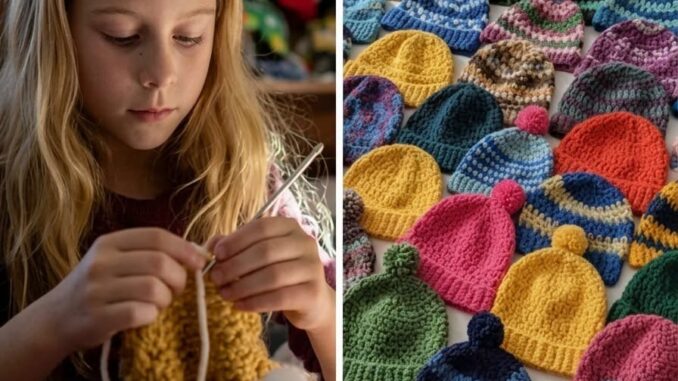
Emma possessed a heart bigger than anyone I had ever known. Early in December, after watching a touching television segment about children spending the winter holidays in hospice care, a quiet determination settled over her. She turned to us and announced her grand plan: she was going to crochet eighty hats, ensuring every child in that hospice received a handmade token of warmth.
She taught herself complex stitches using YouTube tutorials, pooled her own allowance money to buy bulk yarn, and spent every free afternoon practicing, improving, and smiling to herself as she worked. Every completed hat went into a large, designated bag beside her bed. By the time Daniel left for a routine two-day business trip, she had finished seventy-nine. She planned to stitch the eightieth that very night.
Daniel’s absence, however, acted as an open invitation for Carol. She had a persistent habit of “dropping in” unannounced whenever he traveled, treating my home like a revolving door.
That afternoon, Emma and I returned from the grocery store, arms loaded with bags and chattering excitedly about the icing we needed for upcoming gingerbread cookies. Emma darted down the hall to her room to pick out colors for hat number eighty.
Five seconds later, a blood-curdling scream echoed down the hallway.
I dropped my grocery bags and sprinted to her doorway. Emma was on her knees beside her bed, sobbing so violently her entire small frame shook. The large bag containing seventy-nine meticulously crafted hats—the culmination of weeks of dedication, love, and hope—was completely gone.
Before I could even form words, a calm, chilling voice spoke from behind me. “If you’re looking for those raggedy hats, I threw them away.”
Carol stood in the hallway, sipping tea from one of my finest porcelain cups as if she were posing for a portrait of casual cruelty.
“You… what?” My voice came out thin, stripped of all breath.
“They were ugly,” Carol said with a casual shrug. “And frankly, I don’t understand why you let her spend time on things that embarrass the family. She isn’t my blood—she shouldn’t be wasting time on such pointless hobbies.”
“They weren’t pointless!” Emma sobbed, clinging desperately to my waist.
Carol rolled her eyes, turned on her heel, and walked out without a trace of apology or remorse, treating the destruction of a child’s hard work like tossing out old junk mail.
A Quiet Fury
I spent an hour frantically searching through our trash cans, scouring the neighbors’ bins, and combing the nearby gutters and driveways. There was nothing. Carol had disposed of them completely. That night, Emma cried herself to sleep in my lap, her breathing eventually slowing into exhausted, shallow hitches. I sat in the dark living room, finally letting my own tears fall where she couldn’t see them.
I debated calling Daniel, typing and deleting messages on my phone. Ultimately, I decided to wait until morning, wanting to shield him from distress while he was away on the road.
It was a choice I regretted the second he walked through our front door.
“Where’s my girl?” he called out cheerfully, tossing his keys onto the counter. “I want to see the hats—did she finish the final one?”
Hearing the word hats triggered a fresh wave of quiet tears from Emma. Daniel froze, sensing the heavy, suffocating shift in the atmosphere. I pulled him into the kitchen and told him everything—from the initial scream to the empty trash cans and Carol’s smug confession.
As I spoke, Daniel’s face hardened into an expression I had never witnessed before: a quiet, terrifyingly focused fury.
Without uttering a single word, he walked over to Emma, pulled her tightly into his chest, kissed the top of her head, and whispered fiercely, “Sweetheart, I promise you—Grandma is never hurting you again. Ever.”
He grabbed his car keys and walked out the door.
Two hours later, he returned. His jacket and jeans were streaked with dirt and carried the sour, unmistakable odor of municipal waste. He hauled a large black garbage bag into the kitchen and gently pulled out a pastel-colored, slightly squished crochet hat.
Inside the bag were all seventy-nine hats.
“I searched every industrial dumpster in Mom’s apartment complex until I found them,” Daniel said, his voice trembling slightly as he held the yarn creation. “This isn’t just string, Mom. This is her effort. Her kindness. Her heart. And my mother threw it in the trash.”
Drawing the Line
An hour later, true to her predictable schedule, Carol arrived for her “surprise” visit, wearing an expression of smug entitlement.
Daniel met her at the door, handing her the heavy garbage bag directly. “I found them,” he said, his voice as cold as ice. “Every last one.”
Carol wrinkled her nose in disgust. “You went dumpster-diving? Honestly, Daniel, you are being entirely too dramatic over a pile of ugly hats.”
“They aren’t ugly,” Daniel replied evenly. “But even if they were, you deliberately destroyed something our daughter poured her soul into.”
“She is not your daughter,” Carol snapped back, her mask slipping.
It was the final mistake she would ever make in our home.
Daniel stared at her, a profound realization settling over his features. “Get out,” he said softly. “We’re done.”
Carol sputtered in disbelief. “Daniel! I am your mother!”
“And I am a father,” he answered, stepping forward. “To a little girl who deserves far better than your cruelty.”
She turned to me, expecting backup or hesitation. I simply looked her in the eye and said, “He’s right.”
Furious, she hurled insults about us regretting our choice and slammed the door behind her.
We never regretted it. Not for a single second.
Viral Kindness
The following day, Daniel arrived home carrying a massive box for Emma filled with vibrant new yarns, ergonomic hooks, gift tags, and bubble wrap. “If you want to start over,” he told her with a warm smile, “I’ll learn right alongside you.”
Emma let out a burst of genuine, relieved laughter and handed him a crochet hook. His first attempt at a hat turned out looking remarkably like a lopsided potholder, but he refused to quit. Two weeks of teamwork later, they had completed eighty fresh hats. We packaged them securely and mailed them off to the hospice.
A few days after delivery, the hospice coordinator emailed asking for permission to share photographs of the children wearing their new holiday hats. Emma shyly agreed, her face glowing with quiet pride.
The post went viral almost overnight.
Thousands of people shared the post, praising her selflessness, asking where she learned to crochet, and calling her a true local hero. Operating from my account, Emma replied to the outpouring of love with a simple truth:
“My grandma threw the first ones away, but my daddy helped me make them again.”
That single sentence ignited the internet’s protective instincts. That evening, my phone began ringing incessantly. It was Carol, sobbing hysterically.
“People are calling me a monster! They are messaging me, leaving comments, harassing me! Make them stop!” she wailed.
Daniel took the phone from my hand, his expression entirely neutral. “We didn’t post your name. The hospice did. If you don’t like people knowing what you did… maybe you shouldn’t have done it.”
“You are bullying me!” she shrieked.
“No,” Daniel replied firmly. “You earned every bit of this.” He hung up the phone and blocked her number.
Today, our home is completely at peace. Emma crochets every weekend, almost always sitting side-by-side with Daniel at the kitchen table, surrounded by vibrant skeins of yarn like pools of sunlight, accompanied by the steady, rhythmic click-click of two hooks working in unison.
Carol still sends sporadic text messages around major holidays, asking if we can “put this whole ugly thing behind us.”
Daniel always replies with the exact same message:
“No.”
Leave a Reply