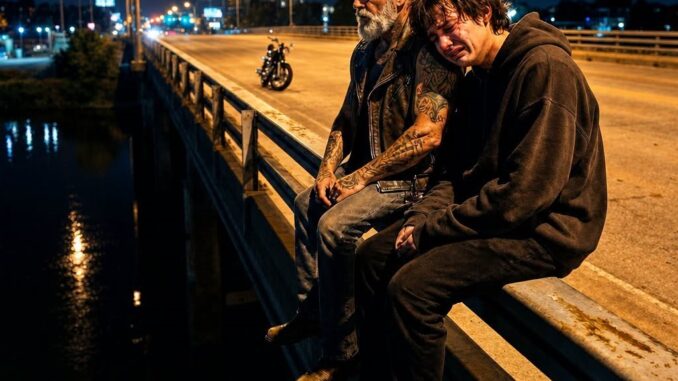
There are moments in a person’s existence that split time cleanly into two halves: the before and the after. For me, that dividing line was a cold concrete ledge high above the ground, a pre-dawn Tuesday in October, and a heavy-set biker in a leather vest who refused to follow the standard script.
When people imagine a person on the edge of a bridge, they usually picture the frantic rush to stop them. They picture megaphones, flashing police lights, crying relatives, and professionals reading meticulously prepared lines from a manual. But none of those traditional rescue measures were what brought me back from the brink. It wasn’t the shouting authorities, nor was it the desperate pleas of my mother. Instead, it was a total stranger who climbed right over the safety barrier, sat down beside me over an endless drop, and spent six hours doing something radical: absolutely nothing to talk me out of it.
The Anatomy of Absolute Isolation
At seventeen years old, I had spent roughly three months methodically constructing my final exit. I had drafted the goodbye note, organized my personal belongings, and carefully selected this specific bridge because its sheer height guaranteed absolute permanence. There would be no room for second chances, no emergency medical intervention, and no waking up in a sterile hospital room to face the collective disappointment of friends and family.
I hauled myself over the railing at four in the morning. My plan was simple: I wanted to witness one final sunrise before letting go of a world that had consistently felt heavy, cold, and entirely indifferent.
During the initial hours, vehicle after vehicle sped past. Drivers caught sight of a young figure perched precariously on the wrong side of the safety barrier with legs swinging over empty air, yet they simply pressed down on their accelerators and vanished into the gloom. I felt zero shock at their indifference. For as long as I could remember, I had felt invisible. It made complete sense that death would be no different.
Then, the low, steady rumble of a motorcycle pierced the quiet morning air.
A single headlight cut through the mist, approaching from the east. I fully expected it to roar past like all the rest. Instead, the throttle eased. The motorcycle decelerated, pulled sharply onto the shoulder, and the engine sputtered to a halt. The distinct sound of heavy boots hitting the pavement echoed against the concrete, followed by a gruff, weathered voice asking a simple question.
“Mind if I sit with you?”
I turned my head to look. He was massive, easily fifty years old or more, featuring a long gray beard, a leather vest heavily adorned with various patches, and arms completely covered in elaborate tattoos. He possessed the rough, intimidating exterior of a man people instinctively avoid.
“I’m not going to talk you out of it,” I warned him immediately, tightening my grip. “So don’t even bother trying.”
He offered a slow, deliberate nod. “Wasn’t planning to.”
To my absolute astonishment, he proceeded to swing his heavy frame directly over the metal railing, settling down right beside me. His legs began to dangle over the exact same horrifying void as mine.
“What on earth are you doing?” I asked, my voice trembling.
“Sitting,” he replied casually, pulling out a crumpled pack of cigarettes. “You smoke?”
“No.”
“Good. Don’t start.” He lit one, took a long, relaxed drag, and exhaled into the wind. “I’m Frank, by the way.”
“I don’t care what your name is.”
“Fair enough.” He watched the distant horizon, where the sky was beginning to streak with pale gray. “Hell of a view from up here, though.”
“That’s precisely why I chose it.”
“Smart,” he agreed without hesitation. “If you’re going to do something, you might as well do it right. That’s what my old father always told me.”
I stared at him, bewildered. “Aren’t you going to tell me I have so much to live for? That things get better? That people genuinely care about me?”
Frank took another slow puff of his cigarette. “Do you want me to say those things?”
“No.”
“Then I won’t.” He flicked a small ash into the rushing wind far below. “Frankly, I despise when people spout that nonsense anyway. As if they truly understand your personal history. As if they have the slightest clue what you’ve been through.”
Tears pricked my eyes, hot and sudden. “Everyone keeps telling me I’m being selfish. They say I’m completely ignoring how this destruction will impact them.”
“And that infuriates you, doesn’t it?”
“Yes,” my voice cracked sharply. “Because where were all of those people when I was suffering in silence? Where were they when I desperately needed a soul to notice that I was drowning?”
Frank nodded slowly, his expression softening. “They only ever show up right when you’re about to walk away. They are never around when you’re fighting just to stay.”
I studied him closely, sensing a deeper resonance. “How could you possibly know that?”
Slowly, he pulled down the collar of his faded shirt, revealing a thick, jagged scar stretching clear across his throat. “Because I was sitting right where you’re sitting thirty-two years ago. A different bridge, but the exact same plan.”
My breath caught in my throat.
“I was twenty-three back then,” Frank continued softly. “Just returned from the Gulf. I witnessed things no human being should ever have to witness, and I carried burdens I couldn’t live with. My wife left, taking my daughter along, declaring I was far too broken to remain a father.”
He took another drag, letting the silence settle around us. “So I tracked down a high bridge and decided to check out permanently. I had everything figured out, waiting for the sunrise just like you are right now.”
“What changed your mind?”
“An older man on a motorcycle pulled over. He didn’t lecture me. He didn’t call the authorities. He simply climbed over that railing and sat beside me for eight straight hours,” Frank smiled faintly. “We talked about everything and nothing. He shared pieces of his life, and I shared mine. Not once did he tell me not to do it, and not once did he make me feel foolish or weak.”
“Why didn’t he try to stop you?”
“Because he understood something fundamental that most people miss entirely. When you’re standing on that specific ledge, you don’t need a mechanic to fix your broken parts. You simply need another human being willing to sit with you in total darkness—someone who isn’t terrified of your pain.”
The Question That Changes Everything
The sun began to peek over the horizon, washing the sky in brilliant strokes of orange and pink. It was stunning, and I intensely resented its beauty.
“So what ultimately made you climb back over to the safe side?” I asked.
Frank remained quiet for a long moment, watching the light spread across the landscape. “He asked me a single question. Just one. And for the life of me, I couldn’t come up with an answer.”
“What was it?”
Frank turned his weathered face toward mine. “He asked me, ‘What would you do if you weren’t in pain?’”
Something shifted deep within my chest. “What do you mean?”
“He didn’t ask what I had to live for, or demand that I think about my family. He asked what my existence would look like if the constant agony vanished entirely. What dreams I might pursue, what sort of life I would build, and who I might become.”
Frank stubbed out the cigarette carefully against the metal structure. “And right then, I realized I had never once considered that possibility. I had spent so much energy trying to flee from the suffering that I completely forgot there might actually be something waiting on the other side of it. Not necessarily instant happiness, but a future I hadn’t yet attempted to create.”
“Did you find that life?”
“Pieces of it, yes.” He pulled out an old smartphone and tapped the screen, showing me a photograph of a smiling woman with kind eyes, two strapping teenage boys, and a young girl wearing pigtails. “That’s my wife, Maria. My sons, Thomas and David. And my granddaughter, Lily.”
“You managed to get remarried?”
“It took fifteen years of hard work, extensive therapy, and countless days where I felt the pull to return to a bridge,” Frank answered, sliding the phone away. “But I kept returning to that core question: What would you do if you weren’t in pain? And slowly, brick by brick, I started constructing that life.”
“And your first daughter? The one your ex-wife took away?”
Frank’s expression shifted, blending sorrow with profound tenderness. “She tracked me down six years ago. She was thirty-one years old, carrying a lifetime of questions, anger, and things she desperately needed to express.”
“How did that turn out?”
“We talked for hours. I took accountability and apologized for my absence, while she unpacked the narratives she had been fed. We cried, we shouted, and eventually, we started fresh.” He smiled warmly. “In fact, she’s the one who bought me this specific leather vest. She told me if I was going to ride a motorcycle, I needed to look the part.”
I glanced down at his various patches. One read Survivor, another Guardian, and a third displayed a pair of stylized angel wings.
“That old man who sat with you,” I whispered. “Did you ever cross paths with him again?”
“He became my sponsor, my mentor, and my closest friend. He’s the one who introduced me to this motorcycle community, teaching me that the most effective way to heal your own wounds is to help heal someone else’s.”
“Is he still with us?”
“He passed away four years ago from lung cancer,” Frank’s voice thickened slightly. “I was holding his hand at the very end. The final words he spoke to me were, ‘Go find someone on a bridge, Frank. Pass it on.’”
The tears I had fought so hard to suppress finally broke free. “So that’s why you stop for people? Because of him?”
“I pull over every single time I spot someone carrying weight that’s too heavy for them. Sometimes they tell me to get lost. Other times, they let me sit. Occasionally, we talk for hours,” he paused, offering a gentle smile. “I’ve sat on fourteen different bridges over thirty-two years. You are number fifteen.”
“How many of those individuals climbed back over the railing?”
“Twelve,” his voice remained steady and clear. “Two did not. I couldn’t save them, and I carry their memories with me every single day.”
“Doesn’t that failure make you want to stop trying?”
“Not at all. It makes me want to try harder, because the next person might be the one who makes it through. The next person might be the one who carries the torch forward.”
The Power of Presence
By this point, the sun was fully risen, casting a brilliant golden glow over the entire bridge. Traffic behind us had grown heavy, and soon enough, authorities would arrive.
“Emma,” Frank said gently, his tone entirely free of pressure. “I am not going to command you not to jump. That remains your choice. It has always been your choice, and no one else can make it for you.”
“But?”
“But I am going to ask you that exact same question.” He turned to face me squarely. “What would you do if you weren’t in pain?”
I opened my mouth intending to say nothing. I wanted to declare that there was zero value left in my existence, that the agony was all-encompassing. Yet the words stalled in my throat.
Deep beneath the layers of darkness, a tiny, stubborn ember flickered—something I had long assumed was completely extinguished.
“I wanted to become a veterinarian,” I murmured, barely audible over the wind. “When I was little. I wanted to help animals.”
“Oh yeah? What kind of animals?”
“Dogs, mostly. The ones nobody else wants. The senior dogs. The sick ones. The creatures everyone else gives up on.”
A gentle smile touched Frank’s lips. “The exact ones that need someone to sit with them in the dark.”
Fresh tears welled up. “But I can’t do that. I’m far too broken. I’ve cycled through hospitals and failed at everything. No one believes in me.”
“I believe in you.”
“You don’t even know me.”
“I know you’re still sitting right here. I know you’ve been fighting a battle most people couldn’t fathom surviving. I know you crossed over this railing, but you haven’t let go yet,” he reached out, placing his warm, calloused hand over mine. “That isn’t weakness, Emma. That is a staggering level of strength you don’t even realize you possess.”
“I’m just so exhausted from fighting.”
“I know. God, I know that exhaustion,” his voice cracked with empathy. “What if you no longer have to fight in absolute isolation? What if there are people ready to sit with you in the dark until the dawn finally breaks?”
“People like you?”
“People like me, and the brothers in my club. People who have stood right where you are standing and managed to reach the other side,” he squeezed my hand reassuringly. “We aren’t clinical professionals or therapists. We are simply broken individuals who figured out how to take the next step, and we help others do the exact same thing.”
A New Chapter
The authorities arrived shortly after hour three, setting up traffic barricades and deploying a professional crisis negotiator. By hour four, my mother arrived, standing behind the barriers and screaming my name in absolute hysteria.
Yet Frank never budged. He remained firmly seated beside me on the narrow ledge, sharing stories of his past, listening to my fears, and occasionally telling terrible jokes that managed to coax a genuine laugh through my tears.
By hour five, he shared insights from his motorcycle club’s outreach work with struggling veterans, explaining how they had quietly altered the trajectory of numerous lives simply by showing up, sitting still, and refusing to panic.
As hour six rolled around, the sun beat down with intense midday heat, leaving me utterly drained. I was exhausted from crying, exhausted from vocalizing my pain, and profoundly tired of holding on.
“Frank,” I whispered. “I don’t actually want to die.”
He didn’t react with theatrical relief, cheers, or dramatic outbursts. He simply nodded with quiet affirmation. “Understood. Are you ready to climb back over?”
“I honestly don’t know if I have the strength.”
“That’s perfectly fine. I’ll help you.”
Slowly, Frank stood up on the narrow ledge, extending a strong, calloused hand downward. “One step at a time, Emma. That’s all any of us can manage.”
I placed my hand in his. He gripped my fingers firmly and pulled me up, guiding me safely back over the safety barrier. The moment my sneakers hit solid pavement, my knees buckled entirely.
Frank caught me, holding me securely as I wept against his leather vest—a complete stranger, a biker, a man who had dedicated six hours of his life to a desperate teenager because someone had done the exact same for him decades prior.
“You’re going to make it,” he murmured softly into my hair. “Maybe not today, and perhaps not tomorrow. But eventually. I promise you.”
Medical professionals transported me to a specialized facility where I spent two weeks in inpatient care. The road ahead was undeniably difficult, but Frank visited every single day, bringing books about animal rescue and sharing more stories of resilience.
Upon my discharge, he introduced me to his motorcycle club—fifty-odd individuals who had each navigated their own profound darkness. They embraced me like family, adopted me as their “little sister,” accompanied me to therapy sessions, and helped me study for my GED after I had dropped out of high school.
That pivotal morning on the bridge was eight years ago.
Today, I am twenty-five years old, currently in my third year of veterinary school, specializing in senior canine care and animal hospice support. I work with the creatures nobody else wants, the ones society easily discards.
Next month, Frank will walk me down the aisle. My biological father chose not to be involved, but Frank stated it would be the honor of a lifetime. His wife, Maria, is actively assisting with wedding preparations, and their granddaughter, Lily, will serve as my flower girl.
Every single year on the anniversary of that day, Frank and I ride our motorcycles back to that exact bridge. We remain safely on the proper side of the railing now, watching the sunrise together and reflecting on how far we have traveled.
Last year, at the break of dawn, we spotted a young man cautiously climbing over the structural barrier. Frank glanced over at me, and I simply nodded in response.
Together, we climbed over, sitting on either side of the stranger. We didn’t lecture him or command him not to jump.
We simply sat with him in the dark until the morning light chased the shadows away.
Leave a Reply