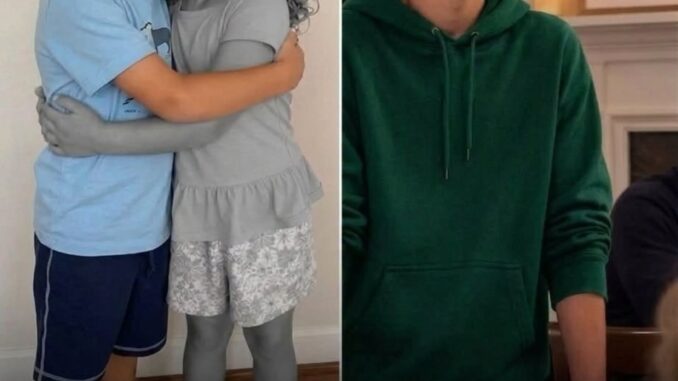
My son had not spoken for eight years, not since the day we buried his twin sister. Then, during our yearly family dinner, he pointed at his father and said, “You knew why I stopped talking.”
Jeremy and Janice were born eleven minutes apart.
For their first five years, they were inseparable. They shared a room, shared toys, and seemed to know what the other was thinking before either spoke.
Then my husband, Zane, took them to the lake.
Only Jeremy came home.
Zane told me Janice had slipped on the rocks and been swept away by the current. He said he jumped in after her and kept swimming until he could barely breathe.
Her body was never recovered.
The police ruled it an accident.
Jeremy stopped speaking at Janice’s funeral.
He didn’t gradually lose his voice. He simply became silent.
For eight years, he never said another word.
I tried everything. Therapy. Music. Art. Specialists who promised patience would eventually break through whatever had trapped him inside himself.
Nothing worked.
Jeremy became thirteen that spring. His teachers called him brilliant. He communicated through writing, gestures, and expressions, but his voice remained locked away.
Every year on Janice’s anniversary, I hosted a small family dinner.
I always made blueberry pie because Janice had once called it her “birthday pie.” Zane came every year, sat at the opposite end of the table, and usually left before dessert.
That year, Jeremy watched his father from the moment he entered.
We were halfway through dinner when my son placed his fork on the table.
Everyone looked up.
Jeremy stared at Zane.
Then he pointed at him.
In a rough, trembling voice I had not heard in eight years, he said:
“You knew why I stopped talking.”
The room froze.
I shoved my chair backward.
“Jeremy?”
Fear crossed his face. He seemed almost frightened by his own words.
Then he ran upstairs and slammed his bedroom door.
I started after him, but Zane caught my wrist.
For the first time in eight years, I saw something in my husband’s eyes that I had never seen before.
Fear.
I pulled my arm away.
“What did he mean?”
Zane said nothing.
He left twenty minutes later, just as he always did.
Around midnight, a folded piece of paper slid beneath Jeremy’s bedroom door.
I picked it up.
His handwriting was cramped.
I heard Dad and Uncle Dean fighting before the lake.
My hands began shaking.
There was more.
Dad said, “If Nora goes to the board, we lose the house.”
Dean said, “Then keep her quiet until this is done.”
Then, beneath those words:
Janice heard it too.
I sat on the hallway floor until morning.
At breakfast, Jeremy pushed another note toward me.
I found Nora in Dad’s old file box.
An address was written underneath.
I drove there immediately.
Nora lived forty minutes away in a small brick duplex.
When she opened the door and heard my son’s name, the color drained from her face.
“Jeremy?” she whispered.
I showed her the note.
She stepped aside.
Inside, she opened an old folder and placed a child’s drawing on the table.
Two stick figures stood beside blue water.
In the corner, written in shaky letters:
NORA BAD. MAN MAD.
“Janice drew that the day before the lake trip,” Nora said.
My throat tightened.
“She heard Zane and Dean arguing. She didn’t understand everything, but she understood they were angry about me.”
I stared at her.
“What does this have to do with Jeremy?”
Nora folded her hands.
“Everything.”
Twenty-two years earlier, Zane and I had nearly lost our first house during a financial crisis.
I had been pregnant and terrified.
Zane told me an anonymous investor had saved us.
Nora slowly pushed an old loan statement across the table.
“I was that investor.”
I stared at her.
She explained that she had been a junior accountant in the family business. She discovered that Dean had been shifting losses into Zane’s division, making him appear financially incompetent.
If Zane’s division collapsed, Dean could force him out and eventually gain control.
“Our house was tied to the loan,” Nora said. “I used part of my grandmother’s inheritance to cover the overdue payment while Zane untangled the accounts.”
“Why?”
“Because what they were doing was wrong.”
I looked down at the documents.
“Did Zane know?”
“Yes.”
“And did Janice hear about it?”
Nora nodded.
“But her death was an accident,” she said quickly. “Zane didn’t take those children to the lake to hurt them. Janice slipped. He tried to save her.”
That should have comforted me.
Instead, it broke something inside me.
At five years old, Jeremy had overheard adults discussing threats and money. Then his sister disappeared into the lake.
He had spent eight years believing the two events were connected.
Nora handed me one final document.
It was a letter from Zane.
He admitted everything about Dean’s manipulation and Nora’s loan.
Then he wrote:
If Claire ever comes to you, give her this.
Nora looked at me.
“He sent it six weeks ago.”
“Why didn’t he tell me?”
“Because he was ashamed.”
When I returned home, Zane was waiting on the porch.
Jeremy stood behind the screen door.
I asked the question immediately.
“Did Janice hear you and Dean arguing before the lake?”
Zane’s shoulders dropped.
“Yes.”
“Did Jeremy hear you?”
“I don’t know.”
“But you knew there was a chance.”
He nodded.
“Why didn’t you tell us?”
He covered his face.
“Because I was terrified Jeremy would believe I caused her death.”
I looked at him.
“You let your son carry that fear for eight years.”
“I thought silence would protect him.”
“No,” I said. “It protected Dean.”
Zane began to cry.
For once, I didn’t comfort him.
A week later, Dean was scheduled to be honored at the family’s annual business dinner.
He entered the room smiling, expecting congratulations.
Instead, I stepped to the microphone.
I told everyone about Nora.
I told them about the falsified records, the hidden transfers, and the loan that saved our house.
Then I told them about Janice.
About the argument.
About the silence that followed.
And about the eight years my son had spent believing his sister’s death was somehow connected to a secret he was too frightened to reveal.
Nora came forward with the original records.
A retired accountant verified the signatures. Former employees provided statements confirming Dean had manipulated the books and blamed others for irregularities.
Dean tried to laugh it off.
“This is an old grievance dressed up as a scandal.”
I placed the proxy documents on the table.
“Zane transferred his voting shares to me during our separation,” I said. “And I will not approve your appointment.”
The investigation eventually removed Dean from leadership.
Nora’s professional record was corrected, and the company reached a settlement with her.
But for me, the biggest victory happened somewhere else.
That old house had always represented security to me.
I once believed Zane had saved it.
Now I understood that Nora had.
I sold the house the following spring.
Part of the proceeds established a small fund for women rebuilding careers after being unfairly pushed out of their professions.
Then, months later, something happened that mattered more than any courtroom or boardroom victory.
I was making blueberry pancakes on a Saturday morning when Jeremy walked into the kitchen.
He sat at the table.
For a moment, he simply watched me.
Then he asked, quietly:
“Did Janice like these better than the pie?”
I nearly dropped the spatula.
I turned toward him.
“Yes,” I whispered. “She did.”
Jeremy nodded.
Then he smiled faintly.
“I remember.”
I sat beside him, tears running down my face.
For eight years, remembering Janice had sounded like guilt.
That morning, for the first time, it sounded like love.
Leave a Reply