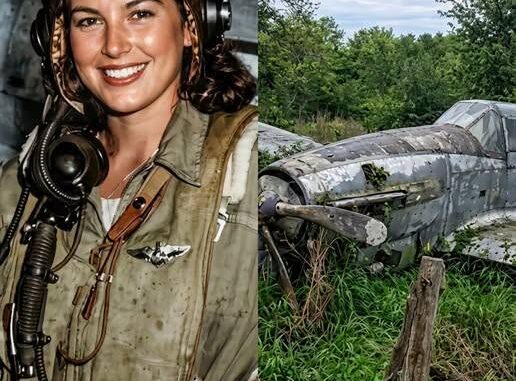
For decades, the disappearance of Evelyn Whitmore remained an unanswered question for her family.
She vanished during World War II, leaving behind a young son, a handful of photographs, and an official explanation that never quite made sense. Her family was told she had disappeared during a wartime flight, but no wreckage was ever recovered and no clear account of her final moments was provided.
Then, seventy years later, something unexpected was discovered beneath the trees of a European forest.
The wreckage of an old fighter aircraft had been hidden there for generations.
And what investigators eventually uncovered nearby suggested that Evelyn’s story was very different from the one her family had been given.
A Mission During the Final Years of the War
In 1944, Evelyn was serving as a military pilot during a period when the war was still raging across Europe.
According to the information available to her family, she had been assigned to transport an aircraft as part of the enormous logistical effort supporting Allied operations.
She departed on what appeared to be a routine mission.
Then she disappeared.
Eventually, her family received official notification that Evelyn was believed to have been lost during the flight.
There was no confirmed crash site.
There were no recovered remains.
There were few details.
For military officials, the case eventually became another wartime loss.
For Evelyn’s family, however, the uncertainty never truly ended.
A Son Who Never Stopped Asking Questions
Evelyn left behind a young son, Robert, who was only a small child when she disappeared.
As he grew older, he naturally wanted to know more about his mother.
What had happened to her?
Where had she disappeared?
Had anyone witnessed the crash?
Was there somewhere he could visit to remember her?
Unfortunately, the answers were limited.
Robert continued searching through military records and old correspondence. He contacted government offices and requested information whenever he believed another record might exist.
The responses rarely provided anything useful.
The official story remained largely unchanged.
Eventually, Robert passed away, leaving behind boxes filled with documents and correspondence from his decades-long search.
Among his possessions was a photograph of Evelyn in her flight uniform.
It was one of the few tangible reminders he had of the mother he barely remembered.
A Discovery Beneath the Forest
Decades later, the mystery unexpectedly resurfaced.
A severe storm moved through the Ardennes region of Belgium, an area deeply connected to the history of World War II.
Trees were uprooted, soil was disturbed, and areas that had remained concealed for generations were exposed.
During subsequent work in the forest, people discovered pieces of an aircraft buried beneath vegetation and soil.
At first, it appeared to be another forgotten remnant of the war.
But investigators examined the aircraft more closely.
A partially preserved identification number offered an extraordinary clue.
The aircraft appeared to be connected to Evelyn’s disappearance.
Suddenly, the decades-old case had a physical location.
The plane had not been found where the family had been led to believe Evelyn disappeared.
It had been lying beneath the Belgian forest.
Evidence That Raised New Questions
Specialists were brought in to document and examine the site.
Among those interested in the discovery was a member of Evelyn’s family who had also served in the U.S. military.
The investigation became deeply personal.
The aircraft wreckage provided clues, but it also created new questions.
The condition of the site suggested that the aircraft’s final moments might not have unfolded exactly as the original account described.
Investigators also discovered evidence indicating that someone may have reached the site after the aircraft came down.
Then came an even more remarkable discovery.
Not far from the wreckage was a small burial site.
A simple marker had been placed over human remains.
The location suggested that someone had taken the time to bury the person who had died there.
That raised an important possibility.
Evelyn might not have died instantly when the aircraft came down.
A Story Preserved Through Generations
Investigators eventually learned about a local family whose relatives had lived in the region during the war.
An elderly resident remembered stories that had been passed down from his father, who had been connected to the local resistance.
According to the family account, local people had discovered the aircraft after it came down.
The pilot had apparently survived the initial crash but was badly injured.
She was reportedly found near the aircraft, and those who discovered her tried to help.
The story suggested that she remained conscious for a period of time.
That possibility changed everything.
For decades, Evelyn had been remembered simply as a missing pilot.
Now there was evidence that she may have survived the crash long enough to understand what was happening around her.
A Personal Message From the Past
Among the items associated with the burial was a personal message believed to have been written by Evelyn.
The fragile document was preserved with extraordinary care.
Its existence was especially meaningful because Evelyn had left behind a young son.
For her family, the discovery transformed an abstract wartime mystery into something deeply personal.
She had not simply vanished into history.
There appeared to be evidence of a final connection between a mother and the child she had left behind.
What Was Her Real Mission?
The discovery also prompted questions about Evelyn’s wartime assignment.
As researchers examined historical records, they encountered information suggesting that her mission may have been more complicated than the original explanation given to her family.
Some wartime operations were classified, and records from that era can be incomplete, contradictory, or difficult to interpret.
Stories about women participating in military aviation and intelligence-related activities have also become an important part of historical research into World War II.
Whether every detail of Evelyn’s mission can now be established with certainty, the discovery nevertheless demonstrated how much of an individual’s wartime story can remain hidden for generations.
Seventy Years of Waiting
For Evelyn’s descendants, the discovery was about more than an aircraft.
It represented the end of a search that had begun with a little boy asking questions about his missing mother.
Robert never lived to see the evidence uncovered.
But the family members who continued looking finally had something they had been missing for decades: a place connected to Evelyn and a clearer understanding of what may have happened to her.
The forest had preserved fragments of a story that official records had never fully explained.
A Life Remembered
Evelyn Whitmore’s story serves as a reminder that history is often made up of people whose names never became famous.
Behind every military record is a human being.
Behind every missing-person file is a family waiting for answers.
And sometimes, those answers can remain hidden for generations before an unexpected discovery brings them back into the light.
For seventy years, Evelyn’s final chapter seemed lost.
Then the forest gave investigators a clue.
The discovery of the aircraft, the burial site, and the surviving memories surrounding the crash helped transform an old mystery into a story that could finally be examined again.
Most importantly, it allowed Evelyn to be remembered not simply as someone who disappeared during the war, but as a mother, a pilot, and a person whose story mattered.
Her family spent decades searching for the truth.
In the end, it was waiting beneath the trees.
Leave a Reply