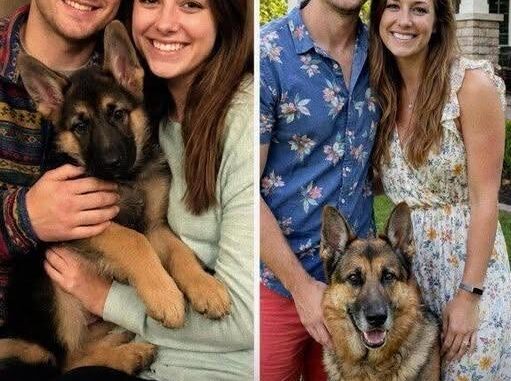
David and I had been together for ten years.
Ten years.
Long enough that sometimes I couldn’t remember what my life had looked like before him.
We met in our twenties, when neither of us had much figured out.
I was working at a small design firm.
David was building his career in finance.
Our first date wasn’t particularly glamorous.
We got coffee.
We talked for hours.
Then the café closed, and we stood outside continuing the conversation because neither of us wanted the evening to end.
By the time we said goodbye, I already knew I wanted to see him again.
That was the beginning.
Over the next decade, our relationship grew slowly.
We moved in together.
We bought a house in the suburbs.
We combined our finances.
We divided household responsibilities.
We adopted a dog.
We celebrated birthdays and holidays together.
We supported each other through difficult periods at work.
When one of us was sick, the other took care of dinner.
When one of us had a bad day, the other listened.
To our friends and family, we were essentially married already.
People referred to us as a couple that was “in it for the long haul.”
Sometimes people even assumed we were married.
We would correct them.
“No, we’re not married.”
And then they’d give us that familiar look.
The look that said:
After ten years, why not?
I didn’t have a good answer.
At first, marriage wasn’t particularly important to me.
When we were younger, I thought it was something we’d eventually discuss.
Then years passed.
One anniversary became another.
Five years.
Seven.
Eight.
Nine.
By our tenth anniversary, I finally realized that marriage mattered to me.
Not because I wanted a huge wedding.
I didn’t.
The idea of spending tens of thousands of dollars on a single day didn’t appeal to me.
I didn’t need a ballroom.
I didn’t need hundreds of guests.
I didn’t need a designer dress.
I wanted something simple.
A small ceremony.
Our closest family.
A few photographs.
A legal commitment that reflected the life we’d already built.
So, on our tenth anniversary, I decided to bring it up.
I planned the conversation carefully.
We were having dinner at one of our favorite restaurants.
The table was quiet.
The lighting was soft.
David had ordered his usual meal.
I had spent the entire evening waiting for the right moment.
Finally, I put down my fork.
“Can I ask you something?”
David smiled.
“Of course.”
“Have you ever thought about us getting married?”
His smile disappeared.
Not completely.
But enough for me to notice.
He leaned back.
“Marriage?”
“Yes.”
“Why?”
“Because we’ve been together for ten years.”
He looked at me.
“And?”
I took a breath.
“I’d like to make it official.”
He was silent.
I continued.
“I’m not asking for a big wedding. I’d be happy with something small. Just us and the people closest to us.”
For a moment, I thought he was considering it.
Then he laughed.
Not cruelly.
But dismissively.
“I’m never marrying you, Sarah.”
My stomach tightened.
He picked up his glass.
“Marriage is just a piece of paper.”
I stared at him.
He continued.
“It doesn’t change anything.”
I didn’t answer.
“If we’re happy now,” he said, “why do we need a legal contract to prove it?”
I looked down at my plate.
There was something about the way he said it.
As if my desire for marriage was childish.
As if wanting legal recognition after ten years meant I was insecure.
He leaned back.
“If you need a piece of paper to feel secure, that’s your issue.”
That sentence hurt.
Much more than I expected.
I had imagined a conversation.
Maybe he’d say he wasn’t ready.
Maybe he’d explain his concerns.
Maybe we’d disagree.
I hadn’t expected him to dismiss the thing I was asking for as meaningless.
Still, I didn’t argue.
I didn’t raise my voice.
I didn’t cry.
I simply nodded.
“Okay.”
He looked surprised.
“Okay?”
“Okay.”
The rest of dinner was quiet.
When we got home, David went upstairs.
He changed clothes.
He climbed into bed.
Within minutes, he was asleep.
I stayed downstairs.
I sat at the kitchen table in the dark.
The house was silent except for the refrigerator humming in the background.
Our dog was sleeping in the hallway.
I looked around the room.
This was the house we’d bought together.
Our names were both on the paperwork.
Our bank accounts were connected.
Our expenses were shared.
Our lives were intertwined in countless ways.
And yet, when I had asked David about marriage, he had called it nothing more than a piece of paper.
I opened my laptop.
I didn’t start planning a wedding.
I didn’t look at engagement rings.
I didn’t search for lawyers.
I simply started researching.
For the first time, I asked myself questions I’d avoided for years.
What would happen if one of us became seriously ill?
What rights would we have if one of us were hospitalized?
What would happen to our shared property?
How were our finances protected?
What legal responsibilities did unmarried partners have?
And what protections did married couples have that we didn’t?
The more I read, the more I realized something.
Marriage might be emotionally symbolic to some people, but legally, it can also create a framework for things like property, inheritance, medical decision-making, and financial responsibilities.
I had never seriously considered those details.
I’d simply assumed that because we’d been together for ten years, everything would work itself out.
That night, I realized that love and legal planning weren’t necessarily opposites.
You could have one without the other.
And pretending otherwise didn’t make problems disappear.
I spent several hours reviewing our finances.
I looked at the house documents.
I reviewed our insurance policies.
I made a list of accounts that needed clarification.
Then I contacted a financial professional and scheduled a consultation.
I also made an appointment with an attorney to understand my legal position as an unmarried partner.
I wasn’t plotting revenge.
I wasn’t trying to punish David.
I was simply taking responsibility for my own future.
At around four in the morning, I finally closed my laptop.
I looked at the clock.
The sun would be up soon.
I went upstairs.
David was still asleep.
I watched him for a moment.
I loved him.
That hadn’t changed.
But something else had changed.
I no longer wanted to assume that love automatically protected me.
The next morning, I woke before him.
I made coffee.
Then I sat at the kitchen table with a folder beside me.
Inside were notes about our finances, property arrangements, insurance, and the legal questions I needed answered.
I wasn’t leaving.
At least, not yet.
But I was done drifting through a ten-year relationship without discussing the future honestly.
Around seven, I heard footsteps.
David walked into the kitchen.
He was yawning.
“Morning.”
I looked up.
“Morning.”
He walked toward the coffee maker.
Then he noticed the folder.
“What is that?”
“Something we need to talk about.”
He picked it up.
He opened it.
His expression changed.
“What is all this?”
“I spent some time researching what our situation actually looks like.”
He looked at me.
“Why?”
“Because you said marriage is just a piece of paper.”
He nodded.
“Yeah.”
“So I decided to understand what that piece of paper actually means.”
He became quiet.
I explained what I’d learned.
The house.
Our finances.
Medical decisions.
Inheritance.
Beneficiary designations.
The legal differences between being married and unmarried.
He listened.
For the first time since our anniversary dinner, he didn’t interrupt me.
Then he asked:
“Are you saying you want to leave?”
“No.”
“Then what are you saying?”
“I’m saying I don’t want to spend another ten years assuming that everything will be fine.”
He sat down.
I continued.
“If you genuinely don’t want to get married, I have to respect that. But then we need to make other plans. We need proper legal documents. We need to protect both of us. We need to be honest about what happens if something goes wrong.”
David looked at the papers.
“You did all this last night?”
“Yes.”
He was silent for a long time.
Then he said:
“I didn’t realize you were this serious about marriage.”
I gave him a tired smile.
“That’s the problem.”
He looked at me.
“I thought you’d be okay with what we have.”
“I am grateful for what we have.”
“Then why isn’t it enough?”
“Because wanting marriage isn’t about being unhappy.”
That seemed to surprise him.
I explained that I wasn’t asking him to prove that he loved me.
I wasn’t asking for a glamorous ceremony.
I wasn’t asking for a photograph to post online.
I wanted us to sit down and make a deliberate decision about our future.
Together.
David leaned back.
“I always thought marriage was about a wedding.”
“For me, it isn’t.”
He looked at the folder again.
“So you were going to make all these arrangements without me?”
“I was going to understand my options.”
He nodded slowly.
“I suppose that’s fair.”
We spent the next several hours talking.
Really talking.
For the first time in years, we discussed subjects we’d avoided because our relationship had always seemed stable.
What would happen if one of us became ill?
What did we want our retirement to look like?
What did we want to leave behind?
How should the house be handled?
What did commitment mean to each of us?
And eventually, we returned to the original question.
Marriage.
David admitted something.
He had always been afraid that marriage would change our relationship.
He had seen friends become unhappy after getting married.
He had watched people treat marriage like a contract instead of a partnership.
He thought avoiding marriage was a way of protecting what we had.
I told him I understood his fear.
But his solution had made me feel as though my feelings didn’t matter.
He apologized.
Not because I’d forced him.
Because he finally understood.
A few weeks later, we met with professionals and put appropriate legal arrangements in place while we continued discussing our future.
Then, one Sunday morning, David surprised me.
He placed two cups of coffee on the table.
He sat down.
“I’ve been thinking.”
I smiled.
“That’s usually dangerous.”
He laughed.
Then he became serious.
“I don’t want you to spend another decade wondering whether I see you as my family.”
I didn’t say anything.
He reached across the table.
“I do.”
He paused.
“And maybe I’ve been hiding behind the phrase ‘it’s just a piece of paper’ because I was scared of what the commitment meant.”
I squeezed his hand.
“So?”
He smiled.
“So maybe it’s time we stop arguing about the paper and start talking about what we want the rest of our lives to look like.”
Months later, we had a small ceremony.
No enormous venue.
No extravagant celebration.
Just the people closest to us.
The same house.
The same dog.
The same two people who had met over coffee ten years earlier.
But something was different.
We weren’t getting married because I had finally convinced David that marriage was important.
We were getting married because we had finally learned how to have an honest conversation about what commitment meant to both of us.
Looking back, I don’t think the lesson was that marriage is essential.
It isn’t.
Different couples make different choices.
Some people build lifelong partnerships without marriage.
Others find meaning and security in it.
The important thing is that both people understand the choice and genuinely agree.
What hurt me that night wasn’t that David didn’t immediately want to marry me.
It was that he dismissed something important to me without taking the time to understand why it mattered.
And what changed everything the next morning wasn’t a dramatic threat or a sudden breakup.
It was information.
I stopped assuming.
I started asking questions.
I learned about my own financial and legal situation.
And I finally understood that protecting yourself doesn’t mean you love your partner any less.
Sometimes, the healthiest thing two people can do is sit down, turn off the distractions, and have the conversation they’ve been avoiding.
That morning, David walked into the kitchen expecting an ordinary cup of coffee.
Instead, he found a woman who had finally decided to take her own future seriously.
And that changed everything.
Not because I wanted him to regret his words.
But because I finally understood mine.
My future mattered.
My questions mattered.
My hopes mattered.
And if we were truly building a life together, then both of us needed to be part of deciding what that life would look like.
Leave a Reply