Rain whispered against the hospital window the evening my grandmother showed me an old photograph.
She had been in the hospital for nearly two weeks, and we both knew her time was becoming short. I spent most days beside her, looking through family albums, remembering old stories, and trying to make her smile whenever I could.
That evening, she stopped turning the pages.
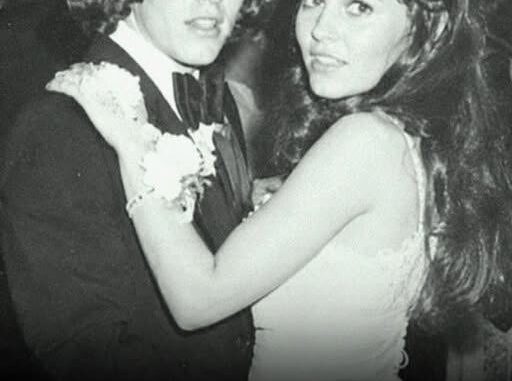
Her finger rested on a black-and-white photograph of a young couple standing side by side.
The girl was my grandmother.
The boy was someone I had never seen before.
“That was Henry,” she said quietly.
“Who was Henry?”
She smiled faintly.
“My first love.”
I sat beside her and listened as she told me a story I had never heard.
They had met when they were teenagers. Henry used to walk her home from school and carry her books. They laughed constantly and eventually became inseparable.
At their senior prom, they shared one final dance.
The song playing that night was Unchained Melody.
Then life changed.
Their families moved in different directions. Letters were exchanged for a while, but eventually the correspondence stopped. Neither knew where the other had gone.
My grandmother married my grandfather and built a family. Henry continued with his own life.
But apparently, some memories never completely disappeared.
“I still hear that song sometimes,” Grandma whispered. “Especially when I close my eyes.”
I looked at the photograph again.
“Would you want to see him?”
She hesitated.
Then she nodded.
“I’ve wondered about him my entire life.”
I made her a promise.
I’d try to find Henry.
That night, I began searching.
I looked through old school records, alumni directories, newspaper archives, and anything else I could find. There were countless people with the same name, and most searches ended with nothing useful.
My mother eventually discovered what I was doing.
She wasn’t happy.
“Please stop,” she told me. “What if you can’t find him? What if something happened to him? You could make things harder for Grandma.”
But I couldn’t forget the expression on my grandmother’s face when she looked at that photograph.
“She asked me to try,” I said.
My mother sighed.
“Some parts of the past are better left alone.”
Maybe she was right.
But I kept searching.
Then something unexpected happened.
My mother brought me an old box she had kept for years.
Inside were letters.
Dozens of them.
They had been written by Henry.
Some were dated decades earlier. Others were from much later. Apparently, he had continued trying to find my grandmother long after their teenage years had ended.
My mother finally admitted that she had known about the letters but had never shown them to Grandma.
“I thought I was protecting her,” she said through tears.
The discovery changed everything.
The final address I found belonged to a small house with white curtains and a garden filled with roses.
I drove there the next morning.
An elderly man answered the door.
For a moment, neither of us spoke.
Then I showed him the photograph.
His expression changed immediately.
He touched the picture with trembling fingers.
“That’s Eleanor,” he whispered.
He knew exactly who she was.
When I explained why I had come, he became emotional.
He had wondered about her for decades.
The next morning, we brought Henry to the hospital.
My grandmother was resting when we entered the room.
At first, she didn’t notice us.
Then Henry quietly said her name.
“Eleanor.”
Her eyes opened.
She stared at him for several seconds.
Then her face changed.
“Henry?”
He smiled through tears.
“I found you.”
She reached toward him.
“So did I,” she whispered.
For a while, nobody spoke.
Then I played the song from my phone.
The opening notes of Unchained Melody filled the quiet hospital room.
Henry stood beside her and held out his hand.
“May I have this dance?”
Grandma smiled.
“You may.”
He helped her stand, and they moved slowly beside the bed.
They couldn’t dance the way they had as teenagers.
Their bodies were older and fragile, and every movement required care.
But none of that seemed to matter.
For a few minutes, they weren’t elderly patients or people carrying decades of memories.
They were two teenagers at a school dance again.
My mother stood quietly in the doorway, crying.
My grandmother noticed her.
“There is nothing to forgive,” she said gently. “You brought him back to me.”
My mother covered her face.
“I only wanted to protect you.”
“I know.”
Henry held Grandma’s hand.
“I waited a long time for this,” he whispered.
“So did I.”
Three days later, my grandmother passed away peacefully.
Beside her was the old photograph.
One of Henry’s letters was tucked carefully underneath it.
At her funeral, my mother held my hand.
“Thank you,” she whispered. “You gave her something I was too afraid to give her.”
I shook my head.
“We were both trying to protect her. We just chose different ways.”
Later, I thought about that final dance.
For most of our lives, we assume that important moments have to be grand. We imagine celebrations, ceremonies, expensive gifts, or dramatic reunions.
But sometimes the most meaningful moments are incredibly simple.
A photograph.
An old letter.
A familiar song.
A hand reaching across a hospital room.
My grandmother didn’t get her youth back.
She didn’t get to rewrite the years that had passed.
But she got one final dance with the person who had once made her heart race as a teenager.
And perhaps that was enough.
Because love doesn’t always disappear simply because time moves forward.
Sometimes it remains quietly tucked away in memories, photographs, letters, and songs—waiting for someone to give it one more chance to be heard.
Leave a Reply