My girlfriend came home from walking our dog one evening, and almost immediately, I knew something was wrong.
Not because the dog was acting strangely.
He wasn’t.
He was happily wagging his tail, sniffing around the apartment, and behaving exactly as he always did.
It was something in his fur that caught my attention.
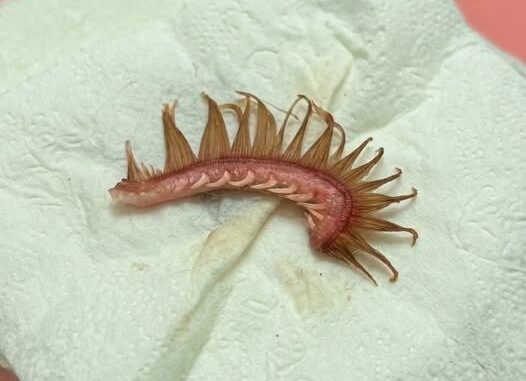
Under the kitchen light, I noticed a strange, translucent shape attached to his coat. It was small, curved, and just unusual enough to make my stomach drop.
For a few seconds, neither of us knew what we were looking at.
And when you don’t know what something is, your imagination has a nasty habit of providing an answer.
Unfortunately, ours immediately went in the worst possible direction.
“Is that a tick?”
My girlfriend crouched beside him.
“I don’t know.”
We started inspecting the dog’s fur more carefully.
The strange object appeared to be caught firmly in his coat. It looked almost as though something had attached itself to him during the walk.
Suddenly, our perfectly ordinary evening became a miniature investigation.
We checked around his ears.
Then his neck.
Then his legs and belly.
The dog seemed completely unconcerned with our growing panic.
He simply stood there, looking at us as if we had suddenly become very strange people.
Meanwhile, our minds were racing.
What if it was a parasite?
What if there were more?
What if we’d missed something?
What if our dog needed to see a veterinarian immediately?
Within minutes, we had gone from noticing one mysterious object to imagining an entire medical emergency.
I was already picturing a veterinary waiting room, expensive tests, and the possibility that we’d have to leave him overnight.
My girlfriend was searching through his fur while I tried to determine whether the mysterious shape was moving.
Then we noticed something odd.
The object wasn’t behaving the way a living creature would.
It seemed to shift slightly when the dog moved, but there was no obvious crawling or independent movement.
My girlfriend leaned closer.
“Wait.”
She stared at it beneath the light.
Then she carefully touched it.
The mystery lasted another two seconds.
And then we both realized what it was.
Not a tick.
Not a parasite.
Not some horrifying creature we’d somehow brought home.
It was a fake eyelash.
Apparently, our dog had managed to pick up someone’s discarded false eyelash during his walk.
The damp weather had made it soggy, and it had become tangled in his fur. Under the kitchen light, its curved shape had looked bizarre enough to convince us that something much more serious was happening.
We stared at each other.
Then we started laughing.
All that panic.
All those ridiculous theories.
All those imagined trips to the veterinarian.
And the terrifying object that had caused it all was nothing more than a tiny piece of cosmetic plastic.
Our dog, naturally, couldn’t have cared less.
He wagged his tail as if he’d just accomplished something impressive.
We carefully removed the eyelash from his fur and threw it away.
Then we looked at each other again and started laughing all over again.
It was such a silly incident, but it stayed with me because of how quickly our minds had transformed something harmless into something frightening.
We hadn’t actually seen a parasite.
We had seen an unfamiliar shape.
Everything else had been supplied by our imagination.
That’s something people do surprisingly often. When we encounter something we don’t immediately understand, our brains try to identify it as quickly as possible. And when there’s uncertainty involved, fear can push us toward the most alarming explanation.
A strange mark becomes an illness.
A noise outside becomes a threat.
A shadow becomes something mysterious.
A harmless object stuck to a dog’s fur becomes, for a few ridiculous minutes, a potential veterinary emergency.
The reality is often much less dramatic.
In our case, it was almost comically ordinary.
A lost eyelash had apparently traveled home with our dog.
The whole episode took only a few minutes, but it reminded us of something important: uncertainty can make ordinary things feel terrifying.
Our dog eventually curled up on the rug and went to sleep.
We sat nearby, still occasionally laughing about the incident.
My girlfriend shook her head and said, “He’s going to give us a heart attack one day.”
She was probably right.
Looking back, the funniest part wasn’t the eyelash itself.
It was how quickly we had built an entire story around it.
We had gone from one strange object to parasites, veterinary bills, possible infections, and emergency treatment—all without having any real evidence that something was wrong.
The dog had known better.
He had never been worried.
He hadn’t been scratching or acting sick.
He simply wanted to eat, sniff around, and settle down for the evening.
We were the ones who turned a tiny piece of plastic into a horror story.
And perhaps that’s why the memory still makes me smile.
It was a harmless reminder that fear can be incredibly convincing, even when it has almost no information to work with.
Sometimes the best response to something unfamiliar isn’t panic.
It’s to pause, take a closer look, and find out what you’re actually seeing.
Because occasionally, the terrifying mystery isn’t a medical emergency or something dangerous.
Sometimes it’s just a fake eyelash stuck to your dog’s fur.
And sometimes, after all that unnecessary panic, the only reasonable thing left to do is laugh.
Leave a Reply