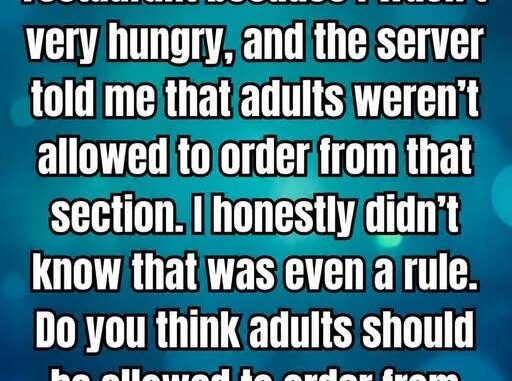
Have you ever looked at a restaurant menu and wished you could simply order the easiest, most comforting meal available?
Maybe you aren’t in the mood for an elaborate entrée. Perhaps you want something smaller, less expensive, or just familiar. Then you notice that the meal you want is labeled for children only.
It raises an interesting question: Should adults be allowed to order kids’ meals?
For many people, the issue isn’t really about chicken nuggets, grilled cheese, or a small serving of pasta. It’s about having the freedom to choose a meal that suits your appetite and your budget without feeling judged for it.
Sometimes Simple Food Is Exactly What You Want
Restaurant meals can be surprisingly large.
After a long day, some customers may not want a huge entrée with multiple sides. They might prefer a smaller portion that is simple and familiar.
Kids’ menus often offer exactly that.
The portions are usually smaller, the choices are straightforward, and the prices can be more manageable than those of regular entrées.
There is nothing inherently childish about wanting less food or choosing something uncomplicated.
Adults have different appetites, preferences, and budgets. A menu designed for children may occasionally contain the exact combination someone wants.
Why Do Restaurants Have Kids-Only Policies?
Restaurants don’t necessarily create these restrictions simply to make customers uncomfortable.
There can be practical business reasons.
Kids’ meals are often priced differently from standard menu items. They may include smaller portions, inexpensive sides, or promotional pricing intended to make dining with children more affordable.
Restaurants also have to manage food costs, staffing, preparation time, and table service.
If every adult regularly ordered a discounted children’s meal instead of a full-priced entrée, it could affect the restaurant’s finances.
From that perspective, a restaurant’s policy is understandable.
But Could There Be a Middle Ground?
Restaurants don’t necessarily have to choose between allowing every adult to order from the children’s menu and completely banning adults from doing so.
There could be alternatives.
For example, a restaurant could allow adults to order selected kids’ meals at a slightly different price. Another option would be to offer smaller portions of popular menu items for adults.
Restaurants could also create a separate small-portion menu featuring simple dishes at reasonable prices.
That would give customers more flexibility while allowing businesses to protect their costs.
It’s Also About Food Waste
Portion size is another reason to reconsider strict restrictions.
If an adult knows they won’t finish a large entrée, ordering a smaller meal could help reduce food waste.
Not everyone has the same appetite. Some people naturally eat smaller portions, while others may simply not be hungry enough for a full meal.
A smaller serving can sometimes be the more sensible choice.
Of course, restaurants need to determine whether such an option makes financial sense for their particular business.
Price Matters, Too
For many customers, the price difference is significant.
Eating out can become expensive, especially for families, students, retirees, or anyone trying to manage a tight budget.
A smaller meal at a lower price can make the difference between dining out comfortably and deciding to skip the restaurant altogether.
Wanting an affordable meal doesn’t mean someone is trying to take advantage of a business.
Customers should respect restaurant policies, but restaurants can also recognize that affordability is an important part of the dining experience.
Adults Like Comfort Food, Too
There’s also something to be said for personal preference.
Food doesn’t have an age requirement.
Adults can enjoy pizza, macaroni and cheese, pancakes, burgers, or other foods commonly associated with childhood without needing to justify the choice.
Sometimes a simple meal is simply what sounds good.
There is no rule saying that becoming an adult means abandoning familiar foods.
A Little Flexibility Could Go a Long Way
Restaurants have every right to establish their own menus and pricing policies.
At the same time, flexibility can create a better experience for customers.
If someone politely asks whether they can order a smaller meal, the restaurant could offer an alternative if its policies allow it.
Perhaps the customer pays a little more than the children’s-menu price. Perhaps they receive a smaller portion of an adult entrée.
Either way, the goal could be finding a solution that works for both sides.
The Bigger Question
Ultimately, the debate over adults ordering kids’ meals isn’t really about whether grown-ups should be eating food marketed toward children.
It’s about choice.
Customers have different appetites, budgets, and preferences. Restaurants have different operating costs and business models.
Both sides have legitimate considerations.
A restaurant doesn’t have to offer discounted children’s meals to every adult. But there is also little reason to make a customer feel embarrassed simply because they prefer a smaller or simpler dish.
Sometimes the most practical meal is the best meal.
And if a restaurant can offer that choice while still covering its costs, there’s no reason it can’t be a win for everyone.
Leave a Reply