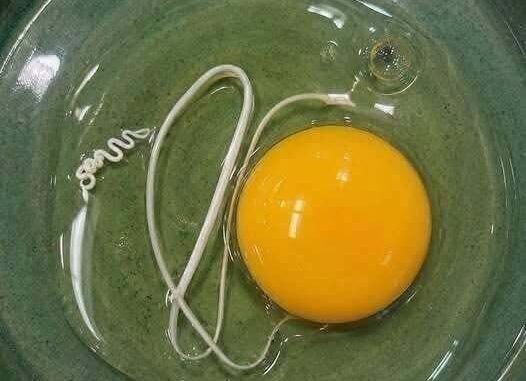
Have you ever cracked an egg and noticed a small, white, string-like structure attached to the yolk?
It may look unusual at first, but there is no reason to be concerned. That naturally occurring strand is called the chalaza, and it is a normal part of an egg.
Many people are surprised to learn that the chalaza has an important structural purpose. It helps keep the yolk positioned within the egg white. Its appearance can also provide a general clue about an egg’s freshness, although it should not be used as the only way to determine whether an egg is safe to eat.
What Is the Chalaza?
The chalaza is a twisted, cord-like structure made from concentrated egg white.
Most eggs contain two chalazae, located on opposite sides of the yolk. Their primary function is to help anchor the yolk and keep it suspended near the center of the egg.
You can think of them as tiny natural support cords inside the egg.
When you crack a relatively fresh egg, the yolk often sits prominently within the thicker egg white. The chalazae contribute to maintaining that position.
Is the White Strand a Baby Chick?
No. The chalaza is not an embryo, blood vessel, or developing chick.
It is simply a natural component of the egg. Chalazae can be found in ordinary unfertilized eggs, including eggs commonly sold in grocery stores.
So if you notice a white strand attached to the yolk, there is no need to remove the egg simply because of its appearance.
Why Is the Chalaza More Noticeable in Some Eggs?
Eggs gradually undergo natural changes during storage.
As an egg ages, moisture and carbon dioxide slowly escape through the microscopic pores in the shell. These changes affect the consistency of the egg white and the appearance of the yolk.
A fresher egg will generally have thicker egg white and a more rounded yolk. The chalaza may also appear more distinct.
As the egg gets older, the white becomes thinner and the yolk can become flatter and more fragile. The chalaza may become less noticeable as well.
This is why a clearly visible chalaza can sometimes be associated with a fresher egg.
However, it is important not to treat the appearance of the chalaza as a definitive freshness test.
What Happens to an Egg as It Ages?
Several natural changes occur while an egg is stored.
1. Moisture Gradually Escapes
Eggshells contain extremely small pores. Over time, some moisture can leave the egg through these openings.
2. Carbon Dioxide Is Lost
Carbon dioxide naturally present inside an egg also gradually escapes. This contributes to changes in the egg’s internal chemistry.
3. The Air Cell Gets Larger
As moisture and gases are lost, the air space inside the shell gradually increases.
4. The Egg White Becomes Thinner
The thick portion of the albumen gradually loses some of its firmness. An older egg may therefore spread more when cracked onto a plate.
5. The Yolk Changes Shape
As the egg ages, the yolk can become flatter and its surrounding membrane may become more fragile.
6. The Chalaza Can Become Less Prominent
The twisted strands that help support the yolk can become less distinct as the egg’s internal structure changes.
Does a Visible Chalaza Guarantee Freshness?
Not necessarily.
A prominent chalaza can be a useful visual indication that an egg has retained some of the characteristics associated with freshness, but it should not be considered a guarantee.
Freshness and food safety are also influenced by factors such as storage conditions, handling, packaging, and the amount of time the egg has been stored.
If you’re unsure about an egg, consider the relevant date information and storage guidance on the packaging, and follow food-safety recommendations for your location.
What About the Appearance of the Egg White?
The consistency of the egg white can provide another visual clue.
When cracked onto a plate, a fresher egg often has a thicker, more concentrated white that stays relatively close to the yolk. An older egg may have a thinner white that spreads more widely.
The yolk of a fresher egg also tends to stand higher and maintain its shape better.
These characteristics are normal results of the changes that occur during storage.
Why the Chalaza Is Easy to Mistake for Something Else
The chalaza can look surprising because it doesn’t resemble the smooth, transparent egg white surrounding it.
Its twisted appearance may lead people to wonder whether it is part of the shell or something unusual inside the egg.
In reality, it is simply one of the egg’s natural structural features.
Once you know what it is, seeing one becomes much less mysterious.
Should You Remove the Chalaza Before Cooking?
There is generally no need to remove it.
The chalaza is a natural part of the egg and can be cooked along with the rest of the egg. It may become less noticeable during cooking.
Some recipes may call for particularly smooth or uniform egg mixtures, in which case a cook may choose to remove visible strands for appearance or texture. That’s a matter of preference rather than a requirement.
A Small Detail With an Interesting Purpose
The next time you crack an egg and see a white strand wrapped around the yolk, take a closer look.
That unusual-looking structure is the chalaza, a natural part of the egg that helps keep the yolk in position.
Its appearance can also offer a general clue about the egg’s condition, particularly when considered alongside the thickness of the egg white and the shape of the yolk.
But remember: no single visual feature can guarantee food safety.
So there’s no need to be alarmed when you see that little white strand. Far from being something strange or unwanted, it is simply one of the fascinating structures that help make an egg what it is.
Leave a Reply