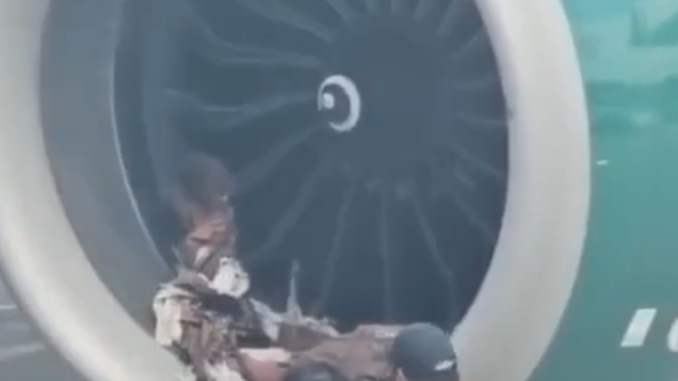
A routine departure at Charlotte Douglas International Airport took an unexpected turn when a Frontier Airlines aircraft experienced engine damage while still on the ground.
The incident occurred on August 16, 2025, involving Frontier Flight F93134, scheduled to travel from Charlotte to New York’s LaGuardia Airport.
No passengers or crew members were reported injured, but the unusual event left travelers facing a lengthy delay while another aircraft was arranged.
What Happened at the Gate?
The aircraft involved was an Airbus A320neo registered as N365FR.
While the plane was parked at the gate and being prepared for departure, a ground air-conditioning hose was pulled into the aircraft’s left engine.
Ground air-conditioning equipment is commonly used while aircraft are parked to provide conditioned air to the cabin without requiring the aircraft’s own systems to operate in the same way.
In this case, the hose was drawn toward the engine and became caught in the rotating fan.
The hose was damaged and disintegrated, prompting ground personnel to stop the operation and assess the aircraft.
Passengers Faced a Long Delay
The incident meant the original aircraft could not simply continue with its scheduled departure.
Passengers were removed from the aircraft while the plane underwent inspection.
Frontier arranged another aircraft for the Charlotte-to-LaGuardia service, but doing so took time. Reports indicate that travelers ultimately experienced a delay of approximately nine hours.
For passengers expecting a relatively short domestic flight, the unexpected wait was understandably a major disruption to their travel plans.
Still, the incident occurred while the aircraft was on the ground, and no injuries were reported.
Why an Engine Inspection Was Necessary
When an aircraft engine encounters foreign material, maintenance teams must determine whether any components have been damaged before the airplane can safely return to service.
Even when the object involved appears relatively lightweight, an aircraft engine operates at very high speeds. Foreign-object ingestion can therefore require detailed inspection of the engine and surrounding components.
In this case, the A320 was taken out of service while maintenance personnel evaluated the damage.
Aircraft records show that N365FR remained stored at Charlotte for several days following the incident and returned to service on August 22, 2025.
A Reminder About Ground Operations
Most attention in aviation naturally focuses on what happens once an aircraft is in the air.
But ground operations are also an important part of aviation safety.
Before an aircraft leaves the gate, numerous people and pieces of equipment may be working around it. Catering vehicles, baggage equipment, maintenance personnel, fuel trucks, passenger stairs, air-conditioning systems, and other ground-support equipment all have to operate within carefully controlled areas.
The Frontier incident demonstrates how an unexpected interaction between an aircraft and ground equipment can create a significant operational problem even before takeoff.
The Importance of Foreign-Object Awareness
Aviation personnel use the term foreign object debris, or FOD, to describe objects or materials that can potentially cause damage to aircraft.
FOD can include everything from loose hardware and tools to pieces of equipment or other materials found around an aircraft operating area.
Airports and airlines therefore use procedures designed to keep ramp areas organized and minimize hazards around aircraft.
The incident in Charlotte serves as a practical example of why those procedures matter.
The Aircraft Was Not Lost
Despite some dramatic descriptions that circulated online, this was not an in-flight accident.
The aircraft was still at the gate when the engine ingested the ground equipment.
The problem was identified on the ground, passengers were taken off the aircraft, and a replacement airplane was arranged.
The aircraft later returned to service after maintenance work and inspections.
That distinction is important because online descriptions of unusual aviation incidents can sometimes make a ground event sound considerably more dangerous than the documented circumstances indicate.
An Unusual Delay With a Simple Lesson
For the passengers aboard Flight F93134, the incident turned what should have been a routine trip from Charlotte to New York into a much longer day.
For the airline and airport personnel, however, the priority was dealing with the aircraft safely before continuing the journey.
The event also illustrates how many different steps are involved in commercial aviation.
A flight can be delayed not only by weather or mechanical problems but also by an unexpected interaction with ground equipment.
In this case, a single air-conditioning hose was enough to damage an aircraft engine and require a replacement aircraft.
Fortunately, the incident remained a ground event, no injuries were reported, and the affected aircraft was eventually returned to service.
For travelers, it was an inconvenient delay. For aviation personnel, it was another reminder that safety procedures on the ground are just as important as those followed once an aircraft takes to the sky.
Leave a Reply