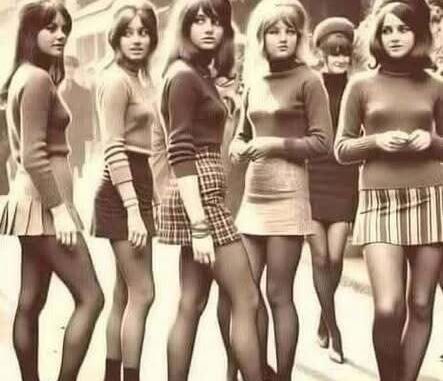
At first glance, the photograph appears to show a group of young women standing together on a European street many decades ago. Their clothing, hairstyles and confident poses immediately give the image a distinctly vintage appearance.
But there is something unusual about the picture that becomes much easier to notice once you know where to look.
Most people initially focus on the women’s clothing and legs. Their positions seem remarkably similar, with several of them standing almost exactly the same way. That unusual consistency can make the photograph feel slightly strange, even before the real detail becomes obvious.
Look More Closely at Their Faces
The key to the photograph isn’t the clothing or the way the women are standing.
It’s their faces.
When you examine their facial features carefully, the resemblance becomes difficult to ignore. The eyes, nose, mouth and overall shape of the face appear remarkably similar from one person to the next.
The reason is that the photograph wasn’t necessarily created by gathering a group of identical-looking women together.
Instead, the image is an example of an old photographic compositing technique.
One Person Appears Several Times
Before modern photo-editing software existed, photographers could still create surprisingly sophisticated visual effects.
One method involved photographing the same person multiple times while carefully changing their position. Individual exposures could then be combined to create the appearance of several people standing together in one scene.
The process required considerable patience and precision.
The photographer needed to control the camera position, lighting, composition and timing so that the separate images could eventually appear to belong to one photograph.
Even a small mistake could reveal the illusion.
Why the Effect Works So Well
The human brain naturally looks for patterns and assumes that a group photograph contains different individuals.
When we see several people standing next to one another, we generally don’t stop to compare every facial feature. Instead, we quickly process the overall scene.
That makes visual tricks like this particularly effective.
The photograph provides enough differences in posture, clothing and positioning to encourage the viewer to interpret the figures as separate people. But once attention shifts toward the faces, the underlying similarity becomes much more apparent.
Photography Was Capable of More Than People Realize
Modern editing software has made image manipulation incredibly accessible, but photographers were experimenting with visual illusions long before computers.
Historical photographers used techniques such as multiple exposures, double exposures, carefully arranged negatives and other forms of darkroom manipulation.
Some effects were created for artistic purposes, while others were designed simply to surprise viewers.
These techniques demonstrate that photography has never been a completely straightforward record of reality. Even early photographers could construct images that challenged what viewers believed they were seeing.
A Clever Example of Visual Perception
The most interesting part of this image may be how differently people experience it before and after noticing the trick.
At first, it looks like an ordinary vintage street scene.
Then the viewer notices the unusual similarities.
Once the faces are compared, the entire photograph takes on a different meaning. What appeared to be a group of women can instead be understood as a carefully constructed photographic illusion.
And once that detail has been noticed, it becomes difficult to look at the image in quite the same way again.
More Than a Vintage Photograph
Images like this are reminders of how much work could go into creating a convincing photograph before digital editing became commonplace.
They also show how easily our perception can be influenced by context. We don’t examine every image detail individually. Instead, our brains make rapid assumptions based on what appears most natural.
That’s precisely what makes this type of photograph so fascinating.
The unusual detail isn’t necessarily hidden somewhere in the background. It’s part of the people standing directly in front of the camera.
What looks like a simple vintage group photograph becomes something much more interesting once you take a second look.
Leave a Reply