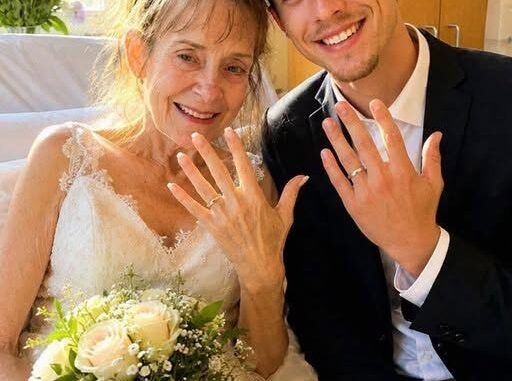
For years, Daniel had volunteered at a local hospice, believing that helping people sometimes meant nothing more complicated than sitting beside them and listening.
That changed when he met Eleanor.
Eleanor was 70 years old and living with a terminal illness. Despite her circumstances, she had a sharp sense of humor and a remarkable ability to make the people around her smile.
When Daniel first introduced himself, she looked at his volunteer badge and jokingly called him “the rookie.”
He laughed.
From then on, Daniel began visiting Eleanor regularly. Sometimes they talked about books. Sometimes they worked on crossword puzzles. Other times, they simply sat together.
Their conversations gradually became more personal.
Eleanor told him about the life she had lived, the things she loved, and the experiences she never had. One afternoon, she shared something that surprised him.
She had always wanted to experience a wedding.
Not necessarily a traditional marriage, she explained. What mattered to her was the feeling of being celebrated and chosen.
She had never experienced that moment.
Daniel listened carefully.
He eventually asked the hospice staff whether it would be possible to organize a small, symbolic ceremony for Eleanor. After discussing the idea with the appropriate people, several members of the hospice team decided to help.
A simple white dress was found through a local charity. Someone brought flowers, and Daniel purchased a modest ring for the occasion.
When Eleanor heard what they were planning, she became emotional.
She reminded Daniel that he didn’t have to do it.
He told her that he wanted to.
The ceremony took place in the hospice garden.
Only a small group attended, including a few nurses and the hospice chaplain. It wasn’t a formal legal marriage. It was simply a personal ceremony created to give Eleanor the experience she had always wanted.
For that afternoon, she wasn’t being defined by her illness.
She was simply Eleanor.
She wore white, smiled for photographs, and enjoyed a small piece of cake afterward. At one point, she proudly held up her hand and said that she was finally a bride.
It became one of the happiest memories of Daniel’s time with her.
Eleanor died several weeks later.
Her funeral was quiet, attended by a few people who had come to know her through the hospice.
After the service, Daniel was approached by a man named Martin, who introduced himself as Eleanor’s attorney.
Martin told Daniel that Eleanor had left instructions for him to receive an envelope after her funeral.
Daniel was surprised.
He had known Eleanor for only a relatively short period of time. He couldn’t understand why she had left something specifically for him.
Inside the envelope was an old photograph and a wedding invitation.
The names on the invitation immediately caught his attention.
One of them was Eleanor.
The other belonged to a man named Thomas.
The date was nearly five decades earlier.
Martin explained that Eleanor had once planned to marry Thomas, but the wedding never took place.
There was another part of the story Daniel didn’t understand until Martin mentioned his family.
Eleanor had known Daniel’s grandmother, Rose.
Years earlier, when Rose was struggling to support her young children, Eleanor had helped her financially. Eleanor had been saving money for her own wedding at the time, but she chose to give some of those savings to Rose.
The decision changed the course of both women’s lives.
Rose eventually raised her children, while Eleanor’s planned marriage disappeared into the past.
Daniel later visited his grandmother and showed her the photograph.
Rose immediately recognized Eleanor.
She explained that the two women had once been close friends.
Rose had always carried feelings of gratitude and guilt over what Eleanor had sacrificed to help her. She had written Eleanor letters over the years but had often struggled to send them.
The story gave Daniel a new understanding of the woman he had met at the hospice.
Eleanor’s final wish had not simply been about wearing a dress or receiving a ring.
It represented something she had carried with her for decades.
She had spent much of her life helping other people, and in the final months of her life, she wanted one small moment that belonged entirely to her.
Martin later gave Daniel one more item: Eleanor’s old engagement ring.
It was the ring connected to the wedding that had never happened.
Along with it was a note asking Daniel not to leave the ring forgotten in a drawer.
Years later, when Daniel’s daughter became engaged, he shared Eleanor’s story with her and offered her the ring.
She understood its history and chose to wear it for her own wedding.
For Daniel, the experience changed the way he thought about the people he met through hospice volunteering.
People often remember someone’s final days, but those days are only one part of a much larger life.
Eleanor had been a friend, a daughter, a woman with dreams, and someone who had once made a significant sacrifice for another family.
Her story also reminded Daniel that kindness can travel through generations.
A decision Eleanor made decades earlier eventually connected her to Daniel, even though neither of them could have known it at the time.
And in the final chapter of her life, a simple ceremony gave her a memory she had wanted for many years.
It wasn’t about wealth, status, or a grand celebration.
It was about friendship, kindness, and the human desire to feel remembered.
For one afternoon in a hospice garden, Eleanor got to experience exactly what she had always hoped for.
She got to be a bride.
Leave a Reply