Three days before Christmas, my father called me with four words I never expected to hear.
“Don’t come home this year.”
There was no greeting or explanation at first. Just silence after the sentence.
When I finally asked why, he explained that my stepbrother, Jason, would be bringing his new wife and her family to Christmas dinner. He said he wanted the evening to be comfortable and didn’t want conversations about my military career taking attention away from Jason.
I understood what he was really saying.
My life, my service, and everything I had accomplished were apparently inconvenient for the family gathering.
I had spent nearly two decades serving in the military. I had missed birthdays, holidays, and countless ordinary moments because of my assignments. But I had still hoped that Christmas would be different.
Instead, my father had decided there wasn’t room for me at the table.
I simply told him I understood and ended the call.
That evening, I canceled my flight home.
A few days later, one of my colleagues noticed the change in my holiday plans and invited me to her family’s Christmas dinner. I appreciated the offer, but I decided to volunteer for an overnight duty shift instead.
There were younger service members in my unit who had children and spouses waiting for them. If someone had to work the holiday, I would rather it be me.
I thought that was how my Christmas Eve would end.
I had no idea it was about to become one of the most memorable nights of my career.
The Storm
Colorado was hit by a powerful winter storm that evening.
Visibility dropped quickly, roads became dangerous, and emergency calls began coming in faster than responders could handle them.
Our unit was called to assist with a major accident on an interstate highway.
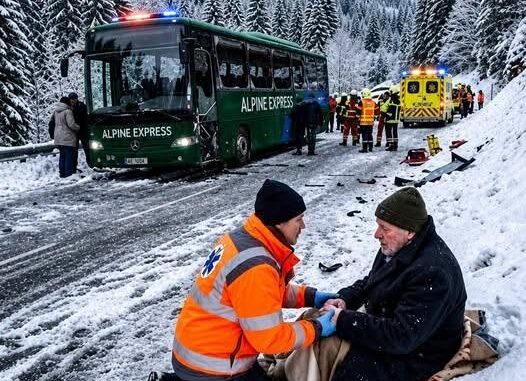
When we arrived, a passenger bus had left the roadway and overturned. Several people were trapped inside, including children. Nearby, a fuel tanker had stopped on an icy slope, creating another serious concern for everyone at the scene.
There was no time to think about Christmas anymore.
We focused on getting people to safety.
My team worked through heavy snow and freezing winds while I helped coordinate the evacuation. One by one, children were brought out of the damaged bus and transferred to waiting responders.
One little boy grabbed onto my jacket and refused to let go.
I knelt beside him and told him he was safe.
Eventually, he allowed the responder beside me to carry him toward a heated vehicle.
Then we turned our attention to the tanker.
The driver, an older man named Walt, was trapped inside the cab. He was injured, frightened, and becoming increasingly weak.
The truck was sitting at an unsafe angle on the icy road.
We needed to get him out as carefully as possible.
I climbed into the cab and kept Walt talking while our team worked.
He told me about his grandchildren, especially his youngest granddaughter, Rosie, who had recently learned to walk.
I encouraged him to keep talking about her.
He told me that he had bought her a small red wagon for Christmas.
I promised him he would get home to see her use it.
After carefully freeing him from the damaged cab, we moved him away from the vehicle and toward the waiting medical team.
Eventually, everyone from the bus had been accounted for, and Walt was receiving medical attention.
I thought the difficult part of the night was over.
I was wrong.
The Cameras
Unknown to me, a local television crew had been recording the rescue from a safe location.
They captured footage of the bus evacuation, the children being carried through the snow, Walt’s rescue, and our team working through the storm.
Later that night, I returned to base exhausted.
I was sitting in the break room when one of my colleagues suddenly called my name.
I looked toward the television.
There I was.
The screen showed footage of me helping passengers from the overturned bus.
A news report described the rescue and credited emergency responders and military personnel with helping dozens of people reach safety during the storm.
Then my phone began filling with messages.
The story had reached national television.
I hadn’t expected any attention.
To me, it had simply been another assignment. We had people who needed help, so we helped them.
But about forty minutes away, my father was sitting at the Christmas dinner he had told me not to attend.
And then he saw the broadcast.
The Phone Call
According to Jason, everyone at the table became quiet when my face appeared on the television.
My father reportedly stared at the screen in disbelief.
The daughter he hadn’t wanted at Christmas was suddenly being shown across the country helping strangers during a dangerous winter emergency.
A few minutes later, my phone rang.
It was my father.
I almost ignored the call.
Instead, I answered.
“Why are you on television?” he asked.
His voice sounded completely different from the one I had heard three days earlier.
I could have reminded him that he was the one who told me not to come home.
I could have asked whether he would have called if he hadn’t seen me on the news.
Instead, I simply said:
“I was doing my job, Dad.”
There was a long silence.
Then he told me he was proud of me.
I thanked him, but I didn’t pretend that four words could erase years of feeling overlooked.
Over the next few days, messages continued arriving.
One of the children from the bus even sent me a handmade thank-you card. I kept it beside the military awards and certificates I had collected throughout my career.
A few days later, Walt and his family visited the base.
His granddaughter Rosie was there.
She had started walking.
She took a few tiny steps across the room before sitting down and laughing.
Walt looked at me and smiled.
“You weren’t required to go up there,” he said.
I told him the truth.
“At the time, it didn’t feel like a choice.”
A Different Kind of Christmas
My father continued reaching out after the holiday.
Eventually, I answered one of his calls.
He didn’t ask me to forget what happened.
Instead, he admitted that he had handled things badly.
I told him that I didn’t need a dramatic apology or a perfect explanation.
I simply needed him to understand that being excluded from the family had hurt.
The rescue had changed something inside me.
For years, I had measured my worth by whether my family recognized what I had accomplished.
That Christmas taught me something different.
Recognition from strangers wasn’t the goal.
Neither was appearing on television.
What mattered was knowing that when people needed help, I showed up.
My father had told me I wasn’t welcome at his Christmas table.
Ironically, that decision placed me exactly where I needed to be.
While my family was gathered around a dinner table without me, I was standing in a snowstorm helping strangers get home safely.
And for the first time in a long time, I didn’t feel like I was missing anything.
Leave a Reply