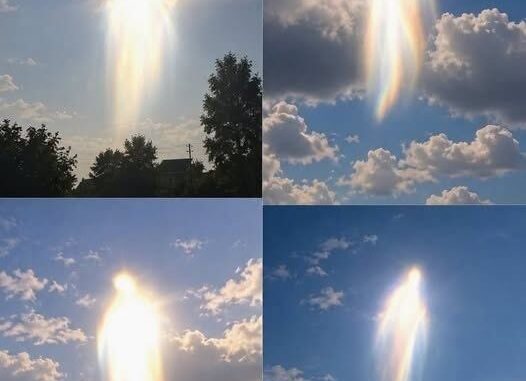
For a brief moment above the Greek island of Ikaria, the sky appeared to display something that seemed almost impossible to explain.
A brilliant, elongated shape appeared high above the island, glowing intensely against the surrounding blue sky. To an observer on the ground, the unusual formation could look surprisingly solid, almost like a luminous figure suspended in the atmosphere.
It was the kind of unexpected sight that could make anyone stop and look twice.
At first, several explanations might come to mind. Could it have been an aircraft reflecting sunlight? Perhaps an unusual cloud formation or an atmospheric phenomenon? Could an optical illusion have changed the way an ordinary patch of light appeared?
Although the exact cause of a particular photograph or observation cannot be established without examining the original image and atmospheric conditions, natural optical phenomena can produce remarkably strange-looking shapes in the sky.
Sunlight, ice crystals, atmospheric particles, clouds, and the human visual system can interact in ways that make ordinary physical processes appear extraordinary.
Sometimes, the sky does not need anything mysterious to create a scene that looks almost otherworldly.
When Light Starts Looking Like an Object
Human vision is exceptionally good at recognizing patterns.
This ability is useful in everyday life. We quickly identify faces, animals, objects, and familiar shapes, often without consciously thinking about the process.
However, the same ability can sometimes lead us to interpret ambiguous patterns as recognizable forms.
A cloud can resemble a face. A shadow can appear to look like an animal. A distant object can seem larger or closer than it really is.
Bright atmospheric phenomena can produce a similar effect.
A vertical beam of light might look like a column. A bright patch could appear to have a recognizable outline. Several overlapping areas of light might seem to form a single object.
The brain naturally tries to organize what the eyes see into meaningful patterns.
As a result, an optical phenomenon created by sunlight may be perceived as something physical suspended in the sky.
The Importance of Sunlight
Sunlight is one of the key ingredients behind many unusual atmospheric displays.
When sunlight passes through Earth’s atmosphere, it interacts with gases, moisture, dust, aerosols, and other particles. Depending on the conditions, light can be scattered, reflected, or refracted.
The angle of the Sun is particularly important.
Near sunrise and sunset, sunlight travels through a longer path across the atmosphere before reaching an observer. This can make certain colors and optical effects more noticeable.
Even during daylight, the interaction between sunlight and atmospheric particles can create halos, bright patches, rays, pillars, and other striking patterns.
From the ground, these effects may appear to occupy a particular location in the sky, even though they are actually produced by light traveling through a much larger volume of atmosphere.
Could Ice Crystals Be Responsible?
One possible explanation for an elongated bright formation is the presence of ice crystals high in the atmosphere.
Tiny ice crystals can behave like microscopic optical components. Their shape and orientation influence how light interacts with them.
Under the right conditions, sunlight passing through or reflecting from ice crystals can produce a variety of optical effects.
One particularly well-known phenomenon is a sun pillar.
A sun pillar appears as a vertical column or elongated streak of light extending above or below the Sun. It can sometimes appear surprisingly bright and well-defined.
The effect is associated with sunlight interacting with flat, plate-like ice crystals in the atmosphere. When the crystals are oriented in particular ways, they can reflect light toward observers on the ground.
The resulting column is not a solid object.
It is an optical effect produced by the combined appearance of light reflected by many individual crystals.
Why a Sun Pillar Can Look Solid
The human eye is not necessarily able to distinguish all the individual sources of light contributing to an atmospheric optical display.
Instead, thousands or millions of tiny reflections can visually blend together.
This can produce the impression of a continuous structure.
Imagine looking at a distant city at night. Individual lights may be separated by considerable distances, yet from far away they can appear to form a continuous glowing area.
Atmospheric optical phenomena can work in a similar way.
Individual ice crystals reflect sunlight in directions that can collectively produce a bright vertical region. From the observer’s perspective, the separate reflections merge into what looks like one luminous column.
This can make an atmospheric effect appear much more solid than it actually is.
Atmospheric Layers Can Change the Appearance
The atmosphere is not uniform.
Temperature, humidity, wind, pressure, airborne particles, and cloud layers can vary considerably with altitude.
These differences can affect how light travels through the atmosphere.
A phenomenon occurring high above the ground may therefore look very different depending on the observer’s position and the atmospheric conditions at that moment.
Two people standing several kilometers apart might even see somewhat different versions of the same optical display.
This is one reason unusual sky photographs can be difficult to interpret without additional information.
The camera captures one perspective at one particular moment, while the atmosphere continues changing around it.
Perspective Can Make a Phenomenon More Dramatic
Perspective also plays an important role.
When looking upward, the human brain has limited information about the actual distance and size of an object or light pattern.
A relatively narrow atmospheric phenomenon can therefore appear much larger than it really is.
The lack of familiar reference points in the sky makes this effect even stronger.
If a luminous formation is photographed against an otherwise clear background, there may be nothing nearby to provide a reliable sense of scale.
The result can be an image that makes a relatively simple optical effect look enormous.
Why Ikaria Makes the Sight Especially Striking
Ikaria is a Greek island in the eastern Aegean Sea, known for its mountainous landscape and open views of the surrounding sky and sea.
Locations with broad horizons can provide excellent opportunities for observing atmospheric phenomena.
When the sky is unobstructed, unusual light effects can be visible over a large portion of the horizon.
The combination of an open landscape, bright sunlight, and atmospheric conditions can make optical phenomena particularly noticeable.
This does not mean that Ikaria itself causes unusual light formations. Rather, the island’s open surroundings can make changes in the sky easier to see.
Cameras Can Also Change How Light Appears
Another factor to consider is photography.
A camera does not always record light exactly as the human eye experiences it.
Exposure settings, focus, lens characteristics, reflections, digital processing, and image compression can all affect the appearance of a bright object or atmospheric phenomenon.
Bright areas may become overexposed, creating glowing edges or streaks that are less obvious to the naked eye.
Lens flare can also produce unexpected shapes when a strong light source is positioned near or inside the camera’s field of view.
For this reason, identifying an unusual object from a single photograph can be challenging.
A clear image is useful, but it does not automatically reveal the physical cause of what was photographed.
Not Every Unusual Light Is the Same
Although ice-crystal phenomena are one possible explanation for elongated light formations, there are many other possibilities.
Depending on the circumstances, unusual sky appearances can involve:
-
Sun pillars and related halo phenomena.
-
Light reflected from clouds or atmospheric particles.
-
Sunlight passing through thin cloud layers.
-
Lens flare or internal camera reflections.
-
Aircraft reflecting sunlight.
-
Distant light sources appearing unusual because of atmospheric conditions.
-
Optical illusions caused by perspective and contrast.
The exact explanation depends on details such as the Sun’s position, weather conditions, camera direction, altitude, cloud cover, and the appearance and movement of the light.
Without those details, it is better to describe a likely class of phenomena rather than claim a definite identification.
Why the Human Brain Sees Familiar Shapes
There is another fascinating part of this mystery: perception itself.
Humans are naturally inclined to find familiar patterns in ambiguous visual information. This tendency is sometimes called pareidolia.
It explains why people can see faces in clouds, rocks, buildings, or random patterns.
The phenomenon does not mean that people are imagining things in a meaningless sense. The visual pattern is real; what changes is the interpretation assigned to it.
If a bright atmospheric formation happens to resemble a human figure, the brain may quickly organize its shape into something recognizable.
That can make the experience feel much more mysterious than the underlying physics actually is.
Nature Can Produce Extraordinary Illusions
One of the most fascinating aspects of atmospheric science is that natural phenomena can look almost artificial.
Rainbows can form enormous arcs across the sky. Halos can surround the Sun or Moon. Crepuscular rays can appear as dramatic beams extending through gaps in clouds.
Sun pillars can create vertical columns of light.
None of these phenomena require supernatural explanations. They are the result of light interacting with the atmosphere under particular conditions.
The fact that these effects can look extraordinary does not make them any less natural.
In fact, understanding the science can make them even more impressive.
What Could the Light Above Ikaria Have Been?
Without the original photograph, exact observation details, and information about the weather and position of the Sun, it is impossible to identify the phenomenon with certainty.
However, an atmospheric optical effect involving sunlight is a plausible explanation for an elongated luminous formation.
If ice crystals were present at an appropriate altitude and orientation, a sun pillar or related halo phenomenon could potentially produce a vertical structure of light.
Other explanations, including lens effects, cloud reflections, or sunlight interacting with airborne particles, could also be considered depending on what the original image shows.
The important point is that an unusual appearance does not necessarily indicate an unusual object.
Final Thoughts
The dazzling light observed above Ikaria is a fascinating example of how easily the atmosphere can create something that looks almost impossible.
Sunlight interacting with ice crystals, clouds, atmospheric particles, and different layers of air can produce brilliant optical effects. Perspective and human pattern recognition can then make those effects appear to have recognizable shapes.
An elongated glow may look like a suspended figure, while a collection of reflections can appear to form a single solid object.
Without detailed evidence, it would be premature to identify the exact phenomenon responsible for a particular sighting. But natural atmospheric optics provide several compelling explanations for why the sky can occasionally produce such extraordinary displays.
Perhaps the most remarkable lesson is that nature does not need anything supernatural to surprise us. Under the right conditions, ordinary sunlight and tiny particles in the atmosphere can combine to create a spectacle that looks like something from another world.
Leave a Reply