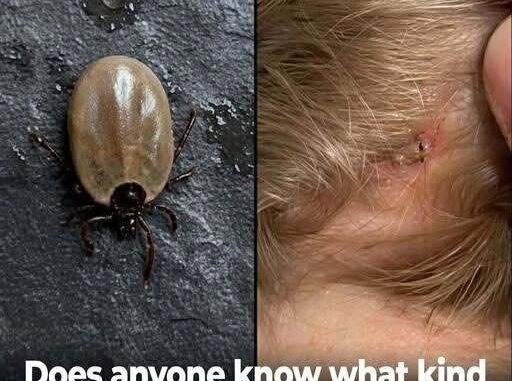
At first glance, a small creature attached to the skin can be difficult to identify. Its unusual shape, dark color, or rounded body may make it look like a strange insect that someone has never seen before.
But sometimes the explanation is much more familiar: it may be a tick.
One important detail is often overlooked when people encounter these tiny creatures. Ticks are not insects. They are arachnids, placing them in the same broad group as spiders and mites.
Their appearance can also change dramatically while they are feeding.
A tick that has recently attached to a person or animal may look very different from the tiny, flattened creature people usually imagine when they hear the word “tick.”
Why a Feeding Tick Can Look So Different
Ticks feed on the blood of animals and humans.
As a tick feeds, its body can expand considerably. A small tick that initially appears flat and difficult to notice may become rounded and much larger after feeding.
This change can make identification confusing, particularly when someone encounters the tick after it has been attached for some time.
Photographs of engorged ticks can therefore look surprisingly different from photographs of unfed ticks.
The exact appearance depends on factors such as the tick’s species, life stage, and how long it has been feeding.
This is one reason why identifying a tick simply by looking at a single photograph can be difficult.
Ticks Are Arachnids, Not Insects
The distinction between ticks and insects is more than a technical detail.
Adult ticks generally have eight legs, like other arachnids, whereas adult insects have six.
Ticks also lack the body structure typically associated with insects.
However, very young ticks can be especially difficult to recognize.
Tick larvae have six legs, which can make them resemble tiny insects. After they molt into the nymph stage, they have eight legs.
Because ticks vary substantially in size and appearance throughout their life cycle, people may not immediately recognize one when they see it.
Why Identification Can Be Difficult
There are many tick species, and they do not all look exactly alike.
Their color, size, markings, body shape, and behavior can vary.
A photograph may provide useful clues, but it may not be enough to determine the exact species with confidence.
Geography also matters.
Different tick species are found in different regions, and the diseases associated with ticks vary depending on the species and location.
For that reason, someone who finds a tick attached to the skin should not assume that a photograph alone can establish whether the tick carries a particular disease.
What Matters Most When a Tick Is Found
If a tick is attached to a person, particularly a child, the priority is usually safe removal rather than trying to identify the creature first.
The longer an infected tick remains attached, the greater the opportunity for transmission of certain tick-borne pathogens, although the level of risk varies depending on the tick species and the disease involved.
A common approach is to use fine-tipped tweezers.
Grasp the tick as close to the skin as possible and pull upward with steady, even pressure.
The goal is to remove the tick without twisting or crushing it.
After removal, clean the bite area and your hands with soap and water or an appropriate antiseptic.
If part of the tick remains embedded in the skin and cannot be easily removed, medical advice may be appropriate.
Avoid Common Removal Mistakes
When people discover an unexpected creature attached to the skin, they may instinctively reach for household substances or try to make the tick detach on its own.
Methods involving burning, applying chemicals, petroleum products, or other substances are generally not recommended.
They can irritate or injure the skin and may make removal more difficult.
Similarly, crushing or squeezing the tick’s body while it is attached is not a good removal technique.
A pair of suitable tweezers and a controlled upward pull is generally a much safer approach.
What to Do After Removal
After removing a tick, it can be useful to make a note of the date and where the bite occurred.
If possible, taking a clear photograph of the tick may also provide useful information later, particularly if symptoms develop.
Some healthcare providers or local health authorities may recommend keeping the tick for identification, depending on the circumstances and location.
However, routinely testing an individual tick is not necessarily recommended everywhere and does not replace monitoring the person for symptoms.
The appropriate response can depend on the region, the type of tick, and the diseases known to occur locally.
Watch for Symptoms
Many tick bites do not result in illness.
Nevertheless, people should pay attention to changes in their health after a tick bite.
Possible symptoms of tick-borne infections can include fever, chills, headache, fatigue, muscle or joint aches, swollen lymph nodes, or a rash.
The timing and combination of symptoms vary significantly between diseases.
Some infections can produce characteristic rashes, while others may not.
A rash does not always appear, so the absence of one does not necessarily rule out infection.
If a person develops unexplained symptoms after a tick bite, particularly fever or a spreading rash, contacting a healthcare professional and mentioning the tick exposure can be important.
Children May Need Extra Attention
Finding a tick on a child can be particularly alarming for parents.
Ticks can attach to areas that are easy to overlook, including the scalp, behind the ears, around the hairline, and other areas where they may be hidden by clothing or hair.
Parents who spend time with children outdoors can make tick checks part of their routine after activities in areas where ticks are present.
A quick examination of the scalp, hairline, neck, ears, waist, underarms, and legs can help identify attached ticks earlier.
Checking clothing and outdoor gear can also be useful.
Ticks can sometimes be carried indoors on clothing or pets before attaching to a person.
Prevention Starts Outdoors
Reducing exposure is one of the simplest ways to lower the chance of a tick bite.
When spending time in areas where ticks are common, wearing long sleeves and long pants can provide an additional physical barrier.
Tucking pants into socks can reduce exposed skin around the lower legs.
Using an appropriate insect repellent according to its label can also provide protection.
After returning indoors, changing clothes and checking the body for ticks can help identify them before they remain attached for an extended period.
Outdoor clothing can also be handled appropriately according to guidance for the specific tick-prone environment.
Don’t Forget Pets
Dogs and other pets can also carry ticks.
A pet that spends time outdoors can bring ticks into the home, where they may later attach to another animal or person.
Regular tick checks and appropriate veterinarian-recommended prevention can therefore be an important part of protecting the entire household.
If a tick is discovered on a pet, owners should follow veterinary guidance for safe removal and ongoing prevention.
A Photograph Cannot Tell the Whole Story
One of the biggest mistakes people can make with an unusual-looking tick is assuming that its appearance tells them everything they need to know.
A photograph may show the general shape of the creature, but it may not reveal its species with certainty.
Location, life stage, feeding status, and physical characteristics all matter.
More importantly, even identifying the species does not automatically establish whether an individual tick transmitted an infection.
The medical significance depends on multiple factors, including whether the tick was carrying a pathogen, how long it was attached, and whether transmission is biologically possible for that particular infection.
The Most Important Step Is Not Panic
Discovering a tick attached to the skin can be unsettling, especially when the creature looks much larger or stranger than expected.
But an unusual appearance does not automatically mean that the bite is dangerous.
The practical response is more straightforward: remove the tick carefully, clean the area, record useful information about the exposure, and monitor for symptoms.
If the person develops concerning symptoms afterward, medical advice should be sought.
The key lesson is that ticks may look very different depending on their species and stage of feeding. A rounded creature attached to the skin may appear unfamiliar, but it could simply be a tick that has become engorged.
When that happens, accurate information and prompt, careful action are much more useful than trying to determine everything from a photograph alone.
Leave a Reply