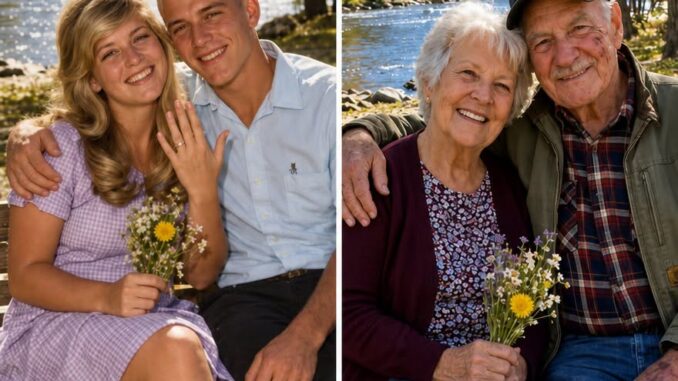
Nine days after he slipped a ring onto my finger, my fiancé shipped out.
“I’m sorry,” Danny whispered.
I brushed the back of my hand against my nose.
“You’re sorry?”
His smile vanished.
“I know.”
“No, Danny. You have no idea. You couldn’t possibly understand.”
“I know I caused you pain.”
“You died.”
He shut his eyes.
“Yes.”
“You let me believe you were dead for fifty-eight years.”
His fingers gripped the edge of the blanket.
“I know.”
“Stop saying that!”
My voice cracked so violently that Selena flinched.
Here I was, seventy-seven years old, sitting inside a stranger’s living room, yelling at the boy I had loved back when I was eighteen.
Part of me wanted to strike him. Part of me wanted to pull him close. I wanted to demand every single missing day of my life back from him, as though he might have tucked them away somewhere safe, just like I had kept his old letters.
Instead, I murmured, “Why?”
Danny glanced toward the window.
Outside, a strong breeze was driving the branches of a pine tree against the glass.
“Come sit with me,” he urged. “Please. There is a great deal you need to hear.”
I dragged my chair closer.
“Then you had better start talking.”
He drew in a breath that rattled deep in his chest.
“I didn’t pass away in Vietnam.”
“I figured that much out.”
A faint, surprised chuckle escaped him. It sounded so uncannily like the Danny of my memories that I nearly fell apart all over again.
“I was on a medical transport back in March of sixty-nine. Our convoy got hit. I suffered severe burns. My left side, my back, my neck. I couldn’t see out of one eye for quite a while. They transferred me from hospital to hospital, and eventually, I ended up in San Antonio.”
His gaze drifted down to his right hand.
“I was in terrible shape, Sukey. For months, I couldn’t even recall my own name.”
I stared straight at him.
“Your mother claimed you passed away in San Antonio.”
“She visited me there.”
“She visited you?”
He gave a slow nod.
“She was right there when I finally came to my senses enough to understand what was going on. I remember asking for you. I remember saying your name. I couldn’t remember my own birthday, but I remembered Dandylion.”
His lips began to tremble.
“She told me you would be much better off thinking I was gone.”
A chilly sensation washed through my chest.
“Why on earth would she do that?”
“She said you were young. She said I would never be the same again. She told me you deserved a husband who could give you children, a home, and a normal life.”
I let out a single, bitter laugh.
“Well, wasn’t that awfully thoughtful of her.”
Danny kept his eyes lowered.
“She was terrified. I think she was scared of what I had become. I struggled to walk. My face was scarred. I was angry constantly, waking up from nightmares screaming. The doctors couldn’t tell her if I’d ever manage to work again.”
“And so she decided to bury you.”
“She decided to let you mourn me.”
“No. She decided to lie straight to my face.”
“Yes.”
“Did you agree with her?”
That question seemed to cut him deeper than any of the others.
“I did.”
The room fell completely silent.
I studied his face, searching for the boy who had once stood on a riverbank and swore he would write every single week.
“I was twenty years old,” he said quietly. “I was deeply ashamed of what had happened to me. I couldn’t bear the thought of you seeing me like that. I kept picturing that yellow dress. I kept thinking of how you laughed when I called you Dandylion. I didn’t want my hospital bed to be the last thing you remembered of me.”
“You don’t get to choose what I can handle.”
“I know.”
“And you certainly don’t get to call it an act of kindness when you rob someone of their own choice.”
“I realize that now.”
I looked at him for a long, heavy moment.
“Did you stop loving me?”
He shook his head so fast it looked almost like the old Danny—the one who could never keep a straight face when he was caught in a fib.
“No. Never.”
“Then why didn’t you write?”
“I wrote you one letter.”
My heart seemed to skip a beat.
“What?”
“After I finally left the hospital. It took me nearly a year just to get well enough to travel. I stayed with my mother in Ohio for a while, undergoing surgeries and physical therapy. I learned how to use a cane and how to look in a mirror without hating the reflection.”
He swallowed hard.
“I wrote to you straight from her kitchen. I told you I was alive. I told you I was coming home the moment I could find work. I told you I would understand if you didn’t want me anymore, but that you deserved the truth.”
“Where is that letter?”
“She destroyed it before I could mail it.”
I stared at him in disbelief.
“What did she do with it?”
“She burned it.”
For a few seconds, there was no sound save for the clock ticking steadily on the wall.
“Did she tell you she burned it?”
“No. She claimed she mailed it. She said she sent it right to the address you gave me, and that it must have gotten lost in the mail.”
“And then?”
“I waited. A month. Two months. I figured maybe you were angry. Maybe you had met someone else. Or maybe you had decided that a dead man was easier to love than a broken one.”
His eyes glistened.
“Eventually, I believed the very thing she wanted me to believe.”
I leaned back in my chair.
For fifty-eight years, I had agonized over whether I had simply been too young, too foolish, or too easily cast aside.
I had blamed the war. I had blamed the Army. I had blamed myself for marrying Ted. In my quietest moments, I had even blamed Danny for passing away before he could fulfill his promise.
Now, I had an entirely new person to blame.
A woman who had been dead for decades.
“Did you ever attempt to find me?”
Danny nodded.
“When I finally had the strength, I searched for you. I wrote to your old address in Reno, but the letter came back. I tried calling directory assistance a few times, but I didn’t know your married name. I only knew your first name was Susan, though everyone called you Sukey. I didn’t know your parents’ names either. Honestly, I was too ashamed to reach out to anyone who had known me before the war.”
“You could have tried harder.”
“Yes.”
“You could have traveled to Reno.”
“Yes.”
“You could have done a thousand things.”
“I know.”
His voice broke completely on that final word.
“I was a coward, Susan. Not about the war. About you.”
I looked at the jagged scar running down his neck.
I had pictured Danny buried beneath foreign earth. I had imagined him resting in some Ohio cemetery. I had pictured him forgetting me in his final moments.
I had never once pictured him growing old.
I had never imagined that somewhere out there, the boy who once gave me a cheap diamond ring had learned to shave with one hand, to sleep through the night, and to live alongside the man in the mirror.
And I had never imagined he had done it all without me.
“Tell me about your life,” I requested at last.
He looked startled.
“What?”
“Your life. All those years I missed out on. Tell me everything.”
He studied me cautiously, as though afraid I might suddenly change my mind.
Then, he began.
He told me about the grueling months in the hospital and his long recovery. He told me about taking a job fixing machinery at a small Ohio factory where the foreman asked no questions about his scars. He spoke of meeting a woman named Elaine at a church supper.
“She was a good person,” he said softly. “She knew about the burns. She knew about the nightmares. I warned her I wasn’t easy to live with.”
“Did you tell her about me?”
“Before we got married.”
A sharp pang of hurt hit me, though I had no right to feel it.
“What did she say?”
Danny’s expression softened.
“She said there was always room in a man’s heart for a memory without turning it into a home.”
I gazed out the window.
“She sounds wiser than both of us.”
“She truly was.”
They had been married for forty-four years. Elaine had passed away six years prior from cancer. They had one daughter, Selena, who lived in California and worked as a nurse. Following Elaine’s passing, Danny had moved out west, hoping the warmer climate might soothe his arthritis. The burns left him with chronic pain, and his mobility had steadily declined over recent years.
“Selena has been taking care of me,” he murmured. “Far more than I deserve.”
“Dad,” Selena’s voice drifted quietly from the doorway, “don’t start that.”
He offered her a tired, affectionate smile.
Then he turned his attention back to me.
“I thought I had a bit more time.”
The words came out so softly I almost missed them.
“What do you mean?”
He looked down at his hand.
“Two weeks ago, I was hospitalized with pneumonia. The doctor told Selena my heart was growing weaker. I heard him say I might not survive another winter.”
My throat tightened up.
“So you sent the flowers.”
“I wanted you to know I was actually alive before I died for real.”
He paused.
“I figured I would write the card, send the flowers, and leave you with the choice of whether or not to remember me. I never imagined you would actually come.”
A faint smile touched my lips.
“You always did underestimate me.”
“That I did.”
For the first time since I stepped inside the house, I caught a spark of that old mischief dancing in his eyes.
Then it faded away.
“I didn’t want you to see me like this.”
I leaned forward.
“Danny, for fifty-eight years, I have kept a picture of you in a yellow dress alive in my own imagination. I have carried a ring that stained my finger green. I have read thirty-one letters so many times I could recite what was written on the back of the paper.”
My voice quaked.
“I didn’t come here to see a handsome young soldier. I came to see you.”
He pressed his knuckles firmly against his mouth.
I reached out and took his hand.
It was warm. The skin was delicate, the fingers crooked, and the nails ridged with age.
But it was his.
For a little while, we simply sat together, neither of us trying to fix the lost years.
Then Selena brought out tea.
She sat right beside me, and the three of us talked until the afternoon sun cast a golden glow across the curtains.
Before I headed out, Danny asked if I might come back again.
I looked straight at him.
“Do you think you can put up with me?”
He smiled.
“I’ve been waiting fifty-eight years to find out.”
I drove home that evening with my hands trembling on the steering wheel.
My daughter called twice. I didn’t answer until I pulled into my driveway.
“Mom? Where have you been? I’ve been worried sick.”
“I’m home.”
“Did you go?”
“Yes.”
A long, heavy silence stretched between us.
“Was it really him?”
I glanced at the mason jar of wildflowers I had brought back with me. Selena had insisted I take them.
“Yes,” I said. “It was really him.”
My daughter began to cry.
I didn’t tell her to stop.
That night, I took the Whitman’s chocolate box down from my cedar chest and placed it directly on the kitchen table.
For the first time in fifty-eight years, I didn’t open it to grieve for a dead man.
I opened it to prepare for a visit.
Because on Sunday, I was going back.
And this time, I wasn’t going to let anyone tell me I couldn’t.
Final Part: The Things We Carry Home
I returned the following Sunday carrying a lemon cake.
It felt like the proper offering for a man who had spent a lifetime wondering if I was still breathing.
Besides, my stubborn lemon tree had finally yielded two lemons after thirty years of outright refusal, and I certainly wasn’t going to let the occasion go to waste.
Danny was waiting by the window when I arrived.
He wore a crisp blue shirt and wore the eager expression of a schoolboy promised a trip to the county fair.
“You came,” he said.
“I told you I would.”
“I know. I just wasn’t certain I’d believe it until I laid eyes on you.”
I set the cake down on the kitchen counter.
“Well, you had better get used to believing me.”
Selena chuckled from the stove.
“He hasn’t stopped talking about you since you left.”
Danny’s face turned pink.
“Selena.”
“What? It’s the truth.”
I found myself laughing along with them.
It was a strange sensation, how quickly decades could dissolve at the sound of a familiar voice. There were moments when I looked at Danny and saw only the boy from the riverbank. Then he would shift in his chair, wince with pain, and I would remember that we were both elderly now, that the life we might have shared was lived apart, and that no amount of wishing could alter it.
Yet I kept coming back.
Every Sunday, I drove the two hours to Susanville.
Sometimes I brought food. Sometimes I brought the newspaper or a book I had recently finished. On one occasion, I brought the old ring.
I had worn it for barely two years, but I had kept it my entire life.
The diamond had turned dull. The gold-colored band was scuffed, and the inner side bore a faint green stain that never entirely washed out.
Danny stared at it resting in my palm.
“You kept it.”
“Of course I kept it.”
“I figured you might have thrown it away.”
“I thought about it once.”
“When?”
“The day I married Ted.”
Danny’s expression shifted.
I took a breath.
“I need to tell you something about Ted.”
He nodded.
“Go ahead.”
“He knew about you.”
Danny watched me carefully.
“How much?”
“Everything I knew. Your letters. The ring. The fact that I cried on our wedding night because I felt guilty for being happy.”
I watched his face, bracing for the question I dreaded.
“Was he angry?”
“No. Not once.”
I offered a small smile.
“He told me grief wasn’t a rival. He said a person could love someone who was gone while still loving the person sitting beside them at breakfast.”
Danny looked away.
“That sounds like a good man.”
“He was.”
I rolled the ring over in my palm.
“The first time Ted ever saw your letters, he was hunting for our car insurance papers and found the box by accident. He asked who you were, and I told him. Then I cried for about an hour straight.”
“What did he do?”
“He made coffee.”
Danny chuckled softly.
“That’s a fine start.”
“He sat right down at the table with me. He read one of your letters, with my permission. Then he tucked it back into the box and told me I never had to hide it from him.”
Tears pricked my eyes.
“I loved Ted, Danny. I need you to understand that. I loved him in a different way, but I loved him deeply. He gave me a wonderful life.”
Danny nodded slowly.
“I hoped you had that.”
“Did you?”
He looked down at the ring.
“I hoped you were happy. I just didn’t know if I could bear finding out for sure.”
I reached across the gap between us and touched his wrist.
“We don’t have to diminish one love just to make room for another.”
He looked at me then, and I watched the tension ease from his features.
“No,” he said quietly. “I suppose we don’t.”
He gently closed my fingers around the ring.
“Keep it.”
“I’ve already been keeping it.”
“I mean, keep it for yourself. You don’t owe me anything. Not your memories. Not your forgiveness. Not even one more Sunday.”
I stared at him.
For fifty-eight years, I had dreamed of what Danny might say if we ever met again. I had imagined apologies, explanations, and perhaps even a declaration that he had never stopped loving me.
I had never imagined he would grant me permission to leave.
It was the first thing he offered me that didn’t come tethered to an obligation.
“I’ll make up my own mind about Sunday,” I told him. “Don’t try getting rid of me before I’ve had a slice of my cake.”
He smiled.
“Yes, ma’am.”
And so, the Sundays continued.
We pieced each other’s lives back together bit by bit.
I told him about raising our children, the house Ted and I bought when mortgage rates were terrifyingly high, our insurance business, and our four grandchildren who had grown so tall I could barely recognize them in old photographs.
I spoke of the lemon tree, which finally produced two lemons the year before Ted passed away and then blessed us with eleven the following summer, as though it were trying to make up for lost time.
In turn, Danny told me about Elaine.
He showed me a photograph of her standing beside a picnic table, dark hair blowing across her face. One hand rested on his shoulder while he laughed at something just out of frame.
“She hated having her picture taken,” he noted.
“She looks happy.”
“She was.”
He spoke of her without embarrassment or apology. He shared how she held him through his nightmares, how she taught him to cook when his fingers grew too stiff to hold a knife, and how she sat by his hospital bed after surgery reading him the newspaper because the pain meds made the words blur.
Once, while we browsed through an album, I asked if he had ever regretted marrying her.
He studied me for a long time.
“No,” he said. “Never.”
I felt a wave of relief at his answer.
I didn’t want to be the great lost love that made every other affection feel like a consolation prize. Elaine deserved better than that. So did Ted.
We had been young once. We had been torn apart by war, by fear, by a cruel deception, and by the choices we made afterward. Yet the years between us hadn’t been empty. They were filled with people who loved us, children who needed us, meaningful work, ordinary mornings, devastating losses, and unexpected joys.
We could not turn back the clock to undo any of it.
All we could do was speak the truth.
And, finally, we did.
In November, Danny delivered the remainder of the story.
It happened on a bitter Sunday when rain tapped against the windowpanes and Selena was away at work.
He had been unusually quiet the entire afternoon.
As I sorted through photographs on his coffee table, he spoke up. “There is something else I never told you.”
I looked up.
“Go on.”
He rubbed his thumb over the edge of his blanket.
“After I left the hospital, my mother took me to a cemetery in Ohio.”
I waited.
“She had purchased a grave marker bearing my name. She claimed it was easier than explaining my absence to the family, telling everyone I had perished overseas.”
That familiar coldness gripped my chest once more.
“Was there a body?”
“No.”
“Then what was buried there?”
“Nothing. Just an empty plot.”
I laid the photographs down.
“She let people mourn you.”
“Yes.”
“And you let her.”
He nodded heavily.
“I did.”
“Why?”
He stared down at his hands.
“Because by then, I was ashamed of everything. My face. My body. The way I walked. The way people stared at me. I was angry at the world, angry at myself, and I had no idea how to be the man I was before.”
He swallowed hard.
“My mother told me that grave would make things easier for everyone. She said if I went back to Reno, you would look at me and only see what the war had done. She said I would shatter the memory you carried of me.”
I leaned back.
“And you actually believed her?”
“Yes.”
He lifted his eyes to meet mine.
“I have spent a long time wondering if she was trying to protect you or protect herself. Perhaps a bit of both. In her mind, she had already lost a son. She wasn’t ready to lose him a second time.”
For a fleeting second, I felt a twinge of pity for her.
Then I remembered the nineteen-year-old girl sitting on her bed, clutching a letter stating that the boy she loved was gone.
“No,” I said softly. “She wasn’t the one who had to live with the consequences.”
Danny bowed his head.
“No.”
We sat in silence for a while.
Then he said, “I don’t want to die with that lie still standing.”
I turned toward him.
“What do you mean?”
“I want to go back to Ohio.”
He looked at me with an urgency I hadn’t seen before.
“I want to set the record straight. I want to tell the family what truly happened. I want to visit that grave, even if it’s empty. I want to stop pretending I perished in a place I never died.”
I weighed the distance, the winter weather, and his failing health.
“That is a grueling trip for a man who can barely make it from his bed to the kitchen.”
“I know.”
“And you aren’t going alone.”
He stared at me in surprise.
“Susan—”
“I haven’t finished. I’ll go with you, provided Selena agrees it’s safe. We will map out a proper plan and take all the time we need. But you aren’t doing this by yourself.”
His eyes filled with moisture.
“Why would you do that for me?”
I thought of all the years I spent imagining him isolated in a hospital, resting in an empty grave, or stranded somewhere beyond my reach.
“Because you asked me to come back,” I answered. “And because I am tired of letting other people decide what we can endure.”
He reached for my hand.
I let him take it.
Selena proved far less enthusiastic about the idea.
“Dad, you were in the hospital just three weeks ago.”
“And I came home.”
“You can barely tolerate a drive to the pharmacy.”
“That is precisely why we won’t drive straight through.”
She turned her gaze to me.
“And you’re encouraging this?”
“I am encouraging him to speak the truth.”
She looked back and forth between me and her father.
For a moment, I thought she would flat-out refuse.
Instead, she pulled a chair up to the table and flipped open her laptop.
“Fine. If we are doing this, we are doing it right. I’ll consult his doctor, arrange accessible lodging, and if the physician says it’s too dangerous, the trip is off.”
Danny smiled weakly.
“That’s my girl.”
“Don’t start.”
She tapped away at the keyboard for a few minutes before pausing.
“There’s something else,” she said, looking up. “I should tell you both.”
Danny’s expression tightened.
“What is it?”
She looked straight at him.
“I’ve known about Susan for years.”
He blinked.
“What?”
“Not everything, not at first. But I found your old letters while clearing out Mom’s desk after she passed away. There were photographs, too. A girl in a yellow dress.”
My heart hammered against my ribs.
“You found my picture?”
Selena nodded.
“Dad kept it tucked inside an old book. Mom knew it was there, too. I think she understood there was a part of his life he never quite figured out how to talk about.”
Danny’s face had gone pale.
“Why didn’t you ever say anything?”
“Because you never asked me to track her down. And because Mom explained a bit of what happened. I figured you needed to make peace with it on your own terms.”
She snapped the laptop shut.
“After Mom died, I asked Dad if he had ever wanted to find you. He told me it was simply too late.”
She looked at him with bright eyes.
“I told him that was a ridiculous answer. He told me to mind my own business.”
Danny offered a sheepish grin.
“I remember that.”
“So I did.”
She reached across the table and squeezed his hand.
“Then he got sick, and I realized he might pass away without ever knowing what became of you. I found Susan’s name in an old address book and tracked her down through an online family notice. I dialed her number.”
I stared at her in shock.
“You were the one who hung up on me.”
She nodded, tears spilling over her lashes.
“I was terrified. I thought you would be furious. I thought you’d tell me to leave him alone and that I was opening a door better left shut.”
I studied her for a long moment.
“Darling, I was seventy-seven years old and had spent fifty-eight years waiting for someone to open that door.”
She laughed through her tears.
“I know that now.”
Danny reached for his daughter’s hand, holding it securely between both of his.
“You did the right thing,” he told her.
She leaned down and pressed a kiss to his forehead.
In that instant, I realized I hadn’t simply found the boy I lost.
I had found the people who loved him after I was gone.
And they had made room for me, too.
We set off for Ohio in the early days of December.
The doctor gave his approval, but with strict conditions. We would make frequent stops. Danny would have his medications alongside a portable oxygen tank. Selena would handle the driving, and I would sit in the back right beside him to assist whenever he needed anything.
I brought the Whitman’s box along.
I couldn’t quite explain why I packed it. Perhaps I wanted the letters to witness where their journey had finally led. Or perhaps I just wanted to ensure that if things went wrong, I wouldn’t spend the rest of my days regretting leaving them behind.
We stopped for the night in Salt Lake City. Danny slept poorly, waking up several times due to cramping in his legs. I sat by his side in the hotel room, holding his hand until he settled down.
At three in the morning, he opened his eyes.
“Sukey?”
“I’m right here.”
“I used to dream about this.”
“About what?”
“Finding you again.”
I waited.
“In my dreams, I was always young. I’d return to Reno, and you’d be standing by the river wearing that yellow dress. I would explain everything, you would forgive me, and we would go home together.”
I rubbed his knuckles with my thumb.
“Dreams are greedy things.”
He managed a tired smile.
“What did you dream about?”
I thought about it for a moment.
“I dreamed about a door.”
“A door?”
“Sometimes it was my front door. Other times it was the door to your house. I would knock, and someone would answer to tell me you weren’t there.”
He turned his head toward me.
“What happened next in the dream?”
“I would just go home.”
His eyes shone in the dim light.
“I’m sorry.”
I looked at him gently.
“I know.”
Then I leaned over and kissed his forehead.
“Go to sleep, Danny. We have a long drive ahead of us tomorrow.”
He closed his eyes.
For a little while, we were simply two old people in a hotel room, listening to the hum of the heater and the wind pressing against the glass.
It was enough.
The cemetery in Ohio was smaller than I had pictured.
It rested behind an old white church on a hill overlooking a road lined with bare, skeletal trees. The grass was pale with frost. Tombstones dating back to the nineteenth century stood weathered and worn by time.
Danny’s mother was buried there, right beside his father.
A short distance away stood a separate grave marker bearing Danny’s name.
His full name. His actual birth date. And a date of death listing 1969.
I stared at it.
For fifty-eight years, I believed he lay beneath the soil somewhere in Ohio. I had pictured his name carved in stone, flowers fading beside it, rain darkening the earth.
Now, here I stood directly in front of the marker, while the man himself sat beside me, breathing through the thin plastic tubes resting beneath his nose.
A wave of anger flared up inside me once more.
“All those years,” I whispered.
Danny gazed at the stone.
“Yes.”
“People came here to mourn you.”
“Yes.”
“Your own family thought you were dead.”
“Yes.”
He looked over at me.
“I won’t ask you to forgive me for that.”
I didn’t answer him.
There were things I could forgive. There were things I might eventually come to understand. But I wasn’t going to hand him a clean slate simply because he finally managed to return.
Love is not some magical eraser.
It is a conscious choice to keep facing the truth.
Selena had arranged for a local funeral director to meet us at the grounds. He brought the necessary paperwork to correct the cemetery’s records, and a church representative agreed to help us contact any remaining members of Danny’s family.
Danny signed the documents with a trembling hand.
The false date of death would be removed. The stone would be replaced with one reflecting the truth: that he had served in the Army, survived the war, and passed away in 2026, more than half a century after the date everyone once believed.
He asked for a few moments alone by the grave.
Selena and I stepped back.
I watched him from beneath the sprawling, bare branches of an oak tree.
He sat in his wheelchair with his head bowed. The winter wind ruffled his white hair. He reached out and touched the cold stone with his left hand.
I couldn’t hear the words he spoke.
I didn’t need to.
After a while, he motioned for me to come over.
I knelt beside him as carefully as my creaky old knees would allow.
“I used to think my mother did this because she wanted to spare you from pain,” he said softly. “But I think part of her just wanted the world to remember the boy I used to be. She couldn’t bear letting him transform into the broken man who came home.”
I looked back at the headstone.
“Perhaps she loved that boy so much she simply couldn’t accept what happened to him.”
“Perhaps.”
He rubbed his thumb across the carved letters of his own name.
“Yet I did come home, Sukey. I really did. It just took me an awfully long time to admit it.”
I took his hand in mine.
“Yes, Danny. You came home.”
We lingered until the afternoon light began to fade away.
Before we left, Danny asked Selena to take a snapshot of the two of us standing beside the grave.
In the picture, I am wrapped in my old brown coat with stray hairs blowing across my forehead. Danny is bundled tightly in a blue blanket, his face thin and scarred, his eyes turned affectionately toward me.
I am smiling.
So is he.
It isn’t the photograph of a young couple that might have been.
It is the photograph of two people who finally stood in the exact same place and spoke the truth.
We returned to California just in time for Christmas.
Danny was completely exhausted from the trip. For several days, he barely stirred from his bed. I stayed at Selena’s place, pitching in with meals and laundry while trying not to hover—while pretending I wasn’t hovering.
One evening, as Selena was changing his linens, I found him watching me from the doorway.
“You’re turning into a regular fixture around here,” he remarked.
“I’m starting to suspect you actually enjoy having me around.”
“I’ve been trying to figure out how to tell you something.”
“Tell me what?”
He offered a faint smile.
“That you can stop driving up here every single Sunday. You don’t need to spend the rest of your life looking after me.”
I sat down on the edge of the bed.
“Danny, I have children. Grandchildren. A house full of responsibilities I can’t quite figure out how to avoid. Nobody is forcing me to spend my remaining years looking after you.”
He looked relieved, though slightly embarrassed.
“Good.”
“Besides, I want to come.”
He stared at me.
“Why?”
I considered the question for a moment.
“Because I like you.”
He blinked in surprise.
Then he laughed so hard he had to pause to catch his breath.
“You like me?”
“Don’t let it go straight to your head.”
“I thought you loved me.”
“I did. I still do, in a way. But loving someone isn’t quite the same as liking them. I like the man who argues about the evening news, cheats shamelessly at cards, and believes every single soup needs an avalanche of black pepper.”
“I do not cheat at cards.”
“You absolutely do.”
“And the soup genuinely needs more pepper.”
I laughed out loud.
He reached out and squeezed my hand.
“Then come back because you like me.”
And so, I did.
The following spring, Danny asked me to bring the yellow dress.
I had kept it, too.
Not because I ever intended to wear it again. The fabric had yellowed with age, and the seams had grown delicate. It had lived tucked away in the back of my closet for decades, folded inside a box alongside old photographs and mementos I couldn’t bear to toss out.
I brought it to Selena’s house tucked inside a garment bag.
Danny was waiting by his usual window.
When I unzipped the bag and revealed it, he covered his mouth with his hand.
“Oh, Sukey.”
“It’s not much to look at anymore.”
He shook his head slowly.
“No. It’s perfect.”
He asked me to hold it up so he could see it properly. His eyes traced the faded fabric, the simple waistline, and the skirt that once used to swing around my knees when we danced.
“I can still picture you in it,” he murmured.
“I was a great deal thinner back then.”
“You were a lot louder, too.”
I laughed.
“That is an outright lie.”
“You used to laugh so hard at my awful jokes that total strangers would turn around to stare.”
“Your jokes were genuinely terrible.”
“They were still better than yours.”
“That is objectively false.”
We bickered back and forth for several minutes before Danny quieted down.
“I’ve been thinking about something.”
“That always sounds dangerous.”
He smiled softly.
“I want to take you to the river.”
I looked at him, startled.
“What river?”
“The one in Reno. The exact spot where I gave you the ring.”
My heart gave a small, aching twist.
“Danny, that is a long journey.”
“I know.”
“You aren’t strong enough to handle another trip like Ohio.”
“We won’t have to do it in a single day. And we don’t need to stay long. I just want to lay eyes on it one last time.”
I studied his face carefully.
The doctors had chosen their words with caution, but I understood their meaning. Danny’s heart was failing. His lungs were scarred. His body was simply tired of bearing the aftermath of a war that had ended decades ago.
We might have months left. We might only have weeks.
We might not have enough time to do everything we dreamed of.
“All right,” I said softly. “We’ll go.”
He closed his eyes.
“Thank you.”
“Don’t thank me just yet. If you try to make me wear that old dress, I am leaving you stranded on the riverbank.”
He chuckled.
“I wouldn’t dream of it.”
We traveled to Reno on a bright, clear morning in May.
Selena drove us. We made two stops along the way, and Danny slept through the majority of the final hour.
When we arrived at the river, the sun hung high overhead, and the water flowed steadily beneath the footbridge. The city had transformed around it. New buildings stood where old landmarks used to be. The pathways were smoother, the benches newer, and the surrounding trees taller.
Yet the river remained entirely the same.
Danny asked Selena to help him settle into a wheelchair positioned for a better view of the water. I sat down beside him on a wooden bench.
For a long while, neither of us spoke.
Then he broke the silence. “I was so certain I knew exactly how my life would turn out.”
I smiled gently.
“At eighteen, we all think we do.”
“I figured I’d come home, marry you, have a couple of kids, land a steady job, and grow old right beside you.”
“I always wanted a white house.”
He turned his head toward me.
“A white house?”
“With a front porch and a garden. You promised you would build it with your own hands.”
“I remember.”
“You were supposed to build a porch swing, too.”
“I was.”
“Though you couldn’t even build a birdhouse without cursing a blue streak.”
“I would have learned.”
We both laughed.
The sound faded, leaving behind only the rushing river and the chirping birds.
“I spent years believing I had stolen that life away from you,” he said softly.
I shook my head.
“No. Life stole the choice right out of our hands. After that, we made other choices. Some good, some bad. But I will never pretend that the life I actually lived was just a consolation prize.”
He looked over at me.
“Neither will I.”
“I loved Ted. He gave me a home, a family, and someone to laugh with over burnt toast. He held me when my mother passed away. He sat with me through every heartbreak involving our children. He was right there beside me when I grew old.”
My voice dropped to a gentle whisper.
“And when he died, I missed him every single day.”
Danny’s eyes glistened with tears.
“I know.”
I looked down at my hands resting in my lap.
“I used to think that admitting how happy I had been meant I had stopped loving you. I thought I had to carry the sadness—”
Leave a Reply