The letter arrived on a Tuesday.
I stood by the sink, rinsing out Dad’s coffee mug as he broke the seal of the envelope. I heard the paper rip. Then total silence. Not a single sound.
I spun around.
Dad was sitting at the kitchen table with his reading glasses slipped low on his nose, holding a single page. He read it once. Then he flipped it over to check the back. It was blank. He flipped it back and read it through a second time.
“Dad? What’s going on?”
He didn’t reply right away. He set the notice down on the wood and smoothed it flat with both palms, the exact way he smooths out the soil after planting a seed.
“Says here,” he murmured slowly, “I’ve got unmaintained agricultural use in a residential zone.”
“What?”
He slid the letter across the table toward me.
It was from the county. Code Enforcement Division. A formal seal sat at the top next to a case number, surrounded by legalese that all boiled down to the same thing.
A complaint has been received regarding the property at 1147 Ridge Road. An inspection will be conducted on Thursday, August 14. Please be advised that unmaintained agricultural use in a residential zone may constitute a public nuisance under County Ordinance 14-207.
I read it twice. Then I looked out the kitchen window.
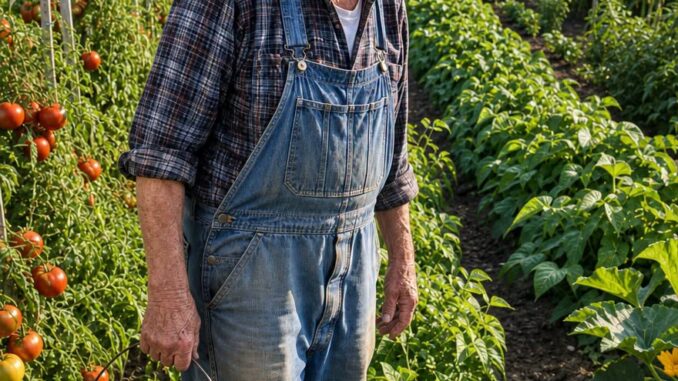
Stretching out past the back porch, past the clothesline, and past the weathered red shed, lay my father’s garden.
Half an acre of it. Nine rows of green beans climbing up twine he’d tied by hand every May. Three hundred staked and caged tomato plants heavy with ripening fruit. Potatoes. Squash. Onions. Beets. Carrots. Cucumbers sprawling over a wire fence. Two towering rows of sweet corn, taller than me, rustling softly in the morning breeze. And along the edge, a patch of strawberries my mother had planted thirty years ago.
There wasn’t a single weed in sight.
Not one. I had witnessed Dad out there at five in the morning, kneeling in the dirt to pluck weeds the size of a fingernail.
“Unmaintained,” I said aloud.
“That’s what it claims.”
“Dad, that garden is the most meticulously cared-for plot in this entire county.”
He took off his reading glasses, folded them neatly, and slid them into his shirt pocket.
“Well,” he remarked. “Somebody disagrees.”
My father is seventy-nine years old.
His name is Arne Lindqvist. He was born right here in this house, on this very land, in 1947. His father was born here before him. He spent thirty-four years working at the town paper mill until it shut down, followed by another twelve driving a school bus, before finally retiring to do what he’d always dreamed of doing.
He grew things.
My mother, Marta, passed away three years ago this October. Pancreatic cancer. Just four months from diagnosis to funeral. They had been married for fifty-one years.
After she died, I figured Dad would let the garden go. I assumed he’d sell the property and move into one of those senior complexes in town, the ones featuring cozy little patios and a shuffleboard court.
He did no such thing. If anything, the garden expanded.
Dad lives by himself. He eats like a bird—a bowl of oatmeal in the morning, a simple sandwich at noon, and some fish with potatoes at night. That’s it. He is as thin as a fence post.
One summer, perhaps two years ago, I stood at the edge of those nine rows of green beans and did some mental math. There had to be hundreds of pounds of beans out there. Thousands of tomatoes. Enough potatoes to feed a small village.
“Dad,” I asked him then. “Who are all these beans for?”
He was kneeling in the dirt, tying up a tomato stem that had drooped in the wind. He didn’t look up.
“People,” he replied.
That was it. That was his entire answer.
I waited for him to elaborate, but he didn’t. He just kept securing the vine with a strip of an old bedsheet, his large, knotted fingers moving with slow, deliberate care.
I assumed he was handing them out to neighbors, bringing them to church, or perhaps just letting them rot on the vine. I didn’t press him.
I really should have.
The neighbor was a man named Brent.
Brent Hollis. He had built that massive gray house on the old Swenson lot last spring.
The Swensons had lived next door to my parents for forty years. Old Mr. Swenson had taught me how to ride a bicycle on the gravel lane between our properties. Following his passing, his children sold the land to a developer, who in turn sold it to Brent. Brent promptly demolished the Swensons’ modest white farmhouse down to the last board, replacing it with something straight out of an architectural magazine.
Two stories of gray siding. Black window frames. A three-car garage complete with a pristine basketball hoop that nobody ever touched. A lawn so green and flawless it looked spray-painted.
And a deck.
A sprawling, wraparound deck on the second floor of the house. It looked straight down into Dad’s fence—directly over the corn, the beans, the tomatoes, and the potatoes.
I usually visited Dad’s place on Sunday mornings to share coffee and check on him, as one does when an aging parent lives alone. On most of those Sunday mornings, I’d spot Brent standing out on that deck in a bathrobe, clutching a coffee mug, scowling down at my father’s garden.
The corn seemed to bother him the most. It always drew his fiercest frown.
That summer, the corn grew tall—over seven feet high—blocking a good portion of his view of the valley.
“He doesn’t seem very fond of the garden,” I mentioned to Dad one morning while watching Brent through the kitchen window.
Dad merely shrugged.
“Takes all kinds,” he said.
I had only spoken to Brent once prior to the arrival of the county letter.
It happened back in June. I was out in the garden helping Dad harvest the season’s first strawberries when Brent stepped out onto his elevated deck to watch us. He looked to be around forty-five—tall and physically fit in the way of someone who patronizes a gym and hires a personal trainer. Impeccable haircut. An expensive wristwatch that flashed in the sunlight.
Dad straightened up from the patch, wiped his palms on his overalls, and walked over to the property line.
“Morning,” he called upward.
Brent glanced down at him. “Morning.”
“I’m Arne Lindqvist. I’ve been meaning to come over and welcome you to the neighborhood.”
“Brent Hollis.”
Dad held up a small green cardboard pint basket, the kind common at farmers’ markets. It was brimming with bright red strawberries, still warm from the morning sun.
“First batch of the season,” Dad said. “My late wife planted these. Finest strawberries in the county, if I do say so myself. You’re more than welcome to them.”
Brent gazed at the fruit. Then at Dad. Then out across the vast rows of rich, dark earth.
“No thanks,” he replied flatly. “I’m not big on fruit.”
Dad lowered the basket slightly.
“Well,” he murmured. “The offer stands. Whenever you want some. The tomatoes will be ready in July, and the beans in August. Just holler.”
Brent gave a single, curt nod without cracking a smile. He turned on his heel and slid the glass door shut behind him.
Dad stood by the fence for a moment, still holding the little basket of strawberries.
Then he walked back over to me and set it down softly in the dirt.
“Not big on fruit,” he muttered. “Huh.”
“Dad, that man was outright rude.”
“He was just busy.”
“He was standing on a deck doing absolutely nothing.”
“Maybe he was busy thinking.” Dad knelt back down among the strawberry plants. “A man is allowed to think.”
That is my father all over. He would manage to find something redeeming to say about a rattlesnake.
So when that ominous letter arrived on Tuesday, I knew instantly who was behind the complaint.
“It’s Brent,” I declared, slamming the envelope onto the table. “It has to be. Nobody else can even see the garden from the road on the other side of the house. It’s him. He’s been glaring at that corn all summer like it personally offended him.”
Dad remained silent.
“He can’t get away with this,” I pressed on. “He can’t just move in here and dictate what you do with your own land. Your family has farmed this property for a century, Dad, and he’s only been here five months.”
“The county says otherwise.”
“The county is dead wrong.”
“Maybe.”
I pulled out my phone and began rapidly typing. “I know a lawyer—well, Jen from work knows one. Her brother-in-law handles property and zoning disputes. I’m calling him right now.”
“Kristin.”
“I mean it, I’m calling him.”
“Kristin,” Dad repeated, his tone so calm and quiet that my fingers froze on the screen. “Let’s just wait and see what the inspector actually says.”
“Dad, they’re going to force you to tear it all out.”
“Maybe they will. Maybe they won’t.”
“How can you possibly be this calm?”
He looked past me out the window, watching the corn sway in the breeze and the tomato plants bowing under the immense weight of their fruit.
“Because I’ve been growing things for seventy years,” he said simply. “You learn that certain things in life cannot be rushed. You plant the seed, you wait patiently, and you see what grows.”
At the time, I didn’t understand what he meant.
I scribbled the lawyer’s name—Doug Pratt—along with his phone number on the back of the county envelope anyway. Just in case.
I took Thursday off from work.
As a dental hygienist in Cedar Falls forty minutes away, I had only taken two sick days in three years, prompting my boss to give me a questioning look when I requested the time.
“Family emergency,” I told her.
“Is your father all right?”
“He’s fine. It’s the new neighbor who’s the headache.”
I drove out to the house at seven that morning. True to form, Dad was already out in the garden, kneeling in the bean rows with his bucket, harvesting.
“Dad, the inspector is due here at nine.”
“I know.”
“Shouldn’t you go inside and change your shirt?”
He glanced down at his attire—his old blue work shirt, frayed nearly white at the elbows with a torn pocket.
“What’s wrong with this shirt?”
“Nothing. Never mind.”
I sat on the back porch steps, nursing a cup of coffee while watching him work. The morning sun crested the tree line, washing the garden in a golden hue. Bees hummed among the squash blossoms, and a lone robin hopped along the edge of a furrow in search of worms.
It was breathtaking. Honestly, it was one of the most peaceful, beautiful sights I had ever beheld.
And some miserable man in a luxury gray house had labeled it an eyesore.
I glanced up at Brent’s deck. It was vacant. The glass door remained shut, and the heavy curtains were drawn tight.
Coward, I thought.
The inspector arrived five minutes before nine.
He was young—maybe twenty-six or twenty-seven—slender, wearing glasses, a short haircut, and a county ID badge clipped to his belt. His name was Tyler Ostrowski, and he arrived in a compact white sedan bearing the county seal on the door.
He was unfailingly polite, which was the first thing I noticed. He shook my hand, shook Dad’s hand, and respectfully addressed Dad as “sir.”
He carried a clipboard under his arm.
“Mr. Lindqvist,” he began, “thank you for meeting with me today. I’m sorry to be a nuisance.”
“No nuisance at all,” Dad replied warmly. “Would you like a cup of coffee?”
Tyler blinked in surprise. I got the distinct impression nobody had ever offered him coffee on an official inspection before.
“Uh, no thank you, sir. I’m all right.”
“Suit yourself.”
Tyler walked the perimeter of the garden, snapping a few photos with his phone, taking measurements, and jotting notes on his clipboard. Dad walked alongside him in quiet companionship, his hands tucked deep into his overall pockets.
I trailed behind them, ready to pounce at the slightest provocation.
At one point, Tyler paused at the end of the tomato rows, standing in silence for a full minute to gaze at them. Three hundred immaculate plants, every single one staked, caged, and tied with clean strips of old cloth. Not a single yellowed leaf. Not a single weed.
“Sir,” Tyler asked, “how many hours a day do you put into this?”
Dad considered the question.
“Six,” he said. “Maybe seven. More in June when the weeds get aggressive.”
“Every single day?”
“Every day the good Lord gives me.”
Tyler jotted something down on his pad, then glanced over toward the imposing gray house and its empty deck before returning his gaze to the garden.
When we eventually returned to the porch, Tyler exhaled a long breath, looking thoroughly uncomfortable as he tapped his pen against the clipboard.
“Mr. Lindqvist, I’m truly sorry,” he admitted. “I really am. But a formal complaint is a complaint. The local code dictates that agricultural use exceeding a quarter acre in an R-2 zone requires a special permit. You’ve got roughly half an acre out there, and no permit on file.”
“Never needed one before,” Dad noted calmly. “My father grew this garden, and his father before him.”
“I understand completely. But the zoning laws were updated in 2019 when they rezoned this entire stretch of Ridge Road for residential housing.” Tyler looked genuinely regretful. “Technically, it’s a grandfathered use—but only as long as nobody files a grievance. And someone did.”
“So what happens next?” I demanded, my voice cutting sharply through the air.
Tyler stared down at his clipboard, clearly hating every word he had to say.
“I have to issue an official notice of violation,” he explained. “Thirty days to bring the property into compliance.”
“Which means what?”
“Which means reducing the cultivated area to under a quarter acre, or removing it entirely.”
“Tear it out?” I interjected. “You’re telling him he has to bulldoze half his life’s work?”
“Or apply for a special permit. But that process takes about six months, during which the complaint stays active and the daily fines would—” He trailed off apologetically. “I’m sorry. I really am.”
“Thirty days,” Dad repeated softly.
“Thirty days, sir.”
I stood up, trembling with suppressed fury. I could feel the outline of the envelope containing the lawyer’s contact information burning a hole in my back pocket.
I wanted to scream. I wanted to lecture this young man with his clipboard about how my father’s garden predated him, about how my mother planted those strawberries, about how our family roots ran deeper in this soil than his grandparents’ lineage.
And I wanted to storm over to that gray house, pound on Brent Hollis’s door, and give him a piece of my mind regarding his deck, his pristine fake lawn, and his smug face.
I opened my mouth to let loose.
Then Dad placed a hand gently on my arm.
He didn’t squeeze. He didn’t pull me back. He just rested his warm, heavy hand there, exactly the way he used to when I was a little girl throwing a tantrum at the dinner table.
I snapped my mouth shut.
Dad rose slowly from the porch steps, his knees giving a faint pop, and walked over to Tyler, extending a hand.
Tyler looked momentarily startled before shaking it.
“I appreciate you coming out here today,” Dad said. “I know you’re just doing your job.”
“Thank you, sir.”
Dad didn’t immediately release his grip.
“Would you do me one favor,” he asked, “before you file the paperwork?”
Tyler hesitated. “If I’m able.”
“Come back this Saturday,” Dad instructed. “At six in the morning.”
Tyler looked over at me for translation.
I shrugged, just as mystified as he was. I had no earthly idea what my father was planning.
“Six in the morning,” Tyler echoed. “This Saturday?”
“This Saturday.”
“May I ask why?”
Dad finally let go of his hand.
“There’s something I’d like you to witness,” he said simply. “Before you make up your mind.”
Tyler cast one last look at the garden, then at Dad, and finally up at the neighboring gray house with its vacant deck.
“All right,” he agreed slowly. “Six a.m. Saturday. I’ll be here.”
“Thank you, son.”
Tyler walked back to his white sedan, lingering by the door for a minute with his clipboard before driving off.
I turned sharply to my father.
“What on earth is happening on Saturday?”
Dad picked up his metal bucket from the porch floor.
“Saturday is Saturday,” he replied.
And with that, he walked back out toward the bean rows.
I didn’t return home that evening.
I couldn’t bring myself to leave; I was simply too angry. I called my office and informed them I needed Friday off as well, prompting a heavy sigh from my boss that carried clearly through the phone line.
Then I did something I probably should have avoided.
I walked next door.
It was roughly six o’clock in the evening, the sun casting long, orange shadows across the lawns. Brent’s vehicle—a black SUV polished to a mirror shine—was parked in the driveway.
I marched up the long, flawless walkway, crossed the immaculate turf, and pressed the doorbell. It chimed a cheerful little melody. Of course it did.
Brent pulled the door open wearing a golf shirt and khakis, holding a glass of wine. He looked at me as though trying to place an acquaintance from a party he barely remembered attending.
“Can I help you?”
“I’m Kristin Lindqvist,” I said. “Arne’s daughter. From next door.”
A flicker of recognition crossed his features, vanishing just as quickly.
“Right,” he said.
“You filed a complaint with the county against my father’s garden.”
He didn’t even bother to deny it. He took a leisurely sip of his wine.
“I filed a formal grievance,” he corrected. “Yes, through the appropriate channels.”
“Why?”
“Because it’s an eyesore.” He said it with casual certainty, as if it were self-evident. “It’s half an acre of bare dirt, cornstalks, and rotting produce sitting right outside my back windows. I invested a lot of money into this lot and this house. I certainly didn’t pay a premium to stare at a working farm.”
“It’s not rotting. It’s the cleanest, most productive garden in the county.”
“It’s a farm,” he insisted. “Operating in the middle of a residential neighborhood. There’s a reason zoning laws exist, you know.”
“He is seventy-nine years old. He has lived on that property his entire life. His family has tended that land for a hundred years.”
“And I’m sure that’s very sentimental to him.” Brent’s voice was utterly flat, dripping with boredom. “However, the zoning laws changed. He is out of compliance. That isn’t my problem.”
“You could have spoken to him. You could have walked over here and knocked on his door like a civilized human being.”
“I have no desire to talk to him. The county is handling it.”
“He offered you strawberries,” I countered, my voice shaking with rage. “Back in June. Remember? He walked right up to that fence and offered you fresh strawberries my mother planted before she died. And you told him you weren’t big on fruit.”
Brent’s jaw tightened visibly.
“Look,” he said, his patience wearing thin. “I don’t know what kind of operation your father is running over there. But I see the delivery trucks—early in the morning, every single week. He loads up boxes and drives off before sunrise. That isn’t a cute little hobby garden. That’s a commercial enterprise. He’s likely selling produce without a license and dodging taxes. I’m doing the county a public service.”
I stared at him in disbelief.
“You have no idea,” I whispered. “You haven’t the faintest idea who my father is.”
“I don’t need to know.”
And with that, he shut the door in my face.
I walked back across the lawn, past the fence and the towering cornstalks.
Dad was seated on the back porch in his old metal lawn chair, methodically shelling peas into a ceramic bowl. He had watched me go over, and he had watched me return.
“Well?” he asked.
“He claims you’re running a commercial operation. Selling vegetables without a license.”
Dad let out a genuine, hearty laugh—the first real laugh I’d heard from him since my mother passed away.
“An operation,” he chuckled. “That’s a good one. I’ll have to remember that line.”
“Dad, it isn’t funny.”
“It’s a little bit funny.”
I sank heavily onto the porch steps.
“He noticed your truck,” I continued. “He said you leave before sunrise every single week, hauling boxes.”
Dad’s hands paused over the pod he was holding.
“Fridays,” I said, piecing it together. “That’s what he’s talking about, isn’t it? You’ve been driving off every Friday since Mom died. I always assumed you just suffered from insomnia.”
Dad offered no explanation, simply returning to his task.
“Where do you go, Dad?”
He snapped open a pod with his thumb, sending the fresh peas rolling into the bowl below with a rhythmic plink, plink, plink.
“You’ll see,” he said.
“I want to know right now.”
“You’ll see on Saturday,” he replied quietly. “Everybody will.”
I spent the night in my old childhood bedroom—the one with the faded yellow wallpaper, the twin bed, and the shelf of porcelain horse figurines I had collected when I was ten years old.
At 4:15 AM, I was jarred awake by the low rumble of a truck engine starting up.
I padded over to the window and looked out.
It was still pitch black outside, but the porch light illuminated my father in its yellow glow as he loaded cardboard banana boxes into the bed of his old green pickup—boxes scrounged from the back dock of the local grocery store. He carried them out from the shed one by one, packing them tight with fresh vegetables: tomatoes, beans, potatoes, and squash.
I counted eleven boxes in total.
He stretched a tarp securely over the load, double-checking every knot, before climbing into the cab. The truck backed slowly down the gravel drive with its headlights off until it reached the paved road.
Only then did the headlights flick on, and he vanished into the pre-dawn dark.
I stood at the window, watching the tail-lights fade away.
I almost followed him. I was tempted to grab my car keys, jump behind the wheel, and tail him down Ridge Road.
Instead, I remembered his words: You’ll see Saturday.
I went back to bed, though sleep refused to come.
He returned home at 9:30 AM. The truck bed was entirely empty. He walked into the kitchen, washed his hands, poured himself a fresh cup of coffee, and sat down at the table across from me as if nothing out of the ordinary had occurred.
“Morning,” he said casually.
“Morning.”
He blew gently across the surface of his mug.
“You ought to get to bed early tonight,” he advised. “Tomorrow’s going to be a big day.”
I set my alarm for five o’clock.
As it turned out, I didn’t need it. I was wide awake by 4:30 AM, staring up at the familiar ceiling of my old room.
When I came downstairs, Dad was already bustling about the kitchen. He had brewed a massive pot of coffee—not his usual small four-cup maker, but the oversized thirty-cup commercial urn my mother used to haul to church potlucks. It sat on the counter, perking and gurgling away.
“What is all that for?” I asked.
He wore his trusty blue work shirt, the faded one with the torn pocket.
Without answering, he picked up his harvesting bucket and stepped out the back door into the garden.
Saturday morning broke shrouded in heavy fog.
It was that thick, damp mist that rolls in from the river valley in late summer, blanketing everything in a silent white haze. You could barely make out the far end of the garden; the cornstalks and the perimeter fence dissolved completely into the gray blur.
I stood on the back porch clutching a mug of coffee.
At five minutes to six, twin headlights pierced the fog rolling up Ridge Road—a small white sedan bearing the county seal.
Tyler Ostrowski parked along the shoulder near the foot of our driveway, stepped out wearing a county-issued jacket over his sweatshirt, and clutched his clipboard. He looked half-asleep and distinctly nervous.
He trudged up the gravel drive toward where I stood.
“Morning,” he greeted me. “I’m here, just like he requested.”
“Want some coffee?”
This time, he didn’t hesitate. “Yes, please.”
I filled a cup from the giant urn, and he cupped it warmly with both hands.
“Where’s your father?”
I pointed out into the fog. Out among the bean rows, a faint silhouette was visible—a thin old man in a faded blue shirt, bent over his bucket, quietly picking beans just like any other day.
“What is he hoping I’ll see out here?” Tyler asked, perplexed.
“Honestly, I haven’t the slightest idea.”
Then I glanced upward toward the gray house.
Brent was already out on his deck.
He stood rigidly at the railing clad in a dark blue bathrobe, holding his own coffee mug as he stared down at us—at the county vehicle, at Tyler, and at me.
He had spotted the car pull up and rushed out to watch the proceedings. Naturally. He wanted a front-row seat to see the inspector lay down the law and witness my father’s defeat.
Tyler followed my gaze upward and spotted Brent as well. Brent lifted his coffee mug in a silent, mocking salute.
Tyler didn’t return the gesture.
At precisely six o’clock, more headlights cut through the foggy morning air down the road.
First came an old red Ford pickup with rusted wheel wells, which slowed down and pulled onto the shoulder by the ditch at the edge of our property.
Right behind it rolled a white Chevy and a blue Dodge with a cracked windshield. Then a dented brown Corolla, followed closely by a station wagon, a sedan sporting a donut spare tire, a battered old Buick, and a minivan with a handicap parking tag dangling from the rearview mirror.
They kept coming in a steady procession. One after another, their headlights slicing through the mist, pulling off onto the shoulder and lining up neatly along the roadside ditch.
Tyler lowered his coffee cup to the porch railing with agonizing slowness.
I began to count, unable to stop myself.
Eleven cars. Fourteen. Seventeen.
Doors opened. People began to emerge.
An elderly man wearing a feed store cap and suspenders. A young woman with an infant strapped to her chest in a carrier, leading a toddler by the hand. A heavyset man in a Walmart vest, looking as though he had driven straight over from a graveyard shift. Two teenage boys, likely brothers, lugging a plastic laundry basket between them. A woman dressed in medical scrubs. An elderly woman leaning on a cane while carrying a canvas tote bag. A man with a prosthetic leg. A family of five, the children still sporting pajamas beneath hastily thrown-on jackets.
Every single one of them was carrying something.
Empty cardboard boxes. Empty buckets. Empty grocery bags. Empty laundry baskets. One person even pulled a little red wagon.
Scarcely a word was spoken. A few exchanged quiet nods. Someone murmured, “Morning, Earl.” Another replied, “How’s that hip holding up, Doris?”
Then, as one, they walked up the driveway, past the porch, past Tyler and me, and directly into the garden.
Everyone seemed to know precisely where they belonged.
The old man in the feed store cap marched straight to the potato patch, knelt down with a small hand fork, and began digging. The young mother with the baby headed straight for the strawberry patch along the edge—the very one my mother had planted—sitting her toddler down in the grass to pick and eat happily.
The two teenage boys ambled over to the corn, working in practiced synchronization to pull down ears and twist them off the stalks.
The nurse in scrubs made a beeline for the tomatoes.
The elderly woman with the cane walked at a slow, deliberate pace down to the far end of the bean rows where my father was working. She stopped beside him, placing a gentle hand on his forearm. He straightened up, spoke a few words I couldn’t catch, and handed her his bucket, which was already brimming with harvested beans he had picked specifically for her.
Everywhere I looked, people were moving quietly and carefully through the fog in my father’s garden, filling their boxes, buckets, and bags.
They took only what they needed; nobody showed a trace of greed. Once a bag was full of beans, a few tomatoes, or some potatoes, they stopped, leaving plenty behind for whoever came next.
Tyler stood frozen beside me on the porch.
He had stopped writing entirely, his pen hovering motionless over the clipboard in his hand.
“What is happening here?” he whispered in disbelief.
I couldn’t find my voice to answer.
My eyes swam with hot tears, though I barely understood why. I only knew the truth of it.
Who are all those beans for?
People.
I looked back up toward the deck.
Brent was still standing there, but his coffee mug was no longer raised. His arm hung limp at his side, and his other hand gripped the wooden railing so tightly his knuckles shone white.
He stared down in stunned silence at the garden, at the crowd of people, and at the long line of vehicles stretching down the ditch into the foggy distance.
His face had gone completely rigid.
Then the final vehicle arrived—a silver minivan.
It rolled slowly down the road with the hesitant caution of someone unsure of their destination, or perhaps someone who wished they were anywhere else.
It parked at the very tail end of the line, far down the hill behind all the others.
For a moment, no one emerged from inside.
Then the driver’s-side door swung open.
An older woman stepped out into the mist. She looked to be around seventy—small and slight, wearing an oversized tan raincoat and a pair of white sneakers. Her gray hair was secured neatly with a clip. Tucked beneath one arm were two folded cloth grocery bags, faded with age.
She closed the car door with gentle care, as if afraid of disturbing the morning quiet.
Then she began walking up the driveway.
Her pace was slow, her gaze fixed on the gravel beneath her feet, shoulders hunched inside the roomy coat. She moved like someone retracing a familiar, painful route she had walked many times before and never quite grown accustomed to.
About halfway up the driveway, she lifted her chin.
She looked toward the lush expanse of the garden.
And then her eyes drifted past the crops, past the fence, and upward.
Straight toward the towering deck of the big gray house.
Straight toward the man standing there in the dark blue bathrobe.
She stopped dead in her tracks.
She halted so abruptly that one of her cloth grocery bags slipped from beneath her arm and fluttered down onto the gravel.
She didn’t bother to pick it up.
She simply stood frozen in the middle of my father’s driveway, enveloped in the fog, staring up at Brent Hollis.
Up on his deck, Brent lowered his coffee mug until it rested softly on the wooden railing.
His movements were agonizingly slow and careful.
As if his hands had suddenly forgotten how to function.
For a long, suspended moment, the entire world stood still.
The people down in the garden continued their harvest, oblivious to the drama unfolding by the house. The teenage boys kept snapping corn off the stalks; the toddler continued happily stuffing strawberries into his mouth.
But Tyler and I noticed. And down at the end of the rows, my father straightened up, turned toward the driveway, and watched.
He saw it all, too.
Slowly, the woman in the tan raincoat bent down, retrieved her dropped grocery bag, and clutched both bags tightly against her chest, her eyes never leaving the deck above.
Then Brent finally moved.
He abandoned his coffee mug on the railing and vanished through the glass sliding door. A second later, I heard it slide open with a sharp rattle and slam shut behind him.
A minute elapsed before he appeared around the side of the house—moving fast, barefoot, still wrapped in his bathrobe, sprinting across the dew-soaked lawn directly toward the fence dividing his property from ours.
There was no gate in that fence, and there never had been. Old Mr. Swenson and my father had always simply stepped over the low corner where the wooden post had leaned at an angle for thirty years.
Brent vaulted over it.
He pushed his way through the border rows of corn, shoving the tall stalks aside until he burst out onto the open driveway.
He halted about ten feet away from the woman in the tan raincoat.
They stared at one another.
“Mom?” he breathed.
The woman’s face crumpled instantly.
She didn’t burst into tears right away; rather, her features simply folded inward like a crushed paper bag. She pressed the empty grocery bags harder against her chest.
“Brent,” she whispered, her voice terribly small. “What are you doing here?”
“I live here,” he answered, gesturing frantically back toward the gray house. His hand was shaking violently. “That’s my house. That’s… Mom, that’s my house.”
She turned slowly to look at it—the grand gray siding, the black-framed windows, the three-car garage, the massive deck.
“I didn’t know,” she murmured, tears welling in her eyes. “I didn’t know which place was yours. You never… I’ve never been out here to visit. You never invited me.”
Brent opened his mouth to speak, but no words came out.
“What are you doing here?” he asked again, his voice dropping to a hollow rasp.
His mother looked down at the empty grocery bags in her arms, then at her plain white sneakers, and finally at the gravel beneath her feet.
She didn’t offer an explanation.
She didn’t need to.
Brent looked past her—out at the garden, at the dozens of people filling their boxes and buckets, at the old man in the feed store cap, at the young mother with her baby, at the man in the Walmart vest.
Then he looked back at his mother.
At the two empty cloth bags.
I stood watching as the horrifying realization washed over him, a dark shadow spreading across his face.
“No,” he choked out. “No. Mom, no.”
“Brent—”
“Are you here for… are you here to get food?”
His mother lifted her chin, her lower lip trembling.
“Every Saturday,” she confessed softly. “For a year and a half.”
Brent staggered backward a step, as if he had been physically struck.
“Why?” he demanded, anguish cutting through his voice. “Why would you do that? Mom, I send you money. I send you a check every single month.”
“You send me two hundred dollars,” his mother replied gently. “Every single month, and I am grateful for it. I truly am, honey. I appreciate every penny.”
“Then why—”
“Because my pension is eleven hundred dollars a month,” she explained, her voice cracking. “And my rent is eight hundred. And my heart medication costs three hundred and forty dollars even after insurance. Add in the electric bill, the phone bill, and car insurance.” She shook her head sorrowfully. “It simply doesn’t add up, Brent. It hasn’t added up since your father passed away. I can’t make the numbers work.”
“You never told me.”
“How could I possibly tell you?” Her voice finally broke. “You worked so hard to escape this town. You sacrificed so much. You put yourself through college on student loans, worked two jobs, and built your entire career from scratch. You were so proud of what you achieved. And I was so endlessly proud of you.” She was crying openly now. “Every time you called, you sounded so happy, talking about your clients, your new car, your beautiful house. I refused to be the anchor that dragged you back down.”
“You aren’t dragging me anywhere! You’re my mother!”
“I know,” she wept softly. “I know I am. But I couldn’t bear for you to look at me and see the old house, the empty kitchen cupboards. I didn’t want you to have to remember.”
Brent stood frozen in his bathrobe on the gravel drive, completely barefoot.
“Remember what?” Tyler asked quietly beside me, the question slipping out before he could catch it.
But I already understood. Somehow, deep down, I had known all along.
My father had walked up quietly from the bean rows. He stood a short distance away near the edge of the garden, holding his harvest bucket, completely silent, just watching.
Brent’s mother turned her head and caught sight of him.
“Arne,” she choked out. “I’m so sorry. I’m truly sorry. I swear to you, I didn’t know he was your neighbor.”
“Morning, June,” my father said with infinite gentleness. “There’s no need to apologize to anyone.”
Brent swung around to stare at my father.
“You know her?”
“Every Saturday for a year and a half,” Dad replied. “June prefers the yellow squash and the small red potatoes. Not the big ones—she says the small ones taste just like the ones her mother used to grow.”
June let out a ragged sound that was half a sob and half a laugh.
Brent turned back to look at—
Leave a Reply