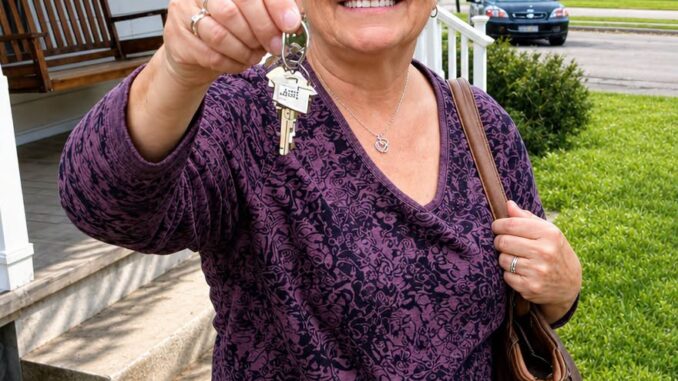
My son-in-law slid a sheet of notebook paper across the kitchen table. There was one number on it, circled twice. $800. “That’s rent, utilities, and your share of the groceries,” my daughter said. She had both hands wrapped around a coffee mug that had gone cold long ago. “And then four days a week with the kids. So you’d be earning your keep, Mom. It wouldn’t be charity.” Earning my keep. It was a Saturday, just past lunch, during the first week of October. The kitchen window was open a crack, and you could hear the dryer fans running down at the elevator, the way you can hear them all over Holdrege at harvest time. A low, steady roar, like a river that never gets anywhere. I looked down at the paper. It had been torn out of a spiral notebook, with the ragged edge still attached. Todd’s handwriting. He makes his eights like two circles stacked on top of each other, the way they teach you in second grade. “Eight hundred,” I said. “A one-bedroom at the apartments out by the highway goes for seven seventy-five,” Todd said. He said it to the salt shaker. He wouldn’t look at me. “We checked. So it’s fair. Right at fair.” “And you’d have family,” Michelle said. “You wouldn’t be by yourself out there anymore.” I am sixty-seven years old. My Social Security check, the one I draw now as Dale’s widow, comes to $1,640 a month. I kept the books at the lumber yard for twenty-two years, so I didn’t need a pencil for this. Eight hundred from sixteen forty left me eight hundred and forty dollars. For my car insurance. My Medicare supplement. My gas. My pills. My tithe. And Christmas for two grandchildren. And for that price, I would be the hired help in my own daughter’s house, four days out of seven. I want to be fair to her, because I’ve had time now to be fair. She didn’t mean it cruelly. That was almost the worst part. She said it the way you’d read somebody the terms on a used car. Pleasant and a little rushed. Like she’d rehearsed it in the bathroom mirror and wanted to get through it before she lost her nerve. “Can I see it again?” I asked. “The basement.” “Sure, Mom. Of course.” We went down. Todd stayed at the table. They had done what they could with it. I’ll give them that. There was a remnant of tan carpet laid over the bare concrete. A double bed with a metal frame. A lamp from Michelle’s old bedroom at home. A dehumidifier hummed in the corner with a hose leading down to the floor drain. The single window was up near the ceiling, about the size of a cake pan. All you could see out of it was the bottom of the neighbor’s fence. It smelled like damp cardboard and laundry soap. “Todd’s going to put up a wall here,” Michelle said, pointing. “So you’d have your own room. Your own space. And the bathroom’s just up the stairs.” “Up the stairs,” I said. “It’s only thirteen steps.” I counted them myself on the way back up. She was right. Thirteen. Sadie had followed us down. She’s four. She had on one sock and a princess nightgown at one o’clock in the afternoon. She stood on the bottom step with her thumb near her mouth. Not in it. Near it. She’s trying to quit. “Grandma,” she said, “are you going to live in the under?” “We’ll see, sweet pea.” “There’s a spider in the under. Eli named him Kevin.” “Well,” I said, “then I’d have company.” Now, I know what some of you are thinking. My friend Brenda from church said it right to my face later. Why didn’t you just tell her no? Why didn’t you say, Michelle, I am your mother, and I will not be charged admission? I could have. I had the words right there behind my teeth. But a refusal at your daughter’s kitchen table turns into a fight. And a fight turns into things said that can never be swept back up off the floor. I have one child. I had already buried my husband. I wasn’t about to risk the only other person on this earth who remembers Dale’s voice over a sheet of notebook paper. So I said, “Thank you, honey. That’s a real offer, and I can see you two worked on it. Let me think on it.” Michelle let out a breath. “Okay. But, Mom, you have to be out of the farmhouse by the first. So.” “I know when I have to be out.” I folded Todd’s paper in half, then in half again, and put it in my purse. In the pocket where I keep my checkbook. Todd watched me do it. He didn’t say anything. Something crossed his face that I couldn’t read at the time. I’ll tell you later what it was. Then I went out to my Buick and sat in it for a minute with both hands on the wheel. I should tell you about the farmhouse, so you understand why I couldn’t just stay put. Dale was a hired man. I say that with my chin up. He worked for Jim Olson south of town for thirty-one years. And for thirty-one years we lived in the hired man’s house on the Olson place. A square white two-story with a bitter north wind and the best garden dirt I ever put a spade into. The house went with the job. We never paid rent on it, and we never owned a single board of it. That was the agreement. It was a fair one. It’s how a good many people out here have raised a family. Dale died two years ago in March. He was greasing the planter in the machine shed, and he sat down on an overturned bucket to rest. And that was all. Jim found him. Jim Olson cried harder at that funeral than I did. Because I hadn’t started yet. The house went with Dale’s job. So by rights, I should have been out of it the spring he died. The Olsons let me stay anyway. Two years and seven months, and they never once brought it up. Jim’s wife sent over sweet corn every August. Jim plowed my lane every winter without being asked. But their boy was coming home to farm. He and his wife had a baby and another on the way. They’d been renting in Kearney. And the hired man’s house was the only place on the farm to put them. Jim came to my door in August with his cap in his hands. It took him ten minutes to get it out. “You take until November, Judy. You take longer if you need it.” “I won’t need longer,” I told him. “That house was always yours, Jim. You’ve been good to me past what anybody could ask.” So that was that. Nobody was the villain in it. A young family needed a home. And I was a widow living alone in five rooms that belonged to somebody else. That’s how I came to be sitting in my car in front of my daughter’s split-level, with a piece of notebook paper in my purse stating my keep was worth eight hundred dollars a month. I started the car. I was going to drive home. I had every intention of doing so. White siding. A green shingle roof. A front porch just deep enough for a swing. And the swing was there, hung on chains, with a seat somebody had painted not too long ago. One step up from the walk. One. “Mother couldn’t do stairs,” Mr. Brandt said, seeing me look at it. He let me in. The front room was the kitchen too. A sink under a good, big window. A gas stove with four burners. A refrigerator that hummed. Room for a table by the wall. A place for a couch. A heating stove in the corner. Through a doorway was the bedroom, complete with a closet. Off that, a bathroom featuring a tub with a grab bar bolted into the studs. That was the house. That was all of it. You could stand in the middle of the front room and see every corner you owned. The window over the sink looked straight out at the elevator, the scale, and the trucks. “It’s loud in harvest,” he said. “The fans run all night. And the freight train comes through around two in the morning and again near five. Mother said she stopped hearing it after a month.” “I’ve been listening to a quiet house for two years, Mr. Brandt. I believe I could stand some noise.” He rubbed the back of his neck. “There’s corn dust on everything from now till Thanksgiving. I won’t lie to you about that.” “What are you asking?” “Five fifty. You cover your own lights and gas. I keep up the roof and the furnace, and I mow it when I mow the store.” Five fifty from sixteen forty left me a thousand and ninety. I did that sum without a pencil too. “It isn’t much,” he said again. “It’s got a door,” I said. “I’ll take it.” He blinked at me. “You want to think it over? Talk to Michelle?” “I’ve been thinking it over for three weeks. Every time I bought birdseed.” I wrote the check right there on the hood of my Buick. I didn’t want to walk back to the store and give myself time to turn sensible. He tried to wave off a deposit. He said he didn’t need a deposit from Dale’s wife. I wrote it for the first month anyway and told him he could hold the deposit in trust. He worked two keys off his heavy ring and put them on a smaller ring of their own. “Front and back,” he said. I held them in my palm. Two brass keys, still warm from his pocket. I went from my father’s house to the hired man’s house at nineteen years old. I had been somebody’s daughter under his roof, and somebody’s wife under her husband’s employer’s roof. And I was grateful for both. I truly was. But I was sixty-seven years old before anybody ever handed me the keys to a place I had chosen entirely by myself. I’m not ashamed to say I had to look away toward the elevator for a minute, so Mr. Brandt wouldn’t see my face. Here’s the part I’m not proud of. I didn’t tell Michelle. Not that day. Not that week. She called on Monday to ask if I’d thought it over, and I said I was still thinking. Which was a lie of the kind that isn’t quite a lie. I was thinking. I was thinking about where to put the couch. Jim Olson and his boy moved me on a Wednesday. They backed a flatbed up to the farmhouse porch and wouldn’t let me carry anything heavier than a lamp. I took my bed. The couch. The kitchen table Dale and I bought at a farm sale in 1981, along with four chairs. My sewing machine. Dale’s recliner. And nine boxes. Thirty-one years in a house, and it boiled down to one flatbed load and whatever fit in the trunk of a Buick. The rest I gave to the Olson boy’s wife. She cried over the canning jars. Jim stood in my new front room with his cap off, turning in a slow circle. “Well, Judy. It’s snug.” “It is.” “Dale would’ve had that porch step shimmed level before I got the truck unloaded.” “He would have,” I said. We both laughed. Then neither of us did. I hung my curtains. I placed Dale’s recliner by the heating stove, facing the window. I set my African violets on the sill over the sink, where they could watch the trucks. That first night the fans roared, and the two o’clock train came through and shook the water in the glass beside my bed. I lay there wide awake and thought, what in the world have you done, Judith? The second night I slept clear through to five. It was Todd who found out. He drives right past the elevator on his way to the plant for the first shift. On the ninth morning, a Monday, he spotted my Buick parked in front of the Brandt house at a quarter to six. A light on in the window. A woman in a housecoat watering violets. Michelle called that night at seven. I knew from the tone in her voice when she said “Mom” that she knew. “You rented a house.” “I did.” “From Mr. Brandt. By the elevator. Todd saw your car.” “That’s right.” “You have been living four blocks from me for over a week, and you let me keep asking if you’d thought about it.” “That was wrong of me,” I said. “I should have told you the day I did it. I was afraid of this phone call, and I put it off, and that was cowardly. I’m sorry for that part.” There was a long silence. I could hear cartoons playing in the background. “What are you paying?” “Five hundred and fifty.” “So it wasn’t even about the money.” Her voice climbed thin. “It’s a two-hundred-and-fifty-dollar difference. You’d rather pay a stranger than your own family?” “Mr. Brandt isn’t a stranger. And no. I’d rather be your mother than your renter, Michelle. That’s all it is.” “We made a place for you!” “You did. I saw the work you put into it.” “I told the daycare we might be pulling Sadie out. I told my boss I might be able to pick up Fridays.” “I didn’t know that.” “Because you didn’t ask! You just smiled and said thank you and went and did whatever you wanted!” I didn’t raise my voice. I have never once gotten anywhere with that girl by raising my voice. Not when she was fifteen, and not now. “Honey,” I said. “I’m going to say one thing, and then I’ll let you go, because you’re upset and it’s the kids’ bedtime. I would have come and watched those babies for nothing. I’d have done it gladly. But you told me I’d be earning my keep. I earned my keep with you a long time ago. I don’t believe I owe anything on it now.” She hung up. I put the phone down on the table Dale and I bought in 1981. I sat there until the window went dark and the elevator lights buzzed on. Ten days. No calls. No pictures on my phone, which she used to send almost every evening. Sadie with spaghetti on her forehead. Eli missing a tooth. Nothing. I’ll tell you the truth about those ten days. I had my door. I had my two brass keys, my porch swing, and my violets. And every evening I sat on that swing in my denim jacket and watched the trucks pull onto the scale. And I wondered if I’d paid too high a price. Because it was never the basement I minded. I’ve lived plainer than that. It wasn’t even the eight hundred dollars, though the arithmetic of it stung. It was the fact that I’d have been down there on terms. Every sack of groceries, I would have been reckoning my share. Every Thursday I felt tired and wanted to sit, I would have heard it echoing in my head. Earning your keep. A grandmother who lives in the house on wages isn’t a grandmother anymore. She’s the hired help who loves them. And when the children grew up and the daycare bill went away, what would my keep be worth then? I wanted to be near those children. I just didn’t want to be owned by the arrangement. Yet I would have traded the swing, the violets, and both keys for five minutes of Sadie on my lap. I knew it. And that made it a very long ten days. What got me through was a shoebox. I went into Brandt’s store on the second day for sunflower seeds. Mr. Brandt was standing at the counter with his glasses pushed up on his forehead and about two hundred slips of paper spread out before him. Invoices. Charge tickets. A bank statement with a coffee ring on it. “Lois used to handle all this,” he said. He wasn’t really talking to me. Lois was his wife, who passed away four years ago. “Forty-three years she did it, and I never once asked her how. Now the accountant in Kearney wants the third-quarter figures by the fifteenth, and I can’t tell you if Don Swanson has paid for his creep feed since May.” I set down my purse. “Do you keep a ledger? Or does it all live in the box?” “There’s a ledger. I stopped being able to make it balance about a year ago.” “Mr. Brandt, I kept the books at the lumber yard for twenty-two years. Double entry. Give me that ledger, that shoebox, and a pot of coffee.” He looked at me as if I’d offered to carry the fifty-pound sacks out for him. It took me three afternoons at the little desk in the back, near the vet supplies. As it turned out, Don Swanson had not paid for his creep feed since May. Neither had four others. And there was a deposit from July that had been entered twice. When I finished, the ledger balanced to the penny. And I’d found him a little over two thousand dollars in charge tickets that nobody had ever billed out. He came out to my porch that Friday evening and stood on my single step with his cap in his hand. Men of that age out here do all their important talking with their cap in their hand. “I’d like you to do that every Friday,” he said. “I can’t pay what it’s worth. But I can drop the rent down to four hundred, if that would be agreeable.” “That would be agreeable.” “It isn’t a favor, Judy. I want you to understand that. You’d be saving my hide.” “I understand it,” I said. “That’s why I’m saying yes.” After he left, I sat on the swing a while longer. There’s a difference. I could feel it, plain as the swing chain in my hand. Mr. Brandt had come to my door. He’d asked me for what I was good at, and he’d offered what he could. Nobody told me I’d be earning my keep. He told me I’d be saving his hide. I thought, that’s all I ever wanted from my own girl. Just to be asked. On the tenth day, a Thursday, I was frying potatoes for supper when a pickup door slammed out front. I knew the sound of that door. It’s Todd’s Ford. The driver’s side handle has stuck ever since he backed into the mailbox. I turned the burner down and looked out the window over the sink. Michelle was getting out of the passenger side. She still had her work clothes on, the scrubs with the little cartoon teeth printed on them from the dentist’s office. Her eyes were red all around the edges. Todd came around the front of the truck holding a yellow legal pad. Even from the window, I could see the whole top page was covered in his handwriting. The children weren’t with them. I wiped my hands on the dish towel and pushed the screen door open before they could knock. Nobody said anything for a second. Behind them, a grain truck shifted gears down on the street. “Judy,” Todd said. He’s a big man. Six foot two. He stood on my front walk like a boy sent to the principal’s office. “I wrote that number. The eight hundred. That was me, not her. I want that said first.” “All right.” “Can we come in?” “You can always come in. The potatoes are about to burn, so someone’s going to have to eat them.” Michelle made a sound that was partly a laugh. He climbed my single step. She stopped in the doorway and looked over my front room. The couch. Her daddy’s recliner. The violets on the sill. Then her gaze drifted to the table. She walked over and placed her hand flat on it, right on the burn mark where she’d set a hot pan down when she was eleven years old. “You kept the table,” she said. I dished up the potatoes and sliced what was left of a ham. Nobody ate much. Then Todd set the legal pad down in the middle of my kitchen table and turned it around to face me. “I need you to look at this,” he said. “I should have shown you this instead of that other paper. I didn’t want you to see it. I didn’t want anybody to see it.” “Of course I kept the table.” It was a budget. An honest one. The kind a man writes at one in the morning when he’s finally stopped lying to himself. Across the top was what came in. His take-home pay from the plant and hers from the dentist’s office. Together, $5,400 a month. Underneath was what went out, line by line. The house payment, including taxes and insurance. $1,180. The truck. $612. Daycare. He’d underlined it. $1,080. Groceries. The light bill. And the credit card they’d charged a new furnace to last January, when the old one quit during a cold snap. Forty-eight hundred dollars, at an interest rate that made me suck my teeth. Fourteen lines in all. At the bottom he’d drawn a box around the total going out. $5,710. “That’s three hundred and ten dollars short,” I said. “Every month. Since June.” He rubbed his jaw. “They cut the overtime in June. I’d been getting ten, twelve hours a week for three years, and we built everything around it like it was steady wages. That was my mistake. When it vanished, I figured it would come back by fall. It didn’t. We’ve been putting the difference on the card.” Michelle was looking down at her plate. “So when your place became available,” Todd said, “I sat down and thought, if Judy’s in the basement, that’s Sadie out of daycare most of the week, and Eli out of after-school care. And then I looked up what an apartment costs, wrote down eight hundred, and told myself it was fair because it was the going rate.” He forced himself to look at me. I’ll give him that much. He looked me right in the eye. “It wasn’t fair. I was plugging a hole in my boat with your Social Security check. And I knew it when I circled that number. I slid it across the table anyway because I was scared. I’m sorry, Judy. Dale would’ve taken me out behind the machine shed.” “Dale would have shown you how to read your own pay stub first,” I said. “Then the machine shed.” He let his breath out. That was what I’d seen cross his face the day I folded that paper into my purse. It was pure shame. He’d been ashamed since before I ever sat down. “And the other part,” I said, turning to my daughter. “The earning my keep part.” Michelle’s chin began to quiver. The exact same way it did when she was small. “I’ve heard it in my head every night since,” she said. “I don’t know how to explain it so it doesn’t sound worse.” “Try.” 她 pushed the heel of her hand against one eye. “I didn’t want to be taking from you. You and Dad never had anything extra. Not ever. And you never once asked anybody for help. Not once. So I couldn’t just say, Mom, we’re going under, I need you. I couldn’t get my mouth to form the words.” She shook her head. “I thought if I made it a formal deal, with a price tag, and you were paying and working while we provided a space, then it would be even. Then nobody was begging, and nobody was accepting charity. I thought that was the respectful way. And then it slipped out of my mouth. Earn your keep. To my own mother. And I heard it, and I saw your face, and I just kept pressing forward because I didn’t know how to stop.” I reached over and took her hand away from her eye, holding it tight. “Michelle. Look at me. Who taught you that you can’t ask for help?” She let out a wet laugh. “You did.” “I suppose I did.” And I had. Thirty-one years in another man’s house, proud of never needing a thing from anybody. She’d learned it right at this very table. “Well, I was wrong to teach it,” I said. “I found that out this month. A man came to my door and asked me for help. Plainly. With his cap in his hand. And it was the kindest thing anybody’s done for me since your daddy died.” Then I pulled the legal pad in front of me and fished my reading glasses out of my jacket pocket. “Todd. Hand me that pencil.” “Judy, we didn’t come here to—” “I know what you came for. You came to say you’re sorry, and you’ve said it, and I’ve accepted it. Now you’re sitting at a bookkeeper’s table with a set of books that don’t balance, and I’m not going to be able to sleep tonight, fans or no fans. Give me the pencil.” He handed me the pencil. “Here’s what I’ll do,” I said. “And it’s what I would have done if anyone had asked me straight. Tuesdays and Thursdays. Both kids. I’ll pick Eli up from school, and Sadie’s mine all day. Here. At my house. Not yours.” “Mom, you don’t have to—” “I’m not finished. I do it as their grandmother. That means no charge. It also means it’s my kitchen and my rules. And if I’ve got a doctor’s appointment in Kearney on a Tuesday, I’ll tell you a week ahead so you can work it out. I am not your employee. And on Fridays I keep Mr. Brandt’s books, and that schedule isn’t changing.” “You keep his books?” Todd asked. “I do. It took a hundred and fifty dollars a month off my rent.” I was already writing. “Now. Does the daycare offer a three-day rate?” Michelle nodded. “Thirty-eight a day for Sadie. Twelve for Eli after school.” I figured it in the margin, the way I figured board feet at the lumber yard for twenty-two years. Two days of Sadie and two of Eli came to a hundred dollars a week. Call it four hundred and thirty-three a month. I drew a line through $1,080. I wrote $647 beside it. “That covers your three hundred and ten,” I said. “And leaves a hundred and twenty-three to spare. Every dime of that spare goes onto the furnace credit card until it’s paid off. Not toward the truck. Not toward Christmas. The card.” Todd stared at the pad. “That’s black ink,” he murmured. Like a man reading a foreign language. “It’s thin black ink. But it’s enough to stop borrowing. And if the plant gives you your overtime back, you don’t build your life on it this time. You squirrel it away.” “Yes, ma’am.” “And one more thing, before I get the pie out.” I took off my glasses. “I love you both. I’m not going to harbor resentment. But I want it understood, kindly, that I won’t be spoken to that way again. Not about keep, and not about earning. If you need me, you come to my door and ask. You might be surprised how often I say yes.” Michelle laid her head down on her daddy’s table, right on the burn mark, and cried in a way she hadn’t even cried at his funeral. Todd placed his large hand on her back. I brought out the pie. It was only a store-bought crust with apples from the Olsons’ tree. They each ate two pieces. That was three weeks ago. The first Tuesday, Sadie walked up my sidewalk carrying a backpack bigger than she was. She stopped dead on the step. “Grandma. You have a swing on your house.” “I do.” “Is it for me?” “It’s for whoever’s sitting on it.” We sat there until her nose grew cold. She wanted to know what every single passing truck was hauling. I told her corn, corn, corn, beans, and corn. At three o’clock, I walked up to the school with her mitten clutched in my hand. Eli emerged from the first-grade doors. He spotted me standing by the flagpole with the other mothers and grandmothers. And he ran. He hadn’t run to me like that since he was three. I used to be the grandma who visited their house and sat in the corner chair. Now I was a destination. Then came Saturday. Michelle asked me. She came to my door after work on a Wednesday, knocked, and said, “Mom, Todd and I haven’t been anywhere alone since before Sadie. Would you want to keep them Saturday night? You can say no.” “I can,” I said. “I’m not going to.” There isn’t a spare room in my house. There isn’t a spare anything. So I made a pallet in the middle of the front room floor out of every quilt I own. The wedding-ring quilt my mother pieced went right on top. I told them it was a nest. We had pancakes for supper, because at Grandma’s house you’re allowed. We played Old Maid until Eli realized Sadie was showing him her cards on purpose. I washed two faces at my kitchen sink while the elevator glowed brightly in the window above. I had intended to sleep in my bed. Sadie wouldn’t hear of it. So I lay down on the couch in my housecoat with the lamp turned low, the two of them resting beside me on the floor quilts, and the fans humming outside just like always. “Grandma,” Sadie whispered in the dark. “Go to sleep, sweet pea.” “Is this your whole house?” “This is the whole thing.” She thought about that. I could hear the gears turning in her head. “I like it,” she said. “I can see you from everywhere.” I had to wait a moment before I could answer her. “I can see you from everywhere too.” “Grandma?” That was Eli, propped up on one elbow. “Mom said you were going to live in our basement, and then you didn’t want to.” “That isn’t quite it, buddy.” “Did you not want to live with us?” Now, that’s a question you’d better answer correctly the first time. “I wanted to live near you,” I said. “That’s different. If I lived in your basement, I’d just be somebody else in your house. Like a piece of furniture. This way, you have to come over. You come see me on purpose.” I reached down in the dark and touched the top of his head. “I wanted to be somebody you’d come see on purpose.” He lay back down. “I’d come see you on purpose,” he said. “I’d come even if you lived in the elevator.” “Well, I couldn’t afford the elevator.” He giggled. Then Sadie giggled because he did. Within four minutes, both were fast asleep. I didn’t sleep much. I didn’t want to. I lay there listening to them breathe beneath my mother’s quilt. In a house the size of a postage stamp. Which I’d rented entirely on my own, with a check written on the hood of a Buick. At two o’clock the freight train rolled through. The glass on the windowsill rattled. Sadie bolted straight up, her hair sticking out in every direction. “It’s only the train,” I whispered. “It comes every night. It’s just passing by.” “Is it saying goodnight?” “I believe it is.” She crawled off the floor, climbed onto the couch, and wedged herself right against me. All knees and elbows, resting her cold feet on my shins. She was back asleep before the caboose went by. I talked to Dale a little bit, in my head, the way I always do. I told him, you’d have that porch step shimmed by now. I told him, the books balance. I told him, I’ve got them both right here with me. And I’m not earning a thing. Michelle came to pick them up in the morning, right before church. I saw the van pull up through the window over the sink. I stood at the stove with a pancake turner. Both children sat at Dale’s and my table in their pajamas, syrup smeared up to their elbows. She came up the walk. She came up my single step. Todd had stopped by the previous Saturday to shim it level. He did it without being asked, using a cedar shingle and Dale’s old torpedo level that I’d handed over to him. She could see all of us clearly through the screen door, which stood wide open. And my daughter paused on the step. And she knocked anyway. “It’s open,” I called out. “Come in, honey. There’s plenty.” She stepped inside. She kissed the top of each sticky head. Then she kissed mine. She grabbed a plate and took a seat in the fourth chair. Outside the window, the first truck of the morning pulled onto the scale. I am sixty-seven years old. I have two rooms. Two keys. Two grandchildren on Tuesdays and Thursdays. And a shoebox on Fridays. I pay four hundred dollars a month for a house you can see in its entirety from the middle. And when my family wants me, they come up one step and knock on my door. I always let them in.
Leave a Reply