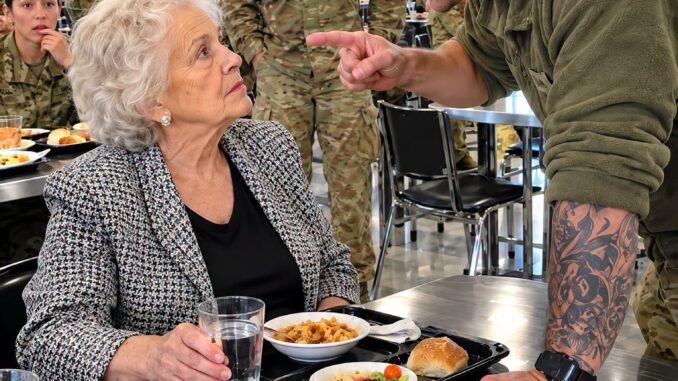
“Hey, Grandma. What was your rank back in the Stone Age?”
I didn’t look up. I’d driven forty minutes for that chili.
“I’m talking to you, ma’am.”
Three soldiers were standing beside my table. The one doing the talking looked about twenty-seven. He had broad shoulders, a strong build, and the confident expression of someone accustomed to being obeyed.
His name tape read REESE. Three chevrons and a rocker identified him as a staff sergeant.
My name is Quinn Braddock. I’m eighty-one years old. I live alone in Clarksville, Tennessee, in a yellow house with too many stairs. I spent thirty-one years working as a school nurse at Burt Elementary.
But long before that, I had served in the United States Army.
That Thursday in October, I was sitting in the dining facility at Fort Campbell, Kentucky. I wore my good gray wool coat and church shoes. Nearly everyone around me was young enough to be my grandchild.
“This is a military installation,” Sergeant Reese said. “You need a pass to be in here. Or did you just wander over from the retirement home looking for a free lunch?”
His two companions laughed.
The atmosphere in the room changed. Conversations became quieter. Forks scraped against trays, and several soldiers glanced in our direction.
I placed my spoon beside my bowl.
That seemed to irritate him even more.
He set his tray on the neighboring table and placed both hands on the table in front of me. A tattoo of an eagle covered his right forearm.
“Look at me when I’m talking to you. We have standards here. We don’t let just anybody walk in and take up space in our dining facility. So I’ll ask again. Who are you, and what are you doing on my post?”
A young private at the next table looked up. She couldn’t have been twenty. She appeared ready to say something, but when she noticed his rank, she hesitated.
I finally turned toward him.
Underneath his stern expression, he looked like a young man who had spent his life being told he was the strongest person in the room.
I studied his name tape, then the patch on his shoulder.
Finally, I noticed the small emblem above his right breast pocket.
It was a blue shield with a white heron, its wings spread wide.
I said nothing.
I simply picked up my water glass.
“What, you can’t hear?” one of the other soldiers asked.
“I asked you for identification,” Sergeant Reese said. He snapped his fingers in front of my face. “Let’s see it.”
I had a visitor’s pass. It was inside my purse, attached to a blue lanyard, with my photograph on it. I’d received it that morning at the Gate 4 visitor center.
I knew I was allowed to be there.
But I didn’t reach for it.
My late husband, Walt, used to say that my stubbornness was the eighth wonder of the world.
I hadn’t driven forty minutes to argue with a young soldier about a pass I already possessed.
I took another sip of water.
His face grew red.
“That’s it,” he said. “You’re coming with me to the gate. Stand up.”
I remained seated.
He straightened and looked me over, from my white hair to my church shoes, apparently searching for another reason to challenge me.
Then he noticed something.
On the collar of my gray coat was a small pin. The brass had darkened with age, and the blue enamel was chipped at one corner.
It was a blue shield with a white heron.
The same emblem he wore on his uniform.
Mine was simply fifty-six years older.
He stared at it.
Then he pointed toward my collar.
“Where did you get that?”
I placed my glass on the table.
“That’s my battalion’s crest,” he said. “People have sacrificed a lot for that symbol. You can’t just wear something like that because you think it looks nice. Take it off.”
“No,” I replied.
It was the first word I’d spoken to him.
“Take it off, ma’am.”
The young private at the next table stood up. I gave her a small shake of my head, and she stopped.
I looked at Sergeant Reese, then past his shoulder toward the wall above the serving line.
There were words painted across thirty feet of cinder block in large blue letters.
He had eaten beneath those words almost every day for three years.
“Sergeant,” I said calmly. “Before you make another decision, I’d like you to turn around and read what’s written on that wall.”
He stared at me.
“I know what it says.”
“Then it shouldn’t take long. Please read it aloud.”
The dining hall became completely quiet.
Slowly, Staff Sergeant Reese turned around.
He read the first line.
“We Carry Our Own.”
That was the battalion motto. Every soldier in the unit learned it during his first days of service.
“Keep going,” I said.
Beneath the motto was another line, written in smaller blue letters. Most people barely noticed it anymore.
He began reading.
“This dining facility is dedicated to First Lieutenant Quinn Hollis, Army Nurse Corps, who carried forty-one of ours home. May 1969.”
He stopped.
For several seconds, he stood completely still.
Then he slowly turned around.
“Ma’am,” he said, his voice suddenly much quieter. “What did you say your name was?”
“I didn’t,” I replied. “You never asked. You asked about my rank.”
I folded my hands on the table.
“It was first lieutenant. And my maiden name was Hollis.”
The entire dining hall seemed to hold its breath.
Sergeant Reese’s expression changed completely. His two companions stepped back, looking from the wall to the small pin on my coat.
Then a deep voice came from near the double doors.
“Staff Sergeant Reese.”
Everyone turned.
A tall man in his fifties was walking down the center aisle. His hair was gray at the temples, and his uniform identified him as the battalion’s command sergeant major.
Beside him was Lieutenant Colonel Gerald Ortiz, the battalion commander, carrying a clipboard.
They had come to meet me. We had a one o’clock appointment.
I’d simply arrived early because I wanted lunch.
Command Sergeant Major Darnell Hayes stopped beside my table.
He looked at Reese.
Then he looked at me.
And something happened that I will remember for the rest of my life.
He came to attention.
Heels together. Shoulders straight. Eyes forward.
Then he raised his hand and saluted me.
“Ma’am,” he said warmly. “Welcome home to the Herons.”
One by one, soldiers throughout the dining hall stood.
Chairs moved across the floor. Trays rattled. Conversations stopped completely.
The young private at the next table had tears in her eyes.
Sergeant Reese remained beside my chair, looking as though he couldn’t find the right words.
I slowly stood up. My knees weren’t as strong as they had been in 1969.
I returned the salute.
It wasn’t as sharp as it once had been, but I still remembered how.
“At ease, Sergeant Major,” I said. “Please, everyone sit down. Your chili is getting cold.”
Nobody moved.
Lieutenant Colonel Ortiz stepped forward and shook my hand with both of his.
“Mrs. Braddock,” he said, “I’m very sorry about what happened. We were supposed to meet you at the visitor center. You arrived before we could get there.”
I smiled.
“It’s Chili Thursday. I wasn’t going to miss it.”
Then he turned toward Sergeant Reese.
He didn’t raise his voice.
He didn’t need to.
“Staff Sergeant, my office. Thirteen-thirty. Bring your first sergeant.”
“Roger, sir,” Reese replied.
His voice cracked slightly.
He looked at me.
“Ma’am, I’m…”
“Not now, son,” I said gently. “Go on. We’ll talk later.”
He nodded and walked toward the doors with his companions.
Two hundred soldiers watched quietly as he left.
When the doors closed, Command Sergeant Major Hayes pulled out the chair beside me.
“May I join you for lunch, ma’am?”
I smiled.
“Only if you don’t take the last of the chili.”
For the first time that afternoon, the room filled with laughter.
But what happened after lunch would teach Sergeant Reese something no training manual could ever fully explain: rank deserves respect, but so does a lifetime of service.
And sometimes, the person sitting quietly at the table has a story worth hearing.
THE END.
Leave a Reply