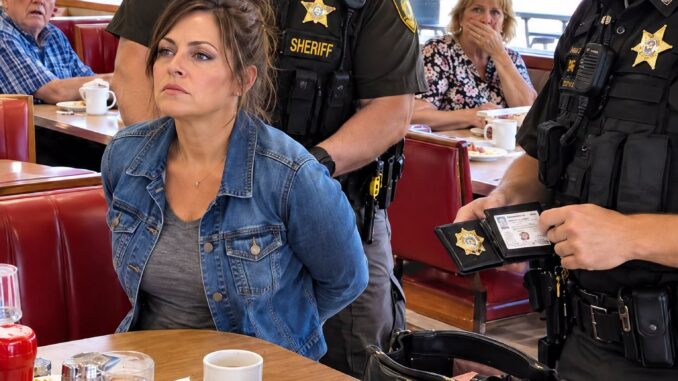
An ordinary afternoon at a small Georgia diner turned into an extraordinary confrontation when a local sheriff reportedly arrested a woman without realizing she was a federal judge. What initially appeared to be a routine law enforcement encounter quickly developed into a situation that raised serious questions about authority, accountability, and the importance of following proper legal procedures.
The woman, identified in the story as Amara Whitlock, was enjoying lunch when Sheriff Dalton Voss approached her and placed her under arrest. According to the account, the sheriff believed she matched the description of someone suspected of an armed theft.
However, the situation took an unexpected turn when a deputy examined her belongings during the booking process and discovered her official federal judicial credentials.
What happened next would reportedly change the atmosphere inside the sheriff’s office.
An Unexpected Arrest at a Local Restaurant
Amara Whitlock was having lunch at the Magnolia Diner in Halvorsen Springs, Georgia. Dressed casually in a denim jacket, she appeared to be an ordinary customer enjoying a quiet afternoon.
Her peaceful meal was interrupted when Sheriff Dalton Voss approached her and ordered her to place her hands behind her back.
Before she could fully understand what was happening, the sheriff placed handcuffs on her wrists.
He reportedly claimed that she matched the description of a suspect connected to an armed theft. He also accused her of resisting arrest, although the account states that she had remained calm throughout the encounter.
Other customers watched silently as the situation unfolded. Some appeared uncomfortable, while others were uncertain whether they should intervene.
Whitlock reportedly warned the sheriff that he was making a serious mistake. However, he continued with the arrest and escorted her outside.
At that moment, nobody inside the restaurant appeared to know her professional identity.
Why the Woman Was Visiting the County
The story later explains that Whitlock had personal connections to the area.
Her aunt, Lorraine Bishop, had lived in Pell County for many years. A retired elementary school teacher, Lorraine had become increasingly concerned about complaints involving the local sheriff’s department.
According to the narrative, residents had described several troubling experiences involving arrests, traffic stops, and interactions with deputies.
Some residents reportedly believed their complaints had not received proper attention. Others expressed concerns about possible retaliation after speaking about their experiences.
Lorraine collected letters from residents and eventually shared them with her niece.
Whitlock understood that her position as a federal judge meant she could not personally investigate allegations or become involved in matters that might later come before her court.
Instead, she reportedly forwarded the documents through appropriate channels, including the relevant federal judicial leadership and investigative authorities.
She also disclosed her family connection and indicated that she would avoid participating in any future judicial proceedings involving the matter.
Her involvement was therefore limited to ensuring that the concerns were directed to the appropriate authorities.
The Deputy Makes an Unexpected Discovery
After the arrest, Whitlock was transported to the local sheriff’s office.
During the booking process, Deputy Miller was instructed to inventory her personal belongings and locate identification documents.
While examining her purse, he discovered a black leather credential case.
When he opened it, he reportedly found an official identification card bearing the seal of the United States District Court and Whitlock’s photograph.
The document identified her as a federal district judge.
Miller immediately realized that the woman brought into the station was not an ordinary suspect.
According to the story, he read the identification several times before calling the sheriff over.
The atmosphere inside the booking area reportedly changed almost immediately.
The sheriff, who had appeared confident during the arrest, was now confronted with information that could have serious professional and legal consequences.
An Urgent Message Adds to the Tension
The situation became even more complicated when Whitlock’s government-issued phone received another message.
The notification reportedly came from Chief Judge Harold Brennan, who was attempting to contact her.
The message indicated that federal investigators were preparing to take action connected to the complaints involving the Pell County Sheriff’s Office.
It also asked Whitlock to confirm that she was safe and away from the sheriff’s department.
Deputy Miller reportedly saw the message and realized that the arrest had occurred at an especially sensitive moment.
Whitlock then reminded the sheriff of his earlier comments and questioned the circumstances surrounding her detention.
She maintained that she had not resisted arrest and requested that the handcuffs be removed.
Deputy Miller eventually unlocked them.
The story describes visible marks around her wrists, providing another reason for the incident to receive careful documentation and review.
Federal Investigators Arrive at the Sheriff’s Office
Shortly afterward, several federal agents reportedly entered the building.
Among them was Special Agent Renee Calloway, who approached Whitlock and asked whether she needed medical attention.
After checking her condition, the agent began arranging for relevant evidence to be preserved.
This reportedly included booking records, dispatch communications, available body-camera recordings, and security footage from the sheriff’s office.
Investigators also planned to obtain surveillance footage from the diner and identify people who had witnessed the arrest.
An Assistant United States Attorney named Monica Delgado was also present.
She explained that the federal team had already been preparing to visit the county because of a separate investigation involving complaints about the sheriff’s department.
The arrest had therefore occurred just as investigators were arriving to address the broader allegations.
Complaints Against the Sheriff’s Department Come Under Review
Special Agent Thomas Greer reportedly explained that his team had been reviewing complaints involving the department for several months.
The concerns described in the story included allegations of improper arrests, intimidation, and failures to investigate complaints submitted by residents.
Some individuals reportedly claimed that their concerns had disappeared from official records or had been marked as resolved without meaningful follow-up.
These were allegations requiring independent examination, not conclusions that could be established simply by collecting complaints.
Investigators would need to examine records, interview witnesses, review available evidence, and determine whether any laws had been violated.
The presence of federal investigators suggested that the concerns were being examined through formal channels.
For Sheriff Voss, the arrival of the investigative team created an uncomfortable situation.
Instead of controlling the conversation, he now had to respond to questions from people who were independently examining his department’s conduct.
Why Accountability in Law Enforcement Matters
The story highlights an important principle: law enforcement officers are responsible for following the law, regardless of their position or authority.
Police officers and sheriffs have significant responsibilities when conducting arrests, questioning individuals, and maintaining public safety.
Their decisions must be based on applicable legal standards and supported by appropriate circumstances.
When someone believes an officer has acted improperly, there should be reliable ways to submit complaints and have them reviewed.
Independent oversight, accurate documentation, and transparent investigations can help maintain public confidence in law enforcement institutions.
It is also important to remember that an allegation does not automatically establish wrongdoing. Investigations must be conducted fairly, and everyone involved should receive appropriate legal protections.
The Importance of Proper Procedures and Independent Investigations
One of the central themes of this story is the importance of following established procedures.
An arrest should not be based on assumptions, personal disagreements, or an individual’s appearance. Officers must have the legal justification required under the circumstances.
Similarly, complaints involving law enforcement personnel should be handled through appropriate investigative processes.
Independent reviews can help determine whether an officer acted within the law and whether departmental policies were followed.
Preserving evidence is particularly important because records, recordings, and witness statements can help establish what actually happened.
These safeguards protect both members of the public and officers who may be facing inaccurate allegations.
Final Thoughts
The story of Amara Whitlock and Sheriff Dalton Voss presents a dramatic account of an unexpected arrest that reportedly exposed wider concerns about accountability within a local law enforcement department.
The discovery of Whitlock’s federal judicial credentials changed the situation, while the arrival of federal investigators brought additional attention to complaints involving the sheriff’s office.
Beyond the dramatic events, the narrative raises important questions about individual rights, responsible policing, transparency, and independent oversight.
Ultimately, public trust depends on institutions applying the law fairly and ensuring that complaints are taken seriously.
Whether involving a local sheriff’s department or a larger government agency, accountability and proper procedures remain essential parts of a fair justice system.
The most important lesson is that authority comes with responsibility, and every individual deserves to be treated according to the law.
Leave a Reply