When Dana welcomed her younger sister Rachel into her home, she believed the arrangement would help everyone.
Dana was undergoing cancer treatment, their 79-year-old mother needed occasional assistance because of arthritis, and Rachel was recovering from financial difficulties.
At first, the family seemed to have found a practical solution.
But when Dana’s ten-year-old son, Noah, mentioned that his aunt was charging Grandma for everyday favors, questions began to emerge.
What started as a small disagreement eventually revealed a much larger financial problem and forced the family to reconsider the meaning of trust, responsibility, and support.
A Difficult Period for the Family
Six months into chemotherapy, Dana was struggling with fatigue and other treatment-related challenges.
Some mornings, even ordinary household tasks felt exhausting.
She tried to maintain a positive atmosphere for her son, Noah, who was ten years old.
Humor became one of their ways of coping.
Dana often described her slow progress around the house as though she were a sports commentator narrating an important competition.
Noah happily joined in.
Their playful exchanges helped make difficult days feel a little more manageable.
Meanwhile, Noah had a personal goal of his own.
He was saving money for a bicycle.
Every quarter he found went into a large glass jar in his bedroom.
He regularly counted the coins, proudly keeping track of his progress.
Despite the challenges at home, Dana tried to preserve these ordinary childhood moments.
Why Rachel Moved In
Around the same time, Dana’s younger sister Rachel experienced financial difficulties.
Her relationship had ended, and she said her former boyfriend had left her with little money.
Rachel needed somewhere to stay while rebuilding her finances.
Dana offered her the spare bedroom.
The arrangement seemed beneficial for both sisters.
Rachel would have a place to live without paying rent, and Dana would receive additional help while undergoing treatment.
Their mother lived only three houses away.
At 79, she remained independent in many ways, but arthritis in both hands sometimes made ordinary tasks uncomfortable.
Rachel volunteered to assist her.
She promised to handle errands, transportation, and other daily needs.
Dana was relieved.
For the first time in months, she felt she could concentrate more fully on her health.
The First Sign of a Problem
One afternoon, Noah approached Dana while she was resting.
He asked why Grandma had to pay Aunt Rachel for help.
Dana initially assumed he’d misunderstood a joke.
But Noah described an incident he’d witnessed.
Grandma had asked Rachel to switch off a hallway light because her hands were hurting.
According to Noah, Rachel requested ten dollars.
When Grandma explained that she didn’t have enough money, Rachel declined to help.
Grandma eventually switched off the light herself.
Dana was surprised.
She went downstairs and asked Rachel about the situation.
Rachel didn’t deny introducing a payment arrangement.
Instead, she described it as a system designed to encourage their mother to remain independent.
She argued that charging small amounts would make Grandma consider whether she truly needed assistance.
Dana wasn’t convinced.
Still, she was exhausted from treatment and hoped the situation was a misunderstanding.
She decided to observe more carefully before drawing conclusions.
A System of Charges for Everyday Tasks
A few days later, Dana found her mother struggling to move a laundry basket.
Because of her arthritis, carrying and lifting could be uncomfortable.
Dana asked why she hadn’t requested Rachel’s help.
Her mother hesitated.
Eventually, she explained that Rachel charged for different household tasks.
The amounts varied.
A glass of water could cost ten dollars.
Laundry assistance might cost twenty dollars or more.
Help with bathing could cost thirty dollars.
Dana was troubled by the arrangement.
She understood that caregiving required time and effort.
However, she believed that any financial agreement should be transparent, voluntary, and appropriate to the circumstances.
Their mother had never agreed to hire Rachel as a paid caregiver.
She also appeared uncomfortable asking for help because she worried about the cost.
That concerned Dana more than the individual amounts.
A Disagreement Between the Sisters
When Dana confronted Rachel, the conversation became tense.
Rachel maintained that the charges encouraged independence.
She also complained that caring for their mother involved more work than Dana realized.
Dana acknowledged that caregiving could be demanding.
But she reminded Rachel that the original arrangement involved providing help in exchange for rent-free accommodation.
There had been no discussion of charging their mother for routine assistance.
Rachel argued that she needed financial stability after her relationship ended.
Dana sympathized with her circumstances but questioned why their mother should carry the burden.
The conversation ended without a resolution.
Dana was physically exhausted and unable to continue arguing.
But she decided she needed a clearer understanding of what was happening.
Different Behavior Around Relatives
The following weekend, Aunt Carol visited.
Carol was the sisters’ mother’s younger sibling.
During the visit, Rachel appeared attentive and helpful.
She brought drinks, adjusted cushions, and offered assistance before anyone requested it.
Carol praised Rachel for taking care of the family during such a difficult time.
Rachel accepted the compliments.
But shortly after Carol left, Grandma asked Rachel to bring her cardigan.
Rachel reminded her about the payment arrangement.
Grandma withdrew the request.
Dana retrieved the cardigan herself.
The contrast between Rachel’s behavior during Carol’s visit and afterward made Dana increasingly uncomfortable.
She began to suspect that other relatives didn’t know about the charges.
Keeping a Record of the Charges
Dana had worked in insurance claims for twenty years.
Her professional experience had taught her the importance of comparing explanations with documented information.
She took out a notebook and began recording the incidents she knew about.
She noted dates, requested amounts, and the tasks Rachel claimed to have completed.
Noah noticed the notebook one evening.
When Dana explained what she was doing, he mentioned something else.
He had heard Rachel quote different prices for the same household task.
He also remembered an occasion when Rachel charged Grandma for a doctor’s appointment ride that Aunt Carol had actually provided.
Dana wrote down the date.
She didn’t want to make accusations without evidence.
But the inconsistencies suggested that the problem might be more serious than she’d initially believed.
A Family Birthday Celebration
Several weeks later, Dana organized a delayed birthday dinner for their mother.
She had been too unwell to arrange a gathering on the actual date, so she wanted to make the occasion special.
She prepared a roast, potatoes, and her mother’s favorite lemon pie.
She also bought yellow tulips.
Her mother had always loved yellow flowers but rarely purchased them for herself.
Relatives arrived throughout the evening.
Aunt Carol brought bread rolls.
Cousin Ben brought wine.
Uncle Mike joined them for dinner.
For a while, the gathering was relaxed.
Everyone shared stories and enjoyed spending time together.
Several relatives praised Rachel for helping Dana and their mother.
Dana remained quiet.
She didn’t want the birthday celebration to become an argument.
But Noah had noticed the same contradiction.
Noah’s Unexpected Birthday Toast
After dinner, Noah asked whether he could make a toast.
The adults smiled.
They expected a sweet birthday message from the ten-year-old.
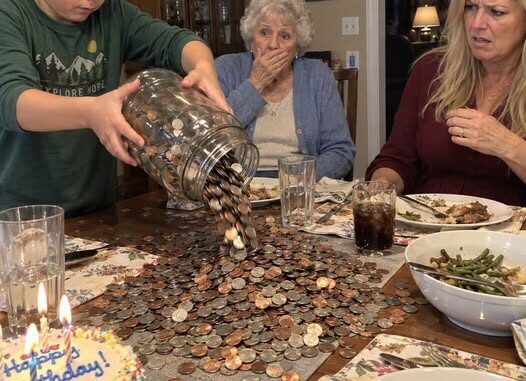
Instead, Noah brought out the large jar containing his bicycle savings.
He placed it on the table.
Then he explained that he wanted to offer Aunt Rachel money because she seemed to expect payment whenever she helped someone.
He tipped the coins onto the table.
The room became quiet.
Rachel looked uncomfortable.
Noah then took a folded paper from his pocket.
He explained that Grandma had received it the previous day and hidden it because she didn’t want Dana to become upset during treatment.
Dana asked to see the document.
At the top were the words:
CARE SERVICES — BALANCE DUE
The paper contained a list of household tasks and associated charges.
An Invoice That Raised Serious Questions
Dana reviewed the document.
It listed amounts for turning off lights, bringing water, assisting with stairs, laundry, bathing, and other everyday tasks.
At the bottom was a total balance of $3,760.
The relatives were surprised.
Rachel initially described the document as a motivational record rather than a genuine invoice.
But Grandma explained that she had already paid Rachel several hundred dollars from her pension.
She hadn’t considered the payments voluntary.
Instead, she’d felt pressured to pay when she needed assistance.
Aunt Carol questioned Rachel about the arrangement.
Other relatives began asking questions as well.
Dana realized that the family needed to understand exactly how much money had changed hands.
Discovering Additional Payments
As the conversation continued, Aunt Carol revealed that she’d sent Rachel $300.
Rachel had explained that she was spending significant amounts on their mother’s care.
Carol believed she was contributing toward necessary expenses.
Cousin Ben then said he’d sent $250 for similar reasons.
Uncle Mike had contributed another $180.
None of them had realized that Grandma was also paying Rachel directly.
Dana began comparing the information.
She reviewed the charges and asked about several dates.
One invoice listed a medical appointment ride that Carol confirmed she’d provided herself.
Another listed assistance on a day when Rachel had been away from the house.
These discrepancies raised questions about the accuracy of the records.
Rachel eventually admitted that she’d begun collecting small payments because she needed money to rebuild her finances.
She said the arrangement had gradually expanded.
Dana understood that Rachel was under financial pressure.
But she believed that accepting money under misleading circumstances had damaged the family’s trust.
A Difficult Conversation About Responsibility
Rachel explained that she’d felt embarrassed about her financial situation.
She was 38, had little savings, and was staying in her sister’s spare bedroom.
She wanted enough money for a rental deposit and reliable transportation.
Dana listened.
She didn’t dismiss the difficulties Rachel had experienced.
However, she pointed out that their mother was also financially vulnerable.
Charging her for ordinary assistance had created additional stress.
The relatives were equally concerned that they’d contributed money without receiving a clear explanation of how it would be used.
Rachel became defensive.
Eventually, she said she wanted to leave.
Dana decided not to force an immediate departure.
She allowed Rachel several days to arrange another place to stay.
But she also made it clear that the financial concerns still needed to be addressed.
Reconsidering the Meaning of Help
Over the next few days, the family occasionally used humor to illustrate how uncomfortable Rachel’s payment system had been.
When Rachel asked for small favors, relatives jokingly mentioned fees.
The exchanges weren’t intended as genuine financial demands.
They were meant to show how unusual it felt to have ordinary family assistance treated as a transaction.
Rachel quickly became frustrated.
She argued that helping others required effort and that people should recognize its value.
Grandma agreed with part of that statement.
Caregiving did involve time, energy, and responsibility.
But she explained that appreciation and fair compensation should be based on honest discussions, not unexpected charges imposed on someone who needed assistance.
Her words helped clarify the issue.
The family wasn’t suggesting that caregiving should always be unpaid.
They were questioning the lack of consent, transparency, and accurate accounting.
Reviewing the Financial Records
That evening, Dana gathered the available documentation.
She reviewed the notes she’d made, the invoices Grandma had kept, and the electronic transfers relatives could verify.
Aunt Carol, Ben, and Mike provided screenshots of their payments.
Dana compared the dates against appointments, transportation arrangements, and other information.
She separated documented payments from amounts that appeared only on Rachel’s invoices.
After reviewing the available records, Dana calculated that $1,940 had been transferred or paid under circumstances the family disputed.
The amount included contributions from relatives and payments made by Grandma.
Dana knew there might have been additional cash payments that couldn’t be verified.
Rather than estimate those amounts, she decided to focus on the documented total.
She wanted the discussion to be based on evidence rather than assumptions.
A Final Family Meeting
At the end of the week, Rachel prepared to move out.
Several relatives gathered at Dana’s home.
Before Rachel left, Grandma presented a document of her own.
It resembled Rachel’s invoices but listed the household support Rachel had received while staying with Dana.
There were entries for accommodation, electricity, meals, transportation, and other everyday expenses.
Rachel objected.
She pointed out that the family had never agreed to charge her for those services.
Grandma explained that the document wasn’t a genuine bill.
It was intended to illustrate the same concern.
Rachel had benefited from family support without expecting to pay for every individual favor.
Grandma wanted her to recognize how the payment system had affected someone else.
Then Dana presented the separate record of documented payments.
An Agreement to Repay the Money
Dana explained that the family’s actual financial concerns were different from the symbolic invoice.
The documented amount was $1,940.
She showed Rachel the records used to calculate it.
The family asked her to repay the money.
Rachel initially said she couldn’t afford to return the full amount.
Dana suggested a gradual repayment arrangement.
She explained that even small, consistent payments would help restore the money to the people who had contributed it.
The relatives agreed to keep records of any repayments.
Rachel eventually accepted the arrangement.
She began by returning a small amount and promised to continue paying as her finances improved.
The conversation didn’t repair the emotional damage immediately.
But it established a practical way to address the financial issue.
What Happened After Rachel Moved Out
Rachel moved into separate accommodation.
Over the following months, she made payments toward the agreed amount.
Aunt Carol helped track the remaining balance and reminded the family when payments were received.
Eventually, the documented amount was repaid.
However, not every dollar Grandma believed she’d paid could be recovered.
Some transactions had been made in cash without records.
Grandma decided not to pursue amounts she couldn’t establish.
She was relieved that the payment system had ended.
Dana also recognized that rebuilding trust would take longer than resolving the financial balance.
She and Rachel remained distant.
Their relationship had been affected by the discovery, and neither was ready to pretend everything had returned to normal.
Changes in Dana’s Health and Family Life
As winter approached, Dana received encouraging results from her medical appointments.
Her scans showed improvement.
Recovery was still gradual, and she continued needing help with everyday tasks.
However, she was beginning to regain some strength.
The experience with Rachel had also changed the way she thought about receiving assistance.
She realized that needing help didn’t mean surrendering independence.
It was possible to accept support while maintaining boundaries and making decisions about one’s own care.
Her mother reached a similar understanding.
Despite her arthritis, she remained involved in family decisions and continued doing the activities she enjoyed.
When she needed assistance, she no longer hesitated to ask.
A Familiar Joke Returns
One afternoon, Grandma was sitting in her favorite chair when she asked someone to switch off a light.
Her hands were stiff, and she didn’t want to get up.
Dana immediately offered to help.
But Noah reached the switch first.
He turned off the light, looked back at the family, and jokingly held out his hand.
He asked whether anyone had ten dollars.
Everyone laughed.
The joke had a different meaning now.
It reminded them of an uncomfortable period, but also of how the family had worked together to address it.
Noah continued saving for his bicycle.
Grandma continued asking for help when she needed it.
And Dana continued recovering, grateful that their home had become a place where ordinary acts of kindness no longer came with unexpected charges.
What This Story Says About Family Caregiving
Family caregiving can involve significant time, emotional energy, and financial responsibility.
In some situations, paid caregiving arrangements between relatives are appropriate.
However, those arrangements work best when expectations are discussed openly.
Important details include which services will be provided, whether payment is expected, how costs will be calculated, and who has agreed to the terms.
Older adults should be able to make informed decisions about their finances without feeling pressured.
Family members who provide care should also have opportunities to discuss their own needs and limitations.
Clear communication can prevent misunderstandings and protect relationships.
In Dana’s family, the central problem wasn’t simply that Rachel wanted compensation.
It was that she introduced charges without a clear agreement and accepted money based on explanations that didn’t match the family’s records.
Final Thoughts
Dana welcomed Rachel into her home during a difficult period because she trusted her sister and believed they could support one another.
When Noah noticed that Grandma was being charged for everyday assistance, the family began asking questions.
The resulting investigation revealed inconsistent invoices, payments from relatives, and financial arrangements that hadn’t been openly discussed.
Although Rachel eventually repaid the documented amount, rebuilding trust remained a separate challenge.
The experience highlights the importance of transparency, consent, and respect when money becomes part of a family caregiving arrangement.
Helping someone doesn’t always have to be free, but financial expectations should be fair, clearly communicated, and understood by everyone involved.
For Dana, her mother, and Noah, the experience ultimately reinforced a simple principle: family support should make people feel more secure, not afraid to ask for help.
Leave a Reply