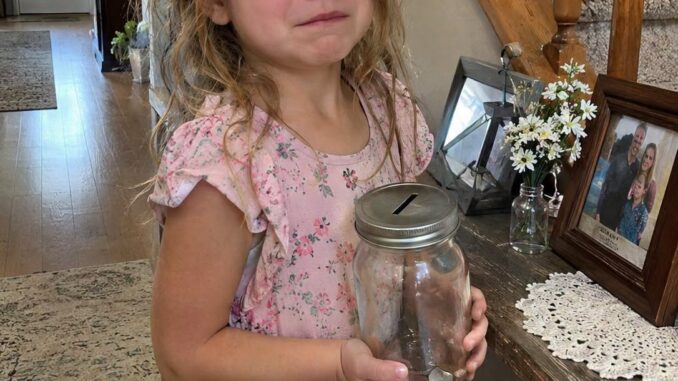
My six-year-old daughter had spent four months saving for her dream bicycle.
Every coin mattered to her.
She counted her money each evening, carefully recorded the total, and proudly watched her savings grow.
By May, she had collected $87.40—more than enough to qualify for the promise my husband and I had made.
We were going to match her savings and help her buy the purple bicycle she’d been dreaming about.
But just days before our planned shopping trip, two visiting cousins emptied her savings jar.
When I called their mother, my sister-in-law Piper, I expected her to help us resolve the situation.
Instead, she laughed.
“It’s just money, Caroline. Family should learn to share.”
What happened afterward changed how our entire family understood that word.
The Bicycle Elsie Wanted More Than Anything
My name is Caroline Ellis. I’m thirty-four, married to Matt, and we live in Lee’s Summit, Missouri.
Matt works as a pharmacist, and I work in medical billing, partly from home.
Our daughter, Elsie, is six.
She’s thoughtful, observant, and unusually careful with her belongings.
She organizes her stuffed animals before bedtime, remembers little details from conversations, and takes promises seriously.
One afternoon in January, we were shopping at Target when she spotted a bicycle.
It was purple, with white tires, a white basket decorated with daisies, and colorful streamers hanging from the handlebars.
Elsie stopped in front of it.
“Mommy, that’s the one I want.”
I checked the price.
It was $159.
I explained that it was a significant purchase.
Elsie considered this.
“How can I save enough?” she asked.
That evening, Matt and I discussed an idea.
Rather than buying the bicycle immediately, we could help Elsie learn about saving toward something important.
We decided to match whatever she saved, dollar for dollar.
If she collected approximately eighty dollars, we’d contribute the remaining amount.
When we explained the plan, Elsie was delighted.
She immediately began looking for a place to keep her money.
A Pink Jar With a Special Purpose
Elsie chose an empty pink plastic snack jar.
She washed it, removed the label, and decorated it with unicorn and rainbow stickers.
She even added a little taco sticker for good luck.
Then she taped a handwritten sign to the front.
BIKE MUNY.
She placed the jar in the center of her dresser.
From that day forward, nearly every coin she received went into it.
She earned a dollar each week for helping set the table and feeding our cat, Biscuit.
When she lost a tooth, she added her tooth-fairy money.
She saved the twenty dollars Grandma Linda gave her for her birthday.
She even put a quarter she discovered between the couch cushions into the jar.
One warm Saturday in April, she set up a lemonade stand.
Our neighbor, Mr. Kowalski, bought several cups and enthusiastically praised her lemonade.
Elsie earned $11.50 that afternoon.
Every dollar went into her savings.
Each night, she sat on her bedroom floor, separated the coins into little piles, and counted everything aloud.
She recorded the total in a notebook.
By the middle of May, she had saved $87.40.
She counted it three times to be certain.
Then she drew a large star beside the total.
“Mommy,” she said proudly, “I did it!”
I hugged her.
“You certainly did.”
We agreed to buy the bicycle that Saturday.
Elsie wanted to carry her jar into the store and hand over her contribution herself.
She was so excited that she started counting down the days.
Unfortunately, our plans changed that Tuesday.
An Unexpected Family Visit
Matt’s older sister, Piper, lived nearby with her husband, Craig, and their two sons.
Tucker was ten, and Brody was eight.
Piper was outgoing and entertaining, but we often disagreed about how her boys behaved during visits.
They had a habit of taking Elsie’s belongings without asking.
Once, Brody brought her toy camper home.
Another time, Tucker refused to return her tablet until Matt intervened.
After Halloween, the boys helped themselves to much of her candy.
Whenever I raised a concern, Piper usually dismissed it.
“They’re just kids,” she’d say.
Matt rarely argued with his sister.
I knew he disliked the situation, but he seemed reluctant to confront her.
I didn’t understand why until later.
On Tuesday afternoon, while I was working from home, Piper arrived unexpectedly with both boys.
She explained that school was closed for a teacher workday and thought the children could spend time together.
Before I could explain that I was busy, the boys had already hurried upstairs.
Piper settled into the living room while I returned to my laptop.
I could hear the children playing.
There was running, laughter, and occasional noise from Elsie’s bedroom.
At one point, something fell.
Piper called upstairs for the boys to be careful but didn’t investigate.
A little after three-thirty, she announced that they needed to leave.
The boys came downstairs quickly.
Tucker had his hands tucked into his sweatshirt pocket.
Brody seemed unusually amused.
I didn’t think much of it.
A few minutes later, they were gone.
Then Elsie appeared in the kitchen.
The Empty Savings Jar
My daughter walked toward me slowly.
She was holding her stuffed bunny, Mr. Buttons.
Her eyes were wet, and she looked as though she was struggling to speak.
“Sweetheart, what’s wrong?” I asked.
She looked up.
“They took my bike money.”
I immediately went upstairs.
Her room was untidy.
Several toys were scattered across the floor, and her bookshelf had tipped over.
On the dresser sat the pink savings jar.
Its lid was open.
There was nothing inside.
The notebook remained beside it.
On the last page, Elsie had written:
$87.40
A large star was drawn next to the amount.
I went back downstairs and sat beside her.
She explained that Tucker had opened the jar and poured out the money.
Both boys had put the bills and coins into their pockets.
When she asked for her savings back, they refused.
During the disagreement, Tucker pushed her, and she bumped against the bookshelf.
There was a mark on her elbow.
Elsie said she’d wanted to tell an adult, but Tucker had warned her that he would damage her favorite stuffed bunny if she did.
She’d been frightened and waited until they left.
I held her close.
Then she asked the question I knew was coming.
“Can I still get my bicycle on Saturday?”
I promised her that Matt and I would make sure the situation was resolved.
A Phone Call That Made Things Worse
I called Piper.
When she answered, I explained what Elsie had told me.
I asked her to speak with the boys and arrange for the money to be returned.
Piper laughed lightly.
“Oh, Caroline. It’s just money.”
I reminded her that Elsie had been saving since January.
She had worked hard, given up small treats, and carefully collected every dollar.
Piper didn’t seem concerned.
“Maybe she needs to learn how to share,” she replied.
I explained that sharing meant offering something willingly.
Elsie hadn’t agreed to give away her savings.
I also told Piper about the bookshelf and the mark on Elsie’s elbow.
Piper brushed aside my concerns.
Then she mentioned that the boys wanted to buy Pokémon cards at the mall.
I was stunned.
“You’re planning to let them spend Elsie’s bicycle money?”
Piper suggested that the money now belonged to the boys because they’d taken it.
She repeated that family members should share.
I realized we weren’t going to resolve anything over the phone.
Instead of continuing the argument, I ended the conversation.
But I knew we needed to address the larger problem.
Matt Reveals Something From His Childhood
When Matt returned home that evening, Elsie had fallen asleep beside me on the couch.
She was still holding her empty jar.
Matt noticed it immediately.
“What happened?”
I told him everything.
He listened quietly.
When I finished, he sat down across from us.
Then he said something unexpected.
“Piper did something like this to me.”
I looked at him.
“What do you mean?”
He began telling me a story I’d never heard.
When Matt was seven, he’d wanted a red Huffy bicycle with a banana seat.
His father had promised to pay half if Matt saved the other half.
So Matt worked toward his goal.
He helped a neighbor with yard work.
He collected recyclable cans.
He saved his small earnings in an old coffee can beneath his bed.
Eventually, he had $19.80.
He was only twenty cents away from his target.
Then, one afternoon, he returned home to discover that the can was empty.
Piper, who was eleven at the time, had taken the money to buy a yellow Sony Walkman.
Matt told their mother.
But instead of making Piper return the money, she told him that his sister needed it more.
“Family shares,” she said.
Matt was devastated.
Later that year, his father lost his job, and the family couldn’t afford the bicycle.
Matt never received it.
He told me that when he’d purchased a mountain bike as an adult, he’d finally fulfilled a childhood wish.
Suddenly, I understood why teaching Elsie to save had meant so much to him.
He wanted her to experience the satisfaction of earning something herself.
And now his daughter had experienced something painfully similar.
Deciding What to Do
Matt suggested replacing the money immediately.
We could afford to do that.
But I worried that simply replacing it wouldn’t teach the cousins why their behavior was wrong.
Elsie needed her savings restored.
She also deserved an apology and reassurance that her belongings would be respected.
Matt agreed.
We discussed the situation and decided to address it at the next family dinner.
Every Sunday, we gathered at Matt’s parents’ house in Independence.
His mother, Linda, prepared a large meal, and the extended family spent the evening together.
Piper and her boys usually attended.
I wanted the adults to understand what had happened, especially because Piper continued describing the incident as sharing.
I came up with a way to illustrate the difference.
The Sharing Jar
Before Sunday, I purchased a large glass jar.
I decorated it with pink ribbon and glittery letters.
Across the front, I wrote:
THE SHARING JAR.
Then I gathered several belongings that Piper had given us over the years.
There was a blue sweater she’d bought me for Christmas.
A red stand mixer she’d given us as a wedding present.
A framed graduation photograph.
And a novelty mug she’d left at our house.
I packed them into a box.
On top, I placed Elsie’s empty pink savings jar.
I wasn’t planning to take anyone else’s property.
The gifts already belonged to us.
I wanted to demonstrate what genuine sharing looked like when someone willingly offered their own possessions.
I also contacted Craig.
He deserved to know what had happened.
When I explained the missing savings, the boys’ behavior, and Piper’s response, he became quiet.
Then he told me something important.
The boys had recently come home from the mall with Pokémon cards and a new toy.
Piper had told Craig she’d used her own savings to pay for them.
He’d been concerned because their household was trying to limit unnecessary spending.
Now he wondered whether some of Elsie’s money had been used.
Craig said he would attend Sunday dinner and help resolve the situation.
A Family Dinner Nobody Expected
On Sunday, we arrived at Linda and Ron’s house.
Elsie stayed close to me.
She’d been unusually quiet since the incident.
Piper arrived later with Craig and the boys.
Tucker carried his new toy, and Brody brought his Pokémon cards.
Elsie noticed them.
I gently guided her toward the kitchen.
During dinner, everyone chatted as usual.
Then Brody proudly showed Grandpa Ron one of his cards.
The conversation turned to how many packs the boys had purchased.
Piper said she’d wanted to treat them.
I glanced at Matt.
He nodded.
It was time to explain what had happened.
I stood and brought the cardboard box into the dining room.
“I brought something to share with everyone,” I said.
I placed the decorated glass jar on the table.
Piper looked curious.
I explained that our recent conversation had made me think about what sharing really meant.
Then I showed the family the sweater, mixer, photograph, and mug.
“These are things Piper gave us,” I said. “They’re ours now, so we can choose whether to share them.”
I paused.
“But there’s something else we need to discuss.”
I lifted Elsie’s pink jar from the box.
Everyone became quiet.
What the Family Learned
I explained how Elsie had saved for months.
I told them about her weekly allowance, birthday money, tooth-fairy money, and lemonade stand.
I showed them the notebook where she’d recorded each total.
Then I explained that Tucker and Brody had emptied the jar during their visit.
I told the family that Elsie had asked for her savings back and had been frightened when the disagreement escalated.
Linda looked toward her granddaughter.
Craig remained quiet.
Piper appeared uncomfortable.
I explained that when I’d asked for help, Piper had described the incident as sharing.
Then I pointed toward the glass jar.
“Sharing is when someone chooses to give something,” I said. “Taking something without permission is different.”
I asked the boys how they would feel if someone took their Pokémon cards without asking.
Before either answered, Piper objected.
“Those belong to them.”
Craig looked at her.
“Exactly,” he said.
Then he asked where the money for their purchases had come from.
Piper didn’t answer immediately.
The room grew quiet.
Tucker Tells the Truth
Grandpa Ron gently asked Tucker whether he and Brody had taken Elsie’s savings.
Tucker looked toward his mother.
Then he admitted that they had.
He explained that Piper had suggested Elsie had plenty of money and that taking some wouldn’t matter.
He also acknowledged that he’d pushed Elsie and warned her not to tell anyone.
Tucker began crying.
“I’m sorry,” he told his cousin.
Brody looked upset too.
He offered Elsie one of his favorite Pokémon cards.
She looked at it for a moment.
Then she shook her head.
“I don’t want a card,” she said softly. “I wanted my bicycle.”
Nobody argued with her.
The adults finally understood that the issue wasn’t simply the amount of money.
It was the time, effort, and trust behind it.
Grandma Linda Remembers the Past
Linda looked toward Piper.
“Did you really tell the boys they could take the money?”
Piper tried to explain.
She said Caroline and Matt could afford to replace it.
She said the boys had been disappointed about not getting new things.
And she repeated the phrase she’d heard growing up.
“Family shares.”
Linda became very quiet.
Then she looked at Matt.
“The Walkman,” she said.
Matt nodded.
His mother remembered the old incident.
She remembered Piper taking the money from his coffee can.
She remembered telling him that his sister needed it more.
And she remembered allowing Piper to keep what she’d purchased.
For years, she’d thought of it as a minor childhood disagreement.
Now she understood how much it had affected him.
Matt told her that he’d never received the bicycle he’d saved for.
Linda looked deeply regretful.
“I should have handled that differently,” she said.
Then she apologized.
Matt accepted her words quietly.
The conversation was difficult, but it was the first time the family had openly acknowledged the pattern.
Restoring Elsie’s Savings
Piper left the dinner early.
Craig stayed with the boys.
After everyone had calmed down, he took out his wallet and counted $87.40.
He placed the money in front of Elsie.
“This belongs to you,” he told her. “I’m sorry about what happened.”
Elsie studied the money.
Then she surprised us.
She gently pushed it back.
“That’s your money, Uncle Craig,” she said.
He looked confused.
“I want to make sure you get your savings back.”
Elsie thought for a moment.
“But Tucker and Brody spent mine.”
Craig asked what she thought would make things right.
She looked at her cousins.
“I want them to earn it back,” she said. “Like I did.”
The adults considered her suggestion.
We agreed that the boys could complete safe, age-appropriate chores with supervision and earn money toward replacing what they’d taken.
Craig would remain responsible for ensuring Elsie was repaid.
We also agreed that the children should have opportunities to talk, apologize, and rebuild trust.
Three Saturdays of Work
The following Saturday, Craig brought Tucker and Brody to our house.
Matt and I had prepared a list of household tasks.
The boys could help pull weeds, wash the car, fold laundry, sweep the garage, and complete other suitable chores.
Each task had a small payment attached.
We explained the arrangement clearly.
Whenever they finished a job properly, they’d earn money toward restoring Elsie’s savings.
Elsie would help check the completed work.
Tucker began pulling weeds.
Brody washed the car.
They folded laundry, cleaned cabinets, and helped with other household jobs.
Matt supervised the outdoor tasks.
At the end of the first Saturday, they’d earned $31.50.
They placed the money in Elsie’s pink jar.
She counted it carefully.
The next Saturday, they returned.
And the Saturday after that.
By the third visit, their attitudes had changed.
Instead of complaining about the chores, they began choosing which tasks they wanted to complete.
Tucker brought work gloves.
Brody started checking his own work before asking Elsie to inspect it.
During one afternoon, Tucker asked Matt about the bicycle he’d wanted as a child.
Matt explained how he’d saved for it but never had the opportunity to buy it.
Tucker listened.
Then he admitted that he hadn’t understood how much Elsie’s savings meant to her.
Matt told him that making a mistake didn’t have to define him.
What mattered was recognizing it and choosing to behave differently.
The Jar Is Full Again
On the third Saturday, Brody placed another dollar into the pink jar.
Elsie sat on the kitchen floor and counted everything.
She separated the bills and coins into neat piles.
Then she looked up.
“Eighty-seven dollars and forty cents!”
Tucker and Brody exchanged relieved smiles.
They’d reached the goal.
Brody sat beside Elsie.
“That was a lot of work,” he said.
Elsie nodded.
“It took me four months.”
Brody considered this.
“We’re older than you, and it took us three Saturdays.”
Then he asked how she’d managed to keep saving for so long.
Elsie smiled.
“I really wanted that bicycle.”
It was a simple answer.
But the boys seemed to understand it.
The Bicycle Finally Comes Home
That evening, we went to Target.
Matt, Elsie, and I were joined by Craig, Tucker, and Brody.
Elsie had asked for her cousins to come.
“They helped earn it back,” she explained. “I want them to see.”
The purple bicycle was still on display.
White tires.
A basket with daisies.
Purple and silver streamers.
Elsie stood in front of it, smiling.
Then she held up her savings jar.
“Can I carry it to the cashier myself?”
“Of course,” I said.
Matt brought the bicycle to the checkout.
Elsie placed her jar on the counter and proudly explained that she’d saved toward the purchase.
She also mentioned that her cousins had helped replace some money that had gone missing.
The cashier patiently counted her contribution.
Matt paid the remaining balance.
Then Elsie took hold of her new bicycle.
She looked happier than I’d seen her in weeks.
But there was one more surprise.
A Small Gift From Tucker
Near the checkout, Tucker noticed a display of bicycle accessories.
He picked up a small silver bell decorated with a purple flower.
It cost $2.99.
He reached into his pocket and took out three dollars.
He explained that he’d earned the money by completing a few extra recycling chores.
He’d saved it separately.
Then he purchased the bell and handed it to Elsie.
“For your bicycle,” he said.
Elsie accepted it.
“Thank you.”
Tucker hesitated.
“I’m sorry I pushed you.”
She looked at him.
“I know.”
“I wanted to say it again.”
Elsie nodded.
“Okay.”
It was a small exchange.
But it felt like the beginning of something better between them.
Piper Begins to Make Changes
Piper didn’t attend the next several Sunday dinners.
Craig continued bringing the boys, and the rest of the family gradually returned to its usual routine.
Several weeks later, Piper came back.
She was quieter than usual.
She asked whether she could speak privately with Matt and me.
We stepped onto the back porch.
Piper carried a shoebox.
She explained that she and Craig had started attending counseling.
During their conversations, she’d begun examining the way she understood money, fairness, and family obligations.
She’d also thought about the incident from Matt’s childhood.
For years, she’d treated the story about his missing savings as a funny family memory.
Now she realized she’d never considered how it felt from his perspective.
“I was wrong,” she said.
Then she opened the shoebox.
Inside was an old yellow Sony Sports Walkman.
An Apology Thirty Years Later
Piper had found the Walkman among her childhood belongings.
It was scratched and no longer worked.
But she had kept it all those years.
She held it out to Matt.
“This should have been yours,” she said.
Matt took it carefully.
He turned it over in his hands.
For a moment, he seemed to be remembering the seven-year-old boy who had saved $19.80 in a coffee can.
Piper apologized.
Not only for taking the money years earlier, but also for encouraging her sons to repeat the same behavior.
Matt listened.
Then Piper turned toward me.
She handed me an envelope for Elsie.
Inside was a check for $87.40 and a handwritten note.
In it, Piper apologized for calling Elsie selfish.
She acknowledged that Elsie had worked hard for her bicycle and deserved to have her savings respected.
Piper also explained that she’d taken a part-time job at a greeting-card store.
She wanted to repay Elsie with money she’d earned herself.
It didn’t erase what had happened.
But it showed that she was beginning to take responsibility.
Elsie’s New Savings Goal
When we gave Elsie the envelope, she read the note carefully.
She asked whether Aunt Piper had really earned the money.
I told her she had.
Elsie thought about it.
Then she accepted the check.
But she didn’t put the money into her original bicycle jar.
Instead, she brought out the large glass jar I’d decorated for Sunday dinner.
She removed the glittery letters that spelled “THE SHARING JAR.”
Then she made a new sign with her purple marker.
DADDYS BIKE.
I looked at her curiously.
“Daddy already has a bicycle, sweetheart.”
She nodded.
“I know. But not the red one he wanted when he was little.”
She explained that Grandma Linda had told her more about Matt’s childhood bicycle.
Elsie wanted to find one for him.
For his birthday.
I was deeply touched.
The bicycle had become more than a childhood wish.
It represented a memory that had stayed with Matt for years.
And now Elsie wanted to do something kind for him.
A Family Project
Over the following months, Elsie continued saving.
She added her allowance.
She organized another lemonade stand.
She collected small amounts whenever she could.
Then Tucker and Brody asked if they could contribute.
They wanted to help buy their uncle the bicycle he’d never received.
Craig contributed too.
So did Grandpa Ron.
Grandma Linda decided to help in a different way.
She began searching local shops, secondhand stores, and bicycle restorers.
Eventually, she found someone who could restore an old red Huffy with a banana seat.
The bicycle was repaired and repainted.
It had fresh tires, a new chain, and colorful streamers.
The family kept the project a secret from Matt.
By October, everything was ready.
A Birthday Surprise
Matt’s birthday was October 14.
At the family gathering, Elsie asked everyone to come outside.
In the front yard stood a red Huffy bicycle.
It had a banana seat, silver and white streamers, and a small silver bell with a purple flower.
Matt stopped on the porch.
He stared at it.
For a moment, he didn’t speak.
Elsie took his hand and led him across the lawn.
“Happy birthday, Daddy.”
He knelt beside the bicycle.
He touched the seat.
Then he gently rang the bell.
Ding.
His eyes filled with tears.
Elsie wrapped her arms around his neck.
The rest of us stood quietly nearby.
Piper was there too.
She watched her brother with tears in her eyes.
Then Linda stepped forward.
She placed a hand on Matt’s shoulder.
“I’m sorry, Matthew,” she said. “I should have helped you get your savings back all those years ago.”
Matt looked up and nodded.
No one could change what had happened decades earlier.
But that afternoon, the family was finally acknowledging it with care and understanding.
Three Bicycles in the Garage
The restored Huffy now stands in our garage.
It’s much too small for Matt to ride comfortably.
He tried once, just to make Elsie laugh, and quickly discovered that an adult doesn’t fit very well on a child’s bicycle.
So he keeps it as a treasured reminder.
Beside it stands Elsie’s purple bicycle.
And next to that is Matt’s gray mountain bike.
Three bicycles.
Three different stories.
On weekends, Matt and Elsie often ride around our neighborhood together.
Sometimes Tucker and Brody join them.
Elsie rides along happily, ringing the little bell Tucker bought her.
The cousins have become more considerate of one another.
Our family still has disagreements, of course.
But we’ve become more willing to talk about them and take responsibility when someone gets hurt.
The Meaning of Sharing
Elsie still keeps her pink savings jar on her dresser.
One evening, I noticed she’d replaced the old sign.
The words “BIKE MUNY” were gone.
In their place, she’d written something new.
FOR GIVING.
I asked what she was saving for this time.
She explained that she wanted to keep money available in case someone needed help.
I smiled.
“Like sharing?”
Elsie thought carefully before answering.
Then she said something I’ll never forget.
“Sharing is when you choose.”
She returned to counting her coins.
I stood in the doorway, looking at the little pink jar with its unicorns, rainbows, and lucky taco sticker.
Four months of saving had taught Elsie patience.
Losing her savings had taught our family the importance of boundaries.
Earning the money back had helped her cousins understand responsibility.
And choosing to give had shown us the difference between generosity and obligation.
In the end, it wasn’t just about a bicycle.
It was about learning that kindness should never require someone to give up their right to say no.
And that the most meaningful gifts are the ones we choose to offer.
The End
Leave a Reply