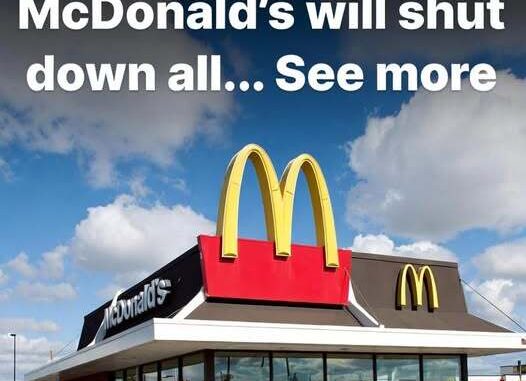
Recent online conversations have sparked confusion about whether McDonald’s is closing locations across the United States. The reality is far less dramatic: the company is not shutting down nationwide. Instead, it is continuously adjusting its network—closing some restaurants while opening or upgrading others.
This kind of movement is a normal part of how large businesses operate, especially one with thousands of locations across diverse markets.
 Why Some McDonald’s Locations Close
Closures can happen for several practical reasons, and they are usually local decisions, not part of a national trend.
 1. Rising Costs and Lease Changes
In cities and high-demand areas, rent and property costs can increase significantly. When operating expenses outweigh profits, companies may choose to relocate or close a specific store.
 2. Urban Development
Neighborhoods evolve. Buildings get redeveloped, and land use changes. Some older restaurants close simply because the space is being repurposed.
 3. Shifts in Customer Traffic
Changes in commuting patterns, population density, or nearby businesses can affect how many customers visit a location.
 4. Store Modernization Strategy
Sometimes closures happen because:
- A newer location is opening nearby
- An older building no longer meets modern standards
- The company wants to consolidate operations
 Where Closures Have Happened
While no region is seeing a full withdrawal, individual closures have been reported in different parts of the U.S.:
Northeast (e.g., New Jersey & New York)
- Some older locations have closed due to high rent and redevelopment
- Especially common in dense areas like Manhattan
West Coast (e.g., Los Angeles & San Francisco Bay Area)
- High operating costs and changing urban patterns
- Some closures followed by new or upgraded restaurants
Southern States (e.g., Texas & Florida)
- Occasional closures tied to restructuring or relocation
- Still strong markets with ongoing expansion
Why New Locations Keep Opening
Even as some stores close, McDonald’s continues to invest heavily in new and improved restaurants.
Modern locations often include:
- Self-order kiosks
- Updated dining areas
- Faster drive-thru systems
- Digital ordering integration
This reflects a broader shift toward efficiency, convenience, and technology.
 The Bigger Picture: Not a Decline, But an Evolution
It’s important to understand that:
- McDonald’s still operates thousands of locations nationwide
- The brand remains one of the most accessible in the U.S.
- Closures are strategic adjustments, not signs of failure
Large companies regularly review performance and adapt to:
- Changing consumer habits
- Economic conditions
- Technological trends
 Why It Feels Like “Many Closures”
Online discussions can make localized changes seem bigger than they are
This happens because:
- People notice closures in their area
- Social media amplifies isolated events
- Context is often missing
 A few closures in visible locations can create the impression of a larger trend, even when the overall network remains strong.
 Final Thoughts
McDonald’s is not disappearing—it’s evolving.
Some locations close due to:
- Cost pressures
- Urban changes
- Strategic repositioning
At the same time, new and improved restaurants continue to open, ensuring the brand stays relevant in a changing market.
In short: Closures are local and selective Openings and upgrades continue The brand remains widely available across the U.S.
Leave a Reply