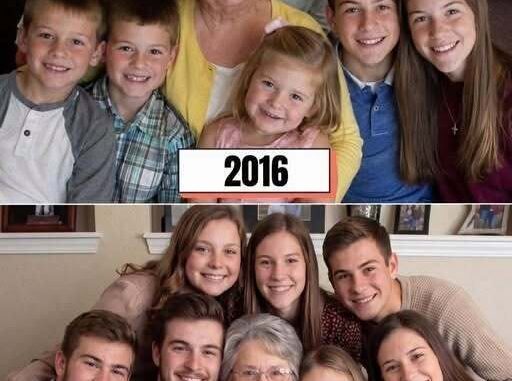
An original fictional family drama.
The morning my son came home from the dead, I was making pancakes.
The kitchen was crowded, as it always was. Someone had left a schoolbag in the doorway. Two of my grandchildren were arguing over the last clean blue plate. The youngest, Sophie, was sitting at the table with a cardboard box in her lap.
Then the doorbell rang.
I wiped my hands on a dish towel and opened the front door.
My son, Daniel, stood on the porch.
Beside him was his wife, Laura.
For ten years, I had believed they were dead.
I gripped the doorframe so hard that my fingers hurt. Behind me, a pancake began to burn.
“Mom,” Daniel said.
I stared at him. His hair was thinner. There were lines around his eyes that hadn’t been there before. But it was him. I knew the shape of his face as surely as I knew my own.
Laura looked past me into the house.
“Are the kids here?” she asked.
I couldn’t answer.
Ten years earlier, seven children had arrived at my door with two small suitcases, a grocery bag of clothes, and the news that their parents were gone. Now those same parents were standing in front of me, alive.
And the box in Sophie’s lap had already told me why.
The Day Everything Changed
I was sixty-two when I became the guardian of my seven grandchildren.
Daniel was my only son. He and Laura had children ranging in age from two to fourteen. Their house was always noisy, their bills always seemed to be late, and they often asked me to watch the children while they sorted out one problem or another.
Then came the phone call.
Daniel told me he and Laura had to travel out of state for a few days. He sounded strained, but he insisted everything would be fine. He asked whether the children could stay with me until they returned.
“Just a little while, Mom,” he said.
I agreed. Of course I did.
Three days later, a man who said he was handling their affairs called to tell me there had been an accident. Daniel and Laura, he said, were presumed dead.
I asked where they were. I asked what had happened. I asked when I could see them.
The answers were vague. I was told there would be paperwork and that someone would contact me.
No one ever gave me a clear explanation.
I spent weeks making calls while seven frightened children waited for their parents to come through the door. Eventually, with legal help, I secured guardianship and began the exhausting work of creating a stable home for them.
I told myself I would find out the full truth someday.
But the children needed breakfast, clean clothes, school supplies, and someone who could get through the day without falling apart.
So I kept going.
Seven Children, One Grandmother
People sometimes speak about raising children as though love alone can pay the bills.
Love helped. It got me out of bed after nights when I had barely slept. It gave me the patience to sit beside a child who had cried herself sick. It kept me from giving up when I felt too old and too tired to do another load of laundry.
But love didn’t pay for shoes.
It didn’t fix the furnace.
It didn’t cover seven sets of school expenses or make groceries cheaper.
I returned to part-time work at a bakery, took in sewing jobs, and learned how to stretch a pot of soup across two dinners. I canceled the small trips I had planned for retirement. I sold the second car. When the washing machine broke, I washed clothes by hand until I could afford a used replacement.
My oldest grandson, Michael, tried to become the man of the house at fourteen.
I had to remind him that he was still a child.
“You can help me,” I told him, “but you don’t have to replace your father.”
He nodded, though I could see how badly he wanted to make things easier for me.
The younger children had different ways of grieving. Emma grew quiet. Noah became angry. The twins, Lily and Grace, refused to sleep in separate beds for nearly a year. Ben kept asking when his mother would call.
Sophie, who was only two when her parents disappeared, remembered almost nothing about them.
That fact broke my heart in a different way.
She knew Daniel and Laura mostly through photographs and the stories her older siblings told.
The Questions I Couldn’t Answer
As the years passed, the children asked fewer questions about the accident.
But I never stopped asking them myself.
I had no graves to visit. No final conversation to remember. No clear account of what had happened.
Whenever I contacted someone connected to Daniel’s old business, I received another incomplete answer.
He had borrowed money, I learned. More than I had known.
There had been creditors, missed payments, and arguments with people I had never met.
I wondered whether the financial trouble had something to do with the trip.
Still, I had no reason to believe my son had deliberately abandoned his children.
The thought was too terrible to hold.
Instead, I made excuses for the gaps in the story. Records got lost. People made mistakes. Tragedies were sometimes confusing.
And each time doubt began to grow, one of the children needed me.
That was enough to push the questions aside.
The Box in the Attic
Everything changed on a rainy Saturday, ten years after Daniel and Laura disappeared.
Sophie was twelve by then. She had my stubbornness and her father’s dark eyes.
She had been looking for old photographs for a school project about family history. I told her there were albums in the attic and warned her not to move the heavy boxes by herself.
An hour later, she came downstairs carrying a dusty cardboard box.
“Grandma,” she said, “I think you need to see this.”
The box was smaller than a suitcase and sealed with old packing tape.
On the lid, someone had written my name.
Inside were seven birth certificates, a folded map, bank documents, and bundles of cash.
I counted the money twice.
Forty thousand dollars.
For a moment, I could hear nothing but the kitchen clock.
Then I unfolded a letter tucked beneath the documents.
It was in Daniel’s handwriting.
The Letter That Explained Too Much
The letter wasn’t addressed to me.
It was addressed to Laura.
Daniel wrote that they needed to leave before their debts caught up with them. He referred to a plan, a new place to live, and an account they could use once they were settled.
Then came the sentence that made me sit down.
The kids will be better off with Mom until we get ourselves established.
Until.
Ten years had passed.
The letter contained no plan to return for the children. It contained no instructions for contacting them. It treated seven human beings as a problem that could be left behind while two adults started over.
The map marked a town in another state.
The bank paperwork showed an account I recognized from Daniel’s old business. I had been told it was closed years earlier.
Yet the documents in the box suggested it had remained active after his supposed death.
I looked at Sophie.
“Where did you find this?”
“Behind the old Christmas decorations,” she said. “It was under a loose board.”
She watched my face carefully.
“Does this mean Mom and Dad didn’t die?”
I wanted to protect her from the answer.
But she was no longer a toddler who could be distracted with a bedtime story.
“I don’t know everything yet,” I said. “But I think we need to find out.”
What the Records Revealed
I contacted the attorney who had helped me with the guardianship years earlier.
He was retired, but he listened as I described the box and agreed to refer me to someone who could review the documents.
Over the next several weeks, we began putting the pieces together.
The account had not been closed when I was told it had been.
The map led to an address connected to Daniel and Laura.
And the story I had been given about their deaths did not match the records we were able to locate.
There had been no confirmed fatal accident involving them.
No death certificates.
No evidence that the children had been orphaned.
The man who had called me years earlier had never been an official representative of any investigating authority. He had been someone Daniel knew.
I sat in the attorney’s office staring at the papers.
For years, I had blamed fate for taking my son and daughter-in-law.
Now it appeared that they had chosen to disappear.
I went home and told the older grandchildren first. Then, together, we explained what we knew to the younger ones.
No one reacted the way I expected.
Michael stood up and walked outside.
Emma cried.
Noah said, “I knew something wasn’t right.”
Sophie asked the question none of us could answer.
“Why didn’t they want us?”
I held her until she stopped shaking.
Their decision, I told her, was not a measure of her worth.
It was a decision the adults had made.
The Morning They Returned
I still don’t know exactly what made Daniel and Laura come back when they did.
Perhaps someone told them we had started asking questions. Perhaps they believed enough time had passed that they could explain everything away.
All I know is that they arrived on a Sunday morning while I was making pancakes.
Daniel stood on the porch with his hands in his pockets.
Laura looked nervous, but not nearly nervous enough.
“We need to talk,” Daniel said.
I stepped outside and closed the door behind me.
For a moment, I could only look at them.
I had imagined seeing my son again a thousand times. In those imagined reunions, I ran toward him. I cried. I thanked God.
The real moment was nothing like that.
“Where have you been?” I asked.
Daniel glanced at Laura.
“We had problems. Serious problems.”
“Your children had problems too.”
“We thought they’d be safer with you.”
“Then why did you tell me you were dead?”
He didn’t answer.
Laura folded her arms.
“We were going to come back when things settled down.”
“Ten years?”
Neither of them spoke.
The Question That Ended the Conversation
I told them I had found the box.
Daniel’s expression changed immediately.
“What box?”
“The one with the birth certificates. The map. The bank records.”
He took a step toward me.
“Mom, listen. Some of that money belongs to us.”
I stared at him.
Not How are the children?
Not Can they ever forgive us?
Not even Are you all right?
His first urgent question was about money.
Something inside me went still.
“You left forty thousand dollars hidden in my house,” I said. “I was working two jobs to feed your children.”
“We couldn’t touch it then,” he replied. “It was complicated.”
“Everything was complicated,” I said. “Except leaving.”
Laura began to cry, but I couldn’t tell whether she was grieving what she had done or what she was about to lose.
I told them they would not enter the house that morning.
Any contact with the children would have to happen carefully, with professional guidance and with the children’s needs placed first.
Daniel protested.
“They’re our kids.”
“They’re children,” I said. “And you don’t get to walk back into their lives as though you stepped out for groceries.”
What Happened to the Money
The money and bank documents needed to be handled properly.
I did not simply decide that everything in the box belonged to me.
With legal assistance, I reported what we had found, reviewed the account’s status, and made sure the funds were handled according to the applicable requirements.
Once the questions surrounding the money were resolved, the funds that could lawfully be allocated to the grandchildren were placed in accounts for their benefit.
For years, I had worried about how I would help them pay for education, training, and the first steps of adult life.
Now there was at least something set aside for their futures.
It did not repay the childhoods they had lost.
It did not return the nights they had waited for a phone call.
But it was one practical thing I could do.
The Children Made Their Own Choices
I did not force the grandchildren to forgive their parents.
I did not forbid them from asking questions, either.
Each child had a different relationship with the idea of Daniel and Laura.
Michael wanted nothing to do with them.
Emma wanted answers.
Noah was furious.
The twins were curious but cautious.
Ben said he needed time.
Sophie wanted to know why they had never sent her a birthday card.
We arranged for support so they could work through those feelings without having to protect me from their anger or sadness.
I had spent ten years making decisions for them because they were too young to make those decisions themselves.
Now some were adults, and the others were growing into people with their own voices.
They deserved the space to use them.
What I Finally Understood
That evening, after Daniel and Laura had left, we sat together in the living room.
No one knew quite what to say.
The youngest children leaned against me on the couch. Michael sat on the floor near the fireplace, just as he had when he was fourteen.
Sophie reached for my hand.
“Grandma,” she said, “you stayed.”
Three small words.
I thought about the years behind us.
The school mornings. The birthdays. The arguments over chores. The hospital visits. The broken appliances. The nights when I had been certain I couldn’t manage one more day.
I thought about how many times I had wished Daniel were there to help me.
Then I looked around the room.
The children were no longer the frightened little group who had arrived with two suitcases.
They were becoming adults with their own plans, personalities, and dreams.
We had made a life.
It wasn’t the life any of us had expected.
But it was ours.
The Family We Built
I used to believe that the worst thing that had happened to our family was losing Daniel and Laura.
Finding the box forced me to confront something harder: they had been alive while their children grieved them.
I cannot pretend that truth was easy to accept.
I also cannot claim that one discovery erased ten years of love, laughter, and ordinary family life.
Those years were real.
The children had grown.
We had celebrated graduations and learned to drive and survived illnesses and made birthday cakes that leaned to one side.
We had built traditions that belonged only to us.
Daniel and Laura’s choices changed how I understood the past, but they did not take those memories away.
That night, Sophie asked whether she could keep the box.
I told her we should preserve the documents safely, but she could keep a small photograph she had found inside.
She chose a picture of all seven children standing in my backyard a few months after they came to live with me.
I was in the photograph too, standing behind them with my arms stretched wide.
We all looked exhausted.
We were smiling anyway.
Sophie placed the picture on the mantel.
Then she came back to the couch and curled up beside me.
For the first time since the doorbell rang, I let myself cry.
Not because my son had returned.
Because the children who had once been left behind were still here, and so was I.
Leave a Reply