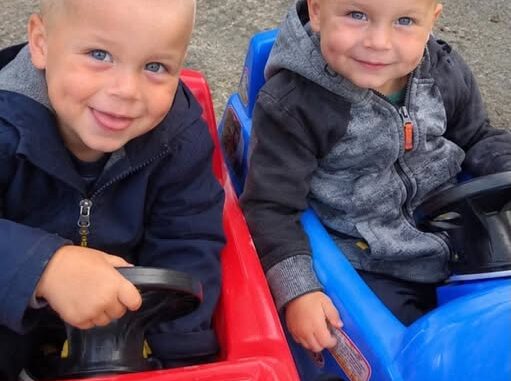
An original fictional family story about parenting, identical twins, communication, and understanding differences in face recognition.
When Emma returned home from grocery shopping, she expected an ordinary afternoon with her husband and their four-year-old identical twin boys.
Instead, she found something she never could have anticipated.
Her sons, Max and Leo, were standing in the living room with their blond curls almost completely shaved off.
On top of each boy’s head was a large letter formed from the hair their father had left behind.
One had an M.
The other had an L.
Their father, Henry, seemed pleased with his solution.
He had always struggled to tell the boys apart, and he believed the unusual haircuts would finally solve the problem.
Emma was upset that he had made such a noticeable change without discussing it with her.
But later that evening, an unexpected discovery revealed that Henry’s decision was connected to something much deeper than a simple parenting mistake.
Raising Two Identical Boys
Emma and Henry had been married for seven years.
Their twins, Max and Leo, were four years old and looked remarkably alike.
Both had blond curls, blue eyes, matching dimples, and almost identical facial features.
Even their voices sounded similar.
To people who didn’t know them well, telling the boys apart was difficult.
But Emma had learned to recognize their individual habits.
Max was thoughtful and quiet.
He usually observed a situation before joining in.
He loved dinosaurs and slept with a green stuffed dinosaur named Pickle.
Leo, on the other hand, was energetic and talkative.
He enjoyed strawberries, disliked getting water on his face, and often rubbed his left ear when he became excited.
Emma could usually recognize them by their expressions, movements, and behavior.
Henry found it more challenging.
Sometimes he called Max by Leo’s name.
Other times, he hesitated before addressing either child.
The boys enjoyed making the situation even more confusing by swapping clothes or pretending to be each other.
Everyone treated it as a harmless family joke.
At least, that was what Emma believed.
The Haircuts That Started an Argument
One afternoon, Emma left Henry at home with the twins while she went shopping.
When she returned, the boys ran toward her.
Their familiar curls were gone.
Instead, each had a very short haircut with a large initial left on top.
Emma stared at them.
“Henry, what happened to their hair?”
Henry walked into the room with a confident smile.
“I found a way to tell them apart.”
Emma looked at the letters again.
“You shaved their initials into their hair?”
Henry nodded.
The boys seemed delighted.
“I’m M!” Max announced.
“And I’m L!” Leo added.
They laughed and pointed at each other’s heads.
Emma wasn’t amused.
She had loved their curls, and Henry hadn’t discussed the haircuts with her beforehand.
Henry argued that the hair would grow back.
Emma agreed that it would, but she was still concerned about the decision.
They decided to continue the conversation later, away from the children.
For the rest of the evening, the boys proudly showed off their new haircuts.
Emma assumed the incident was simply another example of Henry’s unusual problem-solving.
She had no idea what the twins had overheard.
Something Strange on the Baby Monitor
That night, Emma put the boys to bed around 8:30.
Max slept in the bed beside the window.
Leo slept near the door.
A few hours later, Emma checked the baby monitor.
Both boys appeared to be asleep.
Then Leo climbed out of bed.
He walked over to Max and whispered something.
Max sat up.
The boys exchanged blankets and climbed into each other’s beds.
Emma smiled slightly.
She assumed they were playing another identity-swapping game.
Then Henry entered the room.
He was holding the electric hair clippers.
Emma immediately became concerned.
She hurried upstairs and opened the bedroom door.
“What are you doing?” she asked.
Henry turned in surprise.
The twins began laughing.
Henry explained that he had discovered the boys had used the clippers earlier.
Emma looked more closely at their heads.
The initials had nearly disappeared.
The boys had attempted to shave the letters away themselves.
Why the Twins Removed Their Initials
Emma sat beside the boys and asked why they had used the clippers.
At first, neither answered.
Then Leo spoke.
“Because Daddy was sad.”
Emma looked toward Henry.
“What does he mean?”
Henry seemed uncomfortable.
Before he could explain, Max added something.
“Daddy said he was bad at being our daddy.”
The room became quiet.
Emma realized that the children had overheard a private conversation.
Henry explained that he had spoken with his brother, Tom, earlier that afternoon.
He had called because he knew Emma would be upset about the haircuts.
During the conversation, he admitted that his difficulty recognizing the twins made him feel inadequate as a father.
He hadn’t realized the boys were listening nearby.
The twins heard enough to understand that their father was unhappy.
They believed removing the letters might make him feel better.
Their attempt to help had created an entirely new problem.
A Safety Concern the Parents Had Overlooked
Emma was relieved that neither child appeared to have been injured while using the clippers.
But she was also concerned that the equipment had been left where they could reach it.
At four years old, Max and Leo were too young to use electric hair clippers without appropriate adult supervision.
Henry acknowledged that he should have stored them securely.
The parents agreed that grooming tools and other potentially hazardous household equipment needed to be kept out of the children’s reach.
They also decided not to make any further changes to the boys’ hair that night.
Instead, they would arrange to have the uneven patches corrected safely.
Once that issue was settled, Emma returned to the more important conversation.
She wanted to understand why Henry had been so upset about confusing the twins.
A Father’s Private Worry
Henry sat beside the boys.
He explained that he knew them as individuals.
He knew Max loved dinosaurs.
He knew Leo disliked water splashing on his face.
He understood their personalities, routines, and preferences.
But when they stood beside each other without speaking, he sometimes struggled to identify which child was which.
Emma reminded him that they were identical twins.
Many people found it difficult to distinguish them.
Henry nodded.
“But I’m their father,” he said.
He believed he should recognize them immediately.
Every time he guessed incorrectly, he felt embarrassed.
Sometimes he worried that the boys would interpret his confusion as a lack of attention or affection.
Emma had never realized how deeply the issue affected him.
She remembered the times she had laughed when he mixed up their names.
She had assumed Henry found the jokes amusing too.
Now she understood that he had been hiding his discomfort.
The Boys Had Something to Say
Max climbed out of bed and stood in front of Henry.
“Who am I?” he asked.
Henry studied him.
The boy was wearing his brother’s pajamas, and his haircut no longer provided any clues.
After a moment, Henry answered.
“Max.”
Max smiled.
“How did you know?”
“Because you’re holding Pickle.”
Max quickly tossed the dinosaur onto Leo’s bed.
“Try again!”
The boys began switching places.
Henry turned around while they moved.
When he faced them again, he made another guess.
Sometimes he was correct.
Sometimes he wasn’t.
The twins laughed whenever they managed to confuse him.
Eventually, Henry began laughing too.
For the first time that evening, he seemed relaxed.
Emma noticed the change.
The guessing game was no longer about proving whether Henry was a good father.
It was simply a playful moment with his children.
A Conversation About Family Expectations
After the boys settled down, Emma apologized to Henry.
She admitted that she hadn’t understood how much the jokes bothered him.
Henry acknowledged that he should have explained his feelings earlier.
They also agreed that decisions about noticeable changes to the children’s appearance should be discussed together whenever practical.
The twins listened as their parents talked.
Before Henry left the room, Max called out.
“Daddy?”
Henry turned.
“If you get us wrong, it’s okay.”
Leo nodded.
“Sometimes we can’t tell who’s who in pictures either.”
Emma smiled.
The boys occasionally confused their own childhood photographs.
Henry laughed.
“Thanks, guys.”
He wished them good night.
Then he and Emma went downstairs.
Emma thought the conversation was finished.
But Henry had one more thing to tell her.
An Appointment Henry Hadn’t Mentioned
At the kitchen table, Henry admitted that he had visited an eye doctor the previous month.
Emma was surprised.
He hadn’t told her about the appointment.
Henry explained that his difficulty recognizing faces wasn’t limited to the twins.
He sometimes struggled to identify acquaintances when he encountered them unexpectedly.
He could recognize familiar voices and movements more easily than faces alone.
Because of this, he had wondered whether something was wrong with his eyesight.
His eye examination hadn’t identified a vision problem that explained his experiences.
The doctor suggested that Henry consider discussing his face-recognition difficulties with an appropriate specialist.
Henry had arranged a follow-up appointment.
He hadn’t mentioned it to Emma because he was embarrassed and uncertain about what it meant.
Emma reassured him that she wanted to understand what he was experiencing.
She offered to accompany him to the appointment if he wished.
Henry agreed.
Understanding Face Blindness
At a later appointment, Henry discussed his experiences with a specialist.
The assessment suggested that he had characteristics consistent with developmental prosopagnosia, commonly known as face blindness.
Prosopagnosia is a condition involving difficulty recognizing faces.
It is not the same as poor eyesight.
Someone may have normal visual acuity while still experiencing difficulty identifying people from their facial features.
The degree of difficulty varies.
Some individuals have trouble recognizing unfamiliar people.
Others may find it challenging to identify friends, colleagues, or even close relatives by their faces alone.
People with prosopagnosia often rely on other information, such as voice, hairstyle, clothing, posture, or context.
In Henry’s case, these nonfacial clues had always been important.
He simply hadn’t understood why.
The specialist explained that his experiences could be evaluated and that practical recognition strategies might help him navigate daily situations.
What Is Developmental Prosopagnosia?
Developmental prosopagnosia refers to face-recognition difficulties that are present from early life rather than resulting from an identifiable acquired brain injury.
People with this condition may not realize that their experience is unusual.
They may assume everyone finds faces difficult to remember.
Some recognize people through distinctive hairstyles, voices, or mannerisms.
Others depend heavily on context, such as knowing where they expect to encounter someone.
A person who is easy to recognize at work may be difficult to identify unexpectedly at a grocery store.
Prosopagnosia can affect social interactions, particularly when other people misunderstand the difficulty.
For example, someone may appear inattentive or unfriendly because they fail to recognize an acquaintance.
In reality, they may simply be unable to identify the person from their face.
An appropriate professional evaluation can help clarify whether prosopagnosia or another factor is contributing to these difficulties.
Why Identical Twins Presented an Extra Challenge
For Henry, recognizing Max and Leo was especially difficult because the boys shared so many physical characteristics.
Their facial features, hair color, height, and voices were remarkably similar.
Even people without face-recognition difficulties can confuse identical twins, particularly when the children are young.
Henry’s reliance on nonfacial information made the challenge more noticeable.
When the twins wore different clothes or carried their favorite toys, he could often identify them.
When they deliberately swapped those clues, he sometimes struggled.
Understanding this helped Emma see the situation differently.
Henry wasn’t ignoring the boys’ individuality.
He was using the information available to him to recognize them.
And he knew far more about their personalities than he had previously given himself credit for.
Finding Better Ways to Recognize the Twins
After Henry’s appointment, the family stopped treating his recognition difficulties as a test.
Emma no longer asked him to identify the boys in front of relatives for amusement.
Instead, they focused on practical ways to make everyday interactions easier.
Henry paid attention to the twins’ individual habits.
Max usually entered unfamiliar situations cautiously.
Leo tended to approach them with enthusiasm.
Max had a quiet laugh.
Leo often laughed loudly.
Max preferred certain toys and routines.
Leo had his own favorites.
These differences helped Henry recognize the boys without relying entirely on their faces.
The family also encouraged the children to respond naturally when their names were used.
There was no need to make every moment into a guessing game.
Helping the Children Understand
Emma and Henry wanted Max and Leo to understand that their father loved them equally.
They explained the situation in simple language appropriate for their age.
They told the boys that some people recognize faces easily, while others need additional clues.
Henry explained that he sometimes needed to hear their voices or notice their habits before identifying them.
The twins accepted the explanation.
They were more interested in playing with their father than discussing the details.
Over time, the family learned to approach occasional mix-ups with patience.
When Henry used the wrong name, he corrected himself.
When Emma made a mistake, she did the same.
Neither parent treated it as evidence that they didn’t know their children.
The boys continued developing their own interests and personalities.
The Twins’ Hair Eventually Grew Back
Within a few months, the uneven haircuts were no longer noticeable.
Max and Leo returned to wearing their hair in ordinary styles.
There were no more initials.
Henry and Emma agreed that the experience had taught them several lessons.
They needed to communicate more openly about parenting decisions.
They needed to keep grooming equipment safely stored.
And they needed to avoid turning personal difficulties into jokes that might cause embarrassment.
Most importantly, Henry had learned that his ability to recognize faces did not determine the quality of his relationship with his children.
He could still be attentive, affectionate, and involved in their daily lives.
A New School Year
When Max and Leo started kindergarten, their teacher asked whether there were any reliable ways to distinguish them.
Henry smiled.
“Max usually prefers green, and Leo likes blue.”
Then he added a warning.
“But don’t rely entirely on their clothes. They enjoy swapping them.”
The teacher laughed.
She soon discovered that the boys had distinct personalities despite their similar appearance.
Max tended to observe before joining group activities.
Leo was often the first to volunteer.
Their interests and habits provided helpful clues.
The teacher also learned to ask when she was uncertain rather than guessing repeatedly.
The family appreciated her thoughtful approach.
It helped the boys feel recognized as individuals.
A Halloween Surprise
One Halloween, the twins decided to play another trick on their father.
Max wore Leo’s favorite blue sweatshirt.
Leo wore Max’s usual clothes.
They entered the living room and announced that they had exchanged identities.
Henry looked at them.
Then he smiled.
“Nice try.”
The boys stared.
“How did you know?”
Henry pointed toward Max.
“Because you’re waiting behind your brother to see whether your plan works.”
Max looked surprised.
Leo burst into laughter.
Henry laughed with them.
The moment reminded Emma how much had changed since the night of the unusual haircuts.
Henry still sometimes confused the twins.
But he no longer interpreted every mistake as a personal failure.
When Emma Made the Same Mistake
One afternoon, Emma scolded Leo for leaving wet towels on the bathroom floor.
She continued speaking until Max interrupted.
“Mom, that was me.”
Emma stopped.
She had confused the boys herself.
Leo was delighted.
Henry happened to overhear the conversation.
He smiled.
“How can a mother not recognize her own children?”
Emma laughed.
This time, the joke felt different.
It wasn’t intended to embarrass anyone.
It was a reminder that even a parent who usually recognized the twins easily could make an occasional mistake.
Emma apologized to Max for the confusion.
Then she joined the family in laughing about the harmless mix-up.
What the Family Learned
Looking back, Emma realized that the haircuts had revealed an issue the family had overlooked.
She had assumed Henry’s difficulty identifying the twins was something he could control if he simply paid closer attention.
But his experience was more complicated.
Once they understood his face-recognition difficulties, they could approach the situation with greater patience.
The experience also reminded them that parenting involves communication.
Henry had acted without discussing the haircuts.
Emma had made jokes without realizing they were hurtful.
The twins had overheard a conversation and tried to solve a problem they didn’t fully understand.
Everyone had something to learn.
Fortunately, they were able to discuss what happened and make changes.
Why Communication Matters in Parenting
Parents often face situations in which their perspectives differ.
One parent may view something as a practical solution, while the other sees it as unnecessary or upsetting.
Talking through these differences can help families avoid misunderstandings.
In Emma and Henry’s case, the disagreement began with the boys’ haircuts.
But the more important conversation concerned Henry’s feelings about being a father.
He had been carrying a worry that Emma didn’t know existed.
Once he explained it, she was better able to support him.
They also learned that children may overhear adult conversations and interpret them in unexpected ways.
Reassuring children and explaining misunderstandings in age-appropriate language can help them feel secure.
A Different Understanding of Being a Good Parent
Henry had once believed that a good father should always be able to recognize his children immediately.
Over time, he began questioning that assumption.
He knew Max and Leo’s favorite foods.
He understood what frightened them.
He knew how to comfort them when they were upset.
He attended their activities, listened to their stories, and helped them learn new things.
Those everyday actions were important parts of his relationship with them.
His difficulty recognizing their faces did not erase his knowledge of who they were.
Emma also learned to appreciate the many ways Henry understood their sons.
She no longer measured his involvement by how quickly he could identify them.
Instead, she noticed the patience and attention he brought to their daily lives.
Final Thoughts
What began as an unusual haircut turned into an important family conversation.
Henry’s attempt to distinguish his identical twins revealed a private concern about his ability to recognize faces.
After seeking professional guidance, he gained a better understanding of his experiences and learned practical ways to identify the boys.
Emma recognized the importance of listening without making assumptions.
And Max and Leo learned that their father could sometimes confuse their names while still knowing and loving them as individuals.
The family’s experience illustrates that understanding, patience, and open communication can be more valuable than expecting everyone to approach the same situation in exactly the same way.
The twins’ hair eventually grew back.
The initials disappeared.
But the lessons their family learned remained.
Leave a Reply