Some stories are difficult to explain in just a few sentences.
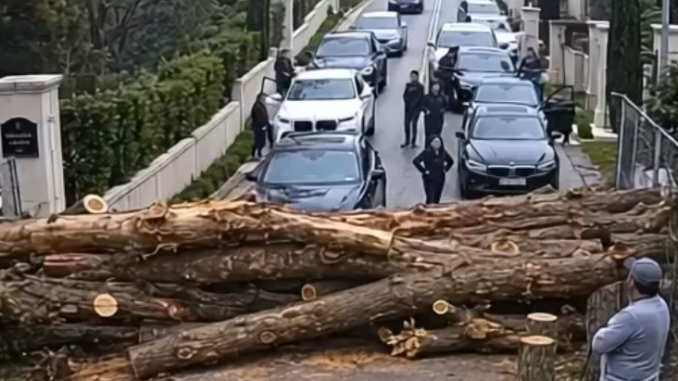
If someone asked me today what happened, I could simply say that several mature tress disappeared from my property without my knowledge, and the situation eventually turned into one of the biggest property disputes our town had seen in years.
That would be accurate—but it would leave out everything that truly mattered.
The real story began on what seemed like one of the most ordinary Tuesdays imaginable.
Nothing about that morning hinted that my week, and eventually my relationship with an entire neighborhood, was about to change.
I had settled into my office just before lunch. My desk overlooked the parking lot, emails filled my screen, and I was halfway through a sandwich while answering routine messages. It was an average workday in every possible way.
Then my phone rang.
The caller ID displayed my sister, Mara.
Normally that wouldn’t have meant much, except Mara had a habit of texting rather than calling. Whenever she called during business hours, it usually meant something important had happened.
I answered immediately.
“Hey,” I said. “Everything okay?”
For a brief moment there was only silence.
Then I heard wind in the background.
“Mara?”
“You need to come home.”
Her voice was calm, but only barely.
People sometimes sound perfectly composed while trying very hard not to panic.
That was exactly how she sounded.
“What happened?”
“Just come,” she replied quietly. “I’ll explain when you get here.”
Without asking another question, I informed my supervisor that a family matter required my immediate attention.
Fifteen minutes later I was driving toward the family property where I had lived most of my life.
The route home followed Pine Hollow Road, a quiet stretch bordered by rolling hills and dense woodland. Usually the drive helped me relax after work.
That afternoon it only made me more anxious.
My mind wandered through every possible explanation.
Had someone been injured?
Had a storm caused damage?
Had one of the old barns finally collapsed?
None of those possibilities prepared me for what I eventually saw.
As soon as I turned onto the gravel lane leading toward my house, something felt…different.
It wasn’t immediately obvious.
There was simply an unfamiliar emptiness.
Anyone who has spent years on the same piece of land understands that feeling.
You notice even the smallest change.
A missing fence post.
A different sound in the trees.
A patch of sunlight where there used to be shade.
Then I saw it.
The row of towering sycamore trees that had lined the eastern edge of my property had disappeared.
Not damaged.
Not trimmed.
Gone.
Only freshly cut stumps remained.
For a long moment I simply sat inside the truck.
Those trees had been part of the landscape for decades.
Three had been planted by my father shortly after our family moved there.
I still remembered helping him carry buckets of water when I was a child.
The remaining trees had naturally filled in over the years, eventually creating a beautiful line of shade that offered privacy, sheltered birds, and became one of the defining features of the property.
Now there were only six smooth stumps rising a few inches above the ground.
Fresh sawdust still surrounded them.
The work had clearly been done professionally.
Large machinery had removed every branch and trunk, leaving surprisingly little evidence that magnificent trees had stood there only hours earlier.
Mara waited near the fence.
She folded her arms as I approached.
“I tried to stop them,” she said before I could even ask.
I stared at the empty space.
“What do you mean?”
She explained everything.
Earlier that morning two commercial trucks had arrived carrying equipment and a professional tree crew.
Workers unloaded chainsaws and safety gear before beginning work.
Thinking there must have been some mistake, Mara walked over to ask what was happening.
One employee politely explained they were completing a scheduled job authorized through a homeowners association located on the ridge overlooking our property.
At first she assumed they had simply entered the wrong address.
She explained that the tress stood well inside privately owned land.
The crew responded that they had paperwork authorizing boundary clearing.
Believing the matter had already been verified, they continued their work.
By the time Mara realized the misunderstanding couldn’t be resolved immediately, several trees had already been removed.
She found a business card tucked beneath the windshield wiper of my truck.
The landscaping company had apparently left their contact information.
I called the number.
A representative answered after only a couple of rings.
After introducing myself, I calmly asked why a crew had removed mature trees from my property.
The representative immediately searched through the day’s work orders.
A few moments later he located the project.
According to their records, they had received authorization connected to nearby development improvements requested by the neighborhood association located above my land.
They believed they had permission to remove vegetation that was said to interfere with a scenic overlook.
I explained that the property boundary had been misunderstood.
The trees had never belonged to the neighborhood association.
They stood entirely on privately owned land.
Silence followed.
The representative admitted they would need to review the documentation and suggested that the authorization might have been based on inaccurate property information.
Although he remained professional throughout the conversation, it became increasingly clear that the situation involved more than a simple misunderstanding.
After ending the call, I stood quietly beside the remaining stumps.
Those trees had provided more than shade.
They marked memories.
Family photographs had been taken beneath them.
Summer afternoons had been spent relaxing nearby.
Children had climbed their lower branches.
Birds returned every spring to nest there.
Replacing mature trees of that size would require many years of growth.
No amount of landscaping could immediately restore what had been lost.
As I looked toward the hillside, the newer homes of Cedar Ridge Estates came into view.
It was an attractive neighborhood with carefully maintained landscaping, stone entrances, and homes positioned to overlook the surrounding countryside.
From that elevation, removing the trees certainly created a broader view.
Whether that had been intentional or simply the result of incorrect assumptions remained unclear.
What mattered now was determining exactly how the mistake occurred.
Instead of reacting emotionally, I decided the best approach would be gathering facts.
The following morning I visited the county records office.
Survey maps, recorded deeds, and historical property documents confirmed what my family had always known.
The property boundary had never changed.
The trees had always stood well inside our land.
Armed with accurate documentation, I contacted both the landscaping company and representatives from the neighborhood association.
To their credit, everyone agreed to meet.
The discussion wasn’t easy.
There were disagreements over surveys, communication failures, and assumptions made during project planning.
However, once the official property records were reviewed together, everyone reached the same conclusion.
The work had extended beyond the intended boundary.
Responsibility needed to be addressed.
What followed became less about conflict and more about finding practical solutions.
Professional arborists evaluated the loss.
Restoration specialists discussed replacement plans.
Insurance representatives became involved.
Several meetings later, agreements were reached regarding compensation, landscape restoration, and procedures designed to prevent similar mistakes in the future.
One important issue also emerged during those discussions.
The private access road serving the neighborhood crossed a portion of my property under long-established legal agreements.
Although emotions initially ran high, everyone quickly recognized that cooperation—not confrontation—would benefit both sides.
The existing access arrangements remained in place, while additional boundary markers and updated documentation helped eliminate future confusion.
Months later, new trees were planted.
They were much smaller than the originals, of course.
It will take many years before they provide the same shade and beauty.
Even so, watching them grow serves as a reminder that thoughtful communication often produces better outcomes than prolonged disputes.
Looking back now, I realize the situation could have become much more divisive.
Instead, it encouraged everyone involved to better understand property boundaries, respect neighboring landowners, and verify information before beginning major projects.
The experience also reinforced an important lesson.
Natural landscapes often carry value that extends far beyond appearance.
Trees provide wildlife habitat, improve privacy, reduce erosion, offer cooling shade, and preserve family memories that cannot simply be measured in dollars.
Protecting those resources requires care, clear communication, and respect for the people who call the surrounding land home.
Sometimes the strongest response to a difficult situation isn’t acting out of anger.
It’s allowing facts, patience, and cooperation to guide the next step.
That approach doesn’t erase what was lost—but it creates the best opportunity to move forward while ensuring the same mistake is far less likely to happen again.
Leave a Reply