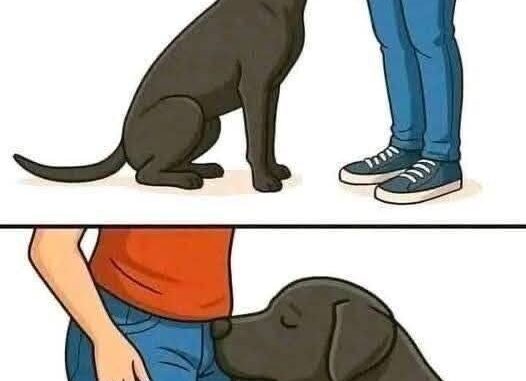
Beyond their practical abilities, dogs also rely heavily on scent to strengthen their emotional connection with humans. This bond is not only built through training, feeding, or daily interaction, but also through constant sensory recognition.
To a dog, your scent is not just a smell—it is a form of identity. It represents safety, familiarity, routine, and emotional stability. That is why dogs often appear calm when they are near their owners’ belongings, even when the person is not physically present.
When your dog sniffs you—whether it’s your feet, hands, or clothing—they are essentially “reconfirming” your identity. It is their way of checking in, grounding themselves, and reinforcing the connection they feel with you.
This behavior may seem simple, but it plays a major role in how dogs maintain emotional balance.
Why Feet Specifically Attract Dogs
While dogs will sniff many areas of the human body, feet are especially interesting to them for several reasons.
First, feet are in constant contact with different environments. Every step you take collects scent particles from floors, soil, grass, shoes, and public spaces. This makes your feet a concentrated source of environmental information.
Second, feet contain sweat glands that produce a distinct scent profile. This scent changes based on temperature, activity level, and even emotional state. Dogs are extremely sensitive to these subtle variations.
Third, feet are often easily accessible. From a dog’s perspective, they are one of the closest and most convenient parts of the human body to investigate during rest or relaxation.
In simple terms, your feet act like a “scent diary” that your dog can read at any time.
Dogs and Emotional Detection Through Smell
One of the most fascinating aspects of canine ability is their sensitivity to human emotions.
While humans rely heavily on facial expressions and tone of voice to understand feelings, dogs often go a step further by using scent. When a person experiences emotional changes such as stress, fear, sadness, or excitement, their body chemistry shifts slightly.
These changes affect sweat composition, hormone levels, and natural body odors.
Dogs can detect these shifts instantly.
This is why many dog owners notice that their pets behave differently when they are upset. A dog may become more affectionate, stay closer than usual, or in some cases, act protective.
Sniffing behavior, including foot sniffing, is part of this emotional awareness process. It allows dogs to “read the atmosphere” of their human companion.
The Role of Routine and Familiar Scents
Dogs are creatures of habit. They thrive on consistency and structure, and scent plays a major role in creating that sense of stability.
Every household has a unique scent pattern created by the combination of people, furniture, food, cleaning products, and environment. Dogs become deeply familiar with this pattern over time.
When you return home after being away, your dog immediately notices changes in your scent profile. Even if you have only been gone for a short time, your body may carry traces of new environments.
By sniffing you—especially areas like your feet or legs—they quickly “update” their internal understanding of your movements and activities.
This helps them maintain a sense of security and predictability.
Curiosity Is Instinct, Not Random Behavior
It is important to understand that sniffing is not a random habit in dogs. It is an instinctive form of exploration and information gathering.
From the moment they are born, puppies use scent to learn about their mother, siblings, and surroundings. As they grow, this behavior becomes more complex and refined.
Unlike humans, who rely heavily on sight, dogs rely on scent to form mental maps of the world.
When your dog sniffs you, they are not just being affectionate or playful—they are actively processing information about:
- Where you have been
- What you have interacted with
- How your body state has changed
- Whether anything in your environment is new or unusual
In this sense, sniffing is a form of communication and understanding.
How Dogs Process Scent Information
A dog’s nose does not simply detect smells—it analyzes them in layers.
When a dog inhales a scent, different parts of the smell are separated and processed individually. This allows them to identify complex mixtures that humans perceive as a single odor.
For example, while a human might smell “sweat,” a dog can detect:
- The salt content
- Hormonal changes
- Environmental traces
- Emotional indicators
- Chemical composition differences
This layered processing gives dogs an incredibly detailed understanding of their surroundings.
It is also why they may spend more time sniffing certain areas of your body or environment. They are collecting as much data as possible.
Why Dogs Repeatedly Sniff the Same Area
If your dog keeps returning to the same spot on your feet or legs, it is not random behavior. Repeated sniffing usually means they are trying to confirm or better understand a scent.
A Final Note on What Your Dog Is Really “Saying”
When you start to understand how much information your dog gathers through scent, everyday behaviors begin to look very different. What once seemed like a simple habit—sniffing your feet, your hands, or even lingering near you after you return home—becomes a form of silent communication.
Your dog is not just reacting to smell; they are interpreting a constantly changing stream of information about you and your environment. In their own way, they are staying updated on your emotional state, your routines, and your presence in the world.
This is also why dogs often seem so aware of changes in their owner’s mood or health. Long before you say a word, your dog may have already detected shifts in your body chemistry or stress levels. Their response—whether it’s staying close, acting more protective, or simply observing quietly—is part of how they maintain balance in your shared environment.
It is important to remember that sniffing is never meaningless for a dog. Even when it appears repetitive or unusual from a human perspective, it serves a purpose rooted in instinct, connection, and understanding.
Rather than discouraging this behavior, recognizing it as natural communication can deepen the bond between you and your pet. It allows you to see your dog not just as an animal that lives in your home, but as a highly perceptive companion who experiences the world in a completely different way.
In the end, your dog’s nose is not just a sensory tool—it is their language. And every sniff is a small sentence in a conversation you may not hear, but are always a part of.
Leave a Reply