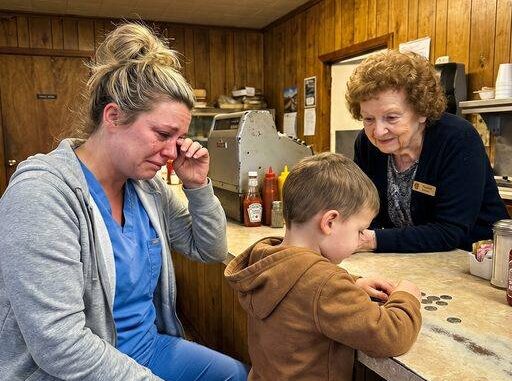
The coffee shop never went back to being “just a coffee shop” after that.
At first, I thought it would fade.
That’s what things usually do. People get excited about something meaningful for a moment, then life moves on, and the moment gets buried under routine again.
But this didn’t fade.
It grew.
Slowly at first. Then all at once.
More cups appeared on the wall. More notes. More handwriting styles, languages, drawings from children, and folded receipts with messages scribbled in pen that was running out of ink.
Some were simple:
“Keep going.”
“You are not alone.”
“This coffee is for you.”
Others were longer, heavier, like someone had been carrying them for years before finally setting them down:
“I lost my job today. I don’t know what comes next, but someone once did this for me, so I’m doing it for you.”
The wall became something people stood in front of longer than they stood in line for coffee.
Sometimes they didn’t even order anything.
They just read.
And breathe.
And leave a little lighter than when they arrived.
I started noticing something else too.
People weren’t just leaving kindness for strangers.
They were leaving it for versions of themselves they used to be.
That hit me one evening when a man in a worn-out work jacket stood in front of the wall for almost twenty minutes. He didn’t move. Didn’t order. Just read.
When he finally came to the counter, he said quietly, “I used to be someone who needed one of these messages. I guess I still am… just in a different way.”
Then he bought three coffees.
“One for me,” he said. “And two for whoever needs them more than I do today.”
That became a phrase people started using:
“Two for whoever needs it more.”
It spread through the shop like it belonged there from the beginning.
The Boy Returns
Months passed.
Then seasons changed.
Winter softened into spring, and with it came something I didn’t expect—the boy returned.
Not the same boy who had placed a quarter on my counter.
Older now. Taller. More certain in his steps.
But still quiet.
He didn’t come alone this time. His mother was with him, and for the first time, she wasn’t wearing exhaustion like armor. There was color in her face. Ease in her posture. The kind of calm that comes when survival stops being the only goal.
They stood at the entrance for a moment before stepping in.
The bell above the door rang softly.
And everything inside the shop seemed to pause, like it recognized them.
The boy looked straight to the wall.
He didn’t say anything at first.
Just walked closer.
I watched him trace the rows with his eyes until he found it—the original cup.
Still there.
Slightly faded, but preserved behind a clear frame I had added months ago when I realized I couldn’t throw it away.
PAID IN FULL BY LOVE.
FOR A MOM WHO KEPT GOING.
He smiled.
A small, private smile.
Then he whispered, “It’s still here.”
His mother stepped beside him and nodded. “So are we.”
That was all they needed to say.
Before leaving, the boy came to the counter again.
This time, he didn’t bring change.
He brought something folded carefully in both hands.
“I wrote something,” he said, placing it on the counter. “For someone else.”
After they left, I opened it.
It read:
“If you’re reading this, you might feel like things won’t change. I thought that too. But sometimes the smallest kindness is the first step to a completely different life. Someone once gave my mom coffee for a quarter. That changed everything for us.”
I had to sit down for a moment after reading it.
Because I realized something then:
He didn’t just remember what happened.
He had carried it forward.
The Wall Becomes Something Bigger
The coffee shop started attracting attention outside the neighborhood.
At first, it was local schools.
Teachers brought students to see “the kindness wall.”
They didn’t turn it into a lecture. They just let the students read.
Let them absorb it in silence.
Then came community groups.
Then journalists.
Then people who had never even been inside a coffee shop like ours before.
They all came for the same reason:
To understand why something so simple felt so powerful.
But the truth was, there was nothing complicated about it.
It wasn’t a program.
It wasn’t a movement with rules or leadership.
It was just people responding to each other’s lives with a little more care than expected.
That was all.
Still, something about it kept growing beyond us.
One day, someone donated a frame for every new cup instead of letting them be pinned.
Then someone else donated shelving.
Then lighting.
Then a mural appeared on the opposite wall—painted by a local artist who had once been homeless herself.
She painted hands passing a cup from one person to another.
No faces.
Just connection.
At the bottom, she wrote:
“Small things don’t stay small forever.”
Earl and Nina
Earl still came in every morning.
Same time. Same order.
Plain coffee. No sugar.
But something about him had changed too.
He wasn’t as quiet anymore.
He started talking to people.
Not much. Not loudly.
But enough that others noticed.
Nina, on the other hand, had turned the corner booth into what she jokingly called her “temporary office.” She helped people apply for jobs, wrote resumes, even taught basic computer skills to anyone who needed it.
They still rarely sat together at first.
But one afternoon, during a rainstorm that kept people inside longer than usual, they did.
Earl slid into the booth across from her and placed something on the table.
A cup.
One he had written on earlier that week.
It read:
“For the person who keeps showing up even when it’s hard.”
Nina looked at it for a long moment.
Then she said, “You don’t have to keep doing this alone, you know.”
Earl nodded slowly.
“I know,” he said. “That’s why I’m not.”
That was the beginning of something neither of them labeled.
But everyone could see it forming anyway.
The Teenager
The boy who once stood cold and silent in front of the wall came back again months later.
This time, he wasn’t alone.
He brought someone with him—a younger boy, maybe thirteen, standing slightly behind him like he wasn’t sure if he was allowed to be there.
They both looked tired in a different way.
Not physically.
Emotionally.
The older boy leaned toward the younger one and said quietly, “This is what I told you about.”
The younger boy stared at the wall.
Slowly, he stepped forward.
He read a few cups.
Then more.
And then, without saying anything, he turned to the counter and asked, “Can I leave something too?”
I handed him a cup.
He sat at one of the tables for a long time, writing.
When he finished, he placed it on the wall himself.
It read:
“I didn’t think anyone would notice me either. But I guess someone always does.”
The older boy stood beside him and nodded once.
“Yeah,” he said softly. “They do.”
Then they left together.
What the Shop Became
People started calling the place different names.
“The Coffee Wall.”
“The Second Chance Café.”
“The Kindness Stop.”
But I never renamed it.
Because to me, it was still just the place where a boy once placed a quarter on my counter.
Everything else came after.
One evening, long after closing, I stood alone in front of the wall.
It was quiet.
No customers. No noise. Just the hum of the refrigerator and the soft glow of the lights.
I looked at all of it.
Every cup. Every note. Every story.
And I realized something I hadn’t understood before.
It wasn’t the wall that changed people.
It was the permission it gave them.
Permission to care.
Permission to be seen.
Permission to believe that small actions matter.
The quarter hadn’t just bought coffee.
It had started a ripple that never stopped moving.
Final Reflection
Years later, people would still come in and ask when it started.
I always gave the same answer.
I pointed to the original cup.
And I said:
“It started the day someone decided that something small still mattered.”
Because that’s the truth.
Not everything meaningful begins with something big.
Sometimes it begins with a child’s voice.
A tired mother.
And a single quarter placed on a counter that wasn’t supposed to change anything at all.
But did.
Completely.
Leave a Reply