The moment felt small at first—almost routine
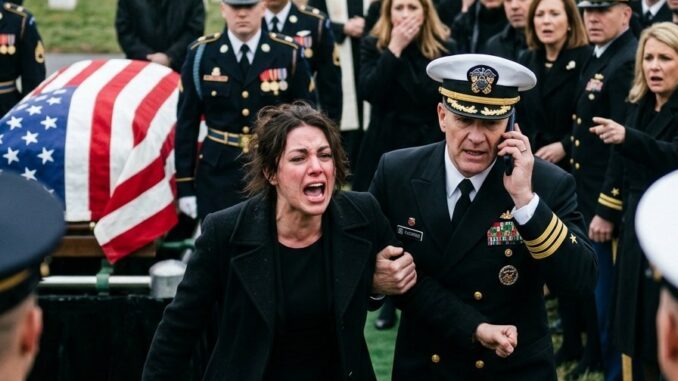
A senior naval officer stepped forward during my father’s memorial service and gently took hold of my arm. His tone was controlled, almost polite, as he told me the front row was reserved for service members.
It sounded like a simple correction. A matter of protocol.
But it wasn’t.
My mother was already seated in the front. My brother sat beside her. Neither of them reacted. Neither of them spoke up.
I stood there in silence, understanding something deeper than the words being said. This wasn’t just about seating. It was about a story that had been told about me for years—a version of me that didn’t belong in that space.
So I stepped back.
And then everything shifted.
The officer’s phone rang. He answered, listened carefully, and his entire expression changed. The confidence in his posture disappeared, replaced by something closer to urgency.
He ended the call and looked directly at me.
His voice carried across the room this time.
“Lieutenant Commander… front row is yours.”
The atmosphere in the chapel changed instantly. Conversations stopped. Heads turned. One by one, uniformed service members stood.
What had just been taken from me was suddenly returned—but in a way no one could ignore.
I walked forward and took my seat.
It should have felt like validation. Instead, it felt complicated. The truth had finally surfaced, but only after years of being buried.
The Story They Told About Me
From the outside, my family looked like many others connected to military life.
My father served in a demanding role. His career shaped everything—our routines, our priorities, even the way we communicated. My mother carried the weight of his absences. My brother thrived in the attention and stories that came with it.
I existed somewhere in the background.
When I decided to follow a similar path, it wasn’t met with celebration. It was met with caution.
I was told to be certain of my decision. I said I was.
And I left.
What followed was something I rarely spoke about. My path didn’t look the way people expected, and for reasons beyond my control, the version of events shared with others became simplified—and incorrect.
Over time, that version stuck.
At family gatherings, I became the one who “didn’t make it.” It was repeated casually, almost like a harmless detail. But repetition has a way of turning assumptions into accepted truth.
I didn’t correct it.
Some stories aren’t yours to tell freely.
My father never openly challenged it either. But in quieter moments, he made it clear he understood more than he said. His support wasn’t loud, but it was real.
For a while, that was enough.
The Day That Changed Everything
When my father passed, I wasn’t there in his final moments. Circumstances kept me away, and by the time I arrived, everything had already happened.
That absence became another silent judgment.
By the time of the memorial, emotions were already layered—grief, distance, and years of misunderstanding.
So when I was asked to step away from the front row, it felt like the continuation of something much older.
Until it wasn’t.
That single phone call revealed the truth in a way no explanation ever could. Titles, recognition, and acknowledgment replaced years of assumption in a matter of seconds.
But recognition, especially when delayed, carries its own weight.
It doesn’t erase what came before.
After the Service
In the days that followed, things began to shift.
Conversations that had never happened finally did. Questions were asked—some carefully, others not. For the first time, the narrative about me started to change.
Not dramatically, but noticeably.
My mother, in particular, began to see things differently. There was an acknowledgment—quiet, but genuine—that the story she had accepted wasn’t complete.
She expressed regret for not questioning it sooner.
I listened.
But understanding something later doesn’t undo the impact of believing it for years.
There are moments that shape relationships in ways that aren’t easily reversed. They don’t always lead to conflict, but they leave a mark.
And sometimes, the most honest response isn’t anger—it’s clarity.
What My Father Left Behind
Before returning to work, I went through some of my father’s belongings.
Among them was a small, carefully kept space with my name on it. Inside were items that suggested he had been paying closer attention than anyone realized.
He may not have spoken openly, but he had seen me.
That mattered.
There was also a note—short, direct, and deeply personal. It acknowledged things left unsaid and included something I had needed to hear long before that moment.
It didn’t change the past.
But it reframed it.
Knowing that he understood, even quietly, filled a gap that had been there for years.
Moving Forward
Life didn’t suddenly become simple after that day.
Work continued. Responsibilities remained. The world didn’t pause for personal clarity.
But something internal had shifted.
The need to prove anything—to family, to others—faded.
What replaced it was quieter: a sense of certainty about who I was, independent of what had been said or assumed.
Relationships adjusted over time. Communication improved in small ways. Some connections became easier, others more distant.
Not everything was repaired.
And that was okay.
There’s a difference between resolution and acceptance. Not every situation leads to full reconciliation, but it can still lead to peace.
A Different Kind of Closure
People often think the hardest part of a life like mine is the lack of visibility—the things that can’t be shared or explained.
But that isn’t it.
The real challenge is being misunderstood by the people closest to you—and learning to move forward without needing them to fully understand.
Being recognized in that chapel didn’t define me.
Neither did the years before it.
What mattered most was something far quieter: knowing that, at least to one person who truly knew me, I had always been seen clearly.
And sometimes, that’s enough.
Leave a Reply