Avocados have become one of the most popular foods in modern diets. From breakfast toast to salads, smoothies, and even desserts, they are everywhere. People admire them for their creamy texture, healthy fats, and versatility. But despite their popularity, avocados still manage to surprise—and sometimes disappoint—people in a very specific way.
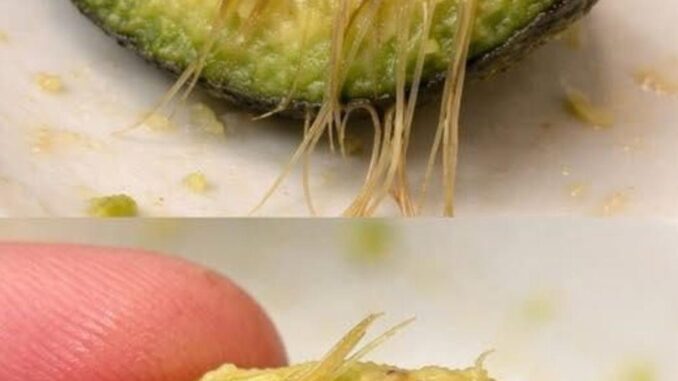
It usually happens at the worst possible moment. You slice into what you believe is a perfectly ripe avocado, expecting smooth, buttery green flesh. Instead, you’re met with thin brown strings running through the fruit. For many, this instantly ruins the experience. The avocado is judged as “bad” and tossed away without a second thought.
But those strings are far more interesting—and far more natural—than most people realize.
What Those Brown Strings Actually Are
The brown fibers inside an avocado are not a sign of rot, mold, or contamination. They are part of the fruit’s natural internal structure.
To understand them, you need to understand what an avocado really is. Botanically, it is a large berry with a single seed. Like all fruits, it has an internal system designed to support its growth while still attached to the tree. That system includes tiny vascular bundles known as xylem and phloem.
These structures act like transport highways. While the avocado is growing, they carry water, sugars, and nutrients throughout the fruit. They help it develop properly and maintain balance as it matures.
Under ideal conditions, these fibers are soft and barely noticeable. They blend seamlessly into the surrounding flesh. But when conditions change, they can become more visible and firm.
Why the Fibers Become Visible
There are several reasons why these internal structures sometimes show up as brown, stringy lines.
One major factor is ripening. As an avocado ripens after being picked, its soft tissue begins to break down. The creamy flesh becomes softer, but the vascular fibers do not break down at the same rate. This creates a contrast that makes them more visible.
Another factor is environmental stress during growth. Avocado trees are sensitive to changes in water supply, temperature, and soil conditions. If a tree experiences irregular watering or sudden weather changes, the fruit may develop stronger internal fibers as part of its natural response.
The age of the tree can also play a role. Younger trees tend to produce fruit with more noticeable fibers, while older, more established trees often produce smoother avocados.
Even the variety of avocado matters. Some types naturally have creamier textures, while others are more prone to developing fibrous strands depending on genetics and growing conditions.
Are Stringy Avocados Safe to Eat?
In most cases, yes.
Seeing brown strings does not mean the avocado is unsafe. These fibers are made of natural plant material—mainly cellulose and lignin. They are the same types of structural compounds found in many edible plants.
The issue is texture, not safety.
However, it’s important to distinguish between a fibrous avocado and a spoiled one. A stringy avocado may still be perfectly fine if it:
- Smells normal
- Has mostly green flesh
- Does not contain large black or sunken areas
On the other hand, an avocado should not be eaten if it has:
- A strong sour or rotten smell
- Large dark patches throughout the flesh
- A watery or slimy consistency
Those are signs of spoilage, not just natural fiber.
Why the Color Turns Brown
The brown color of the strings comes from a natural process called oxidation.
When plant tissues are exposed to oxygen, they begin to change color. This is the same reason cut apples turn brown after sitting out. In avocados, the vascular fibers often oxidize more visibly than the surrounding flesh, especially as the fruit ripens.
This doesn’t automatically mean the fruit has gone bad. It simply reflects a chemical reaction occurring in natural plant material.
When Texture Becomes Noticeable
Even though the fibers are always present inside an avocado, you don’t always notice them. They become more obvious under certain conditions:
- When the avocado is slightly overripe
- When ripening is uneven
- When the fruit has been exposed to stress during growth
- When it comes from certain varieties or younger trees
In these cases, the contrast between soft flesh and firm fibers becomes more pronounced.
This is why two avocados from the same batch can look completely different when cut open.
What You Can Do With a Stringy Avocado
If you open an avocado and find it stringy, you don’t necessarily need to throw it away.
There are many ways to still use it effectively:
1. Mash it thoroughly
Mixing it into guacamole or spreads helps disguise the texture.
2. Blend it
Smoothies, dressings, and sauces break down the fibers completely.
3. Combine it with other ingredients
Strong flavors and varied textures help mask any fibrous feel.
Once processed, most of the stringiness disappears entirely.
How to Avoid Stringy Avocados
While you can’t control how an avocado was grown, you can reduce your chances of getting a fibrous one.
When shopping:
- Choose avocados that feel heavy for their size
- Avoid ones with uneven soft spots
- Look for consistent, unbroken skin
At home:
- Let them ripen naturally at room temperature
- Avoid letting them overripen
- Refrigerate once they reach peak ripeness
Timing plays a major role in texture quality.
The Bigger Picture
It’s easy to expect perfection from produce, especially something as popular as avocados. But nature doesn’t work in uniform patterns. Every fruit is shaped by its environment, its growth conditions, and its biological processes.
The brown strings inside an avocado are simply one example of that reality.
They are not flaws or signs of failure. They are part of how the fruit is built.
Final Thoughts
The next time you cut into an avocado and see those thin brown fibers, it’s worth pausing before deciding it’s ruined.
In most cases, the fruit is still perfectly safe, still nutritious, and still usable.
What seems like a defect is often just a natural variation in how the fruit developed.
And once you understand that, those brown strings stop being something to fear—and become just another reminder that real food is grown, not manufactured.
Sometimes perfection isn’t the goal.
Usability is.
Why We React So Strongly to Imperfections
A big part of why stringy avocados feel disappointing has less to do with the fruit itself and more to do with expectation. Modern shopping habits have trained people to expect uniformity—every avocado should look identical, feel identical, and cut open into a flawless green surface.
But nature doesn’t operate that way.
Every avocado is shaped by a slightly different set of conditions: rainfall, soil nutrients, temperature shifts, harvest timing, and even how long it spent in transit. These small variations don’t usually affect safety or nutrition, but they do affect appearance and texture.
The brown fibers simply make that variation visible.
What we interpret as “imperfection” is often just natural diversity showing through.
The Role of Ripening Chemistry
Inside every avocado, a complex chemical process is constantly unfolding as it ripens. Enzymes break down starches into sugars, fats soften, and cell walls begin to weaken. This is what transforms a firm, bland fruit into something creamy and rich.
However, not all parts of the avocado respond at the same speed.
The soft pulp surrounding the seed breaks down relatively quickly, which is why ripe avocados feel smooth and spreadable. The vascular fibers, on the other hand, are structurally stronger and break down more slowly. This mismatch creates the stringy texture people sometimes notice.
In slightly overripe fruit, this imbalance becomes even more obvious. The flesh may become overly soft while the fibers remain intact, creating a contrast that feels more pronounced when eaten.
Misconceptions About “Bad” Avocados
One of the most common misconceptions is that any unusual texture automatically means the fruit is bad. In reality, “bad” has a very specific meaning in food science—it refers to spoilage caused by microbial growth or decay.
Stringiness alone does not fall into that category.
A truly spoiled avocado will show additional signs such as:
- A strong unpleasant odor
- Extensive dark or blackened flesh
- Liquid or mushy breakdown throughout the fruit
- Mold or visible decay
Without those signs, the fruit is still within the range of normal variation.
The fibers may be unappealing, but they are not dangerous.
Why Some People Never Notice Them
Interestingly, not everyone notices avocado strings even when they are present. This often comes down to how the fruit is prepared and consumed.
When avocados are:
- Mashed into guacamole
- Blended into smoothies
- Spread thinly on toast
- Mixed with strong flavors
…the texture differences become far less noticeable.
In contrast, slicing an avocado neatly and eating it plain makes any fibrous structure much more obvious. Presentation amplifies perception.
A Waste Problem Hiding in Plain Sight
Food waste is one of the unintended consequences of misunderstanding natural variation in produce. Avocados are particularly affected because they are often judged on appearance and texture rather than actual quality or safety.
Perfect-looking avocados are assumed to be good, while anything visually different is often discarded immediately.
But in reality, many of those “imperfect” fruits are still completely usable.
Recognizing that stringy texture is not a defect but a natural feature can help reduce unnecessary waste and encourage more practical use of food that is already perfectly edible.
How Farmers See It Differently
From a farming perspective, these fibers are not viewed as flaws. Growers understand that vascular structure is part of how the fruit develops. Their focus is on overall quality, yield, and consistency across harvests—not eliminating every natural variation.
In fact, slight differences in texture are expected across seasons and orchards. Weather patterns alone can influence how smooth or fibrous a batch of avocados turns out.
What consumers often see as inconsistency is, for producers, simply normal agricultural variability.
Rethinking “Perfect” Produce
The idea of perfect produce is relatively modern. In nature, there is no standardized shape, color, or texture for fruit. Avocados grown in different regions will naturally reflect their environment.
This means that two avocados can be equally fresh and equally nutritious while still looking noticeably different when cut open.
The presence of brown strings doesn’t indicate lower quality—it reflects the individuality of each fruit.
And that individuality is something most people rarely consider when they reach for produce in a store.
Final Perspective
At the end of the day, the brown strings inside an avocado are not a warning sign—they are a biological signature of how the fruit was built and how it matured.
They tell a quiet story about growth, change, and natural variation.
And while they may not match the ideal image of a perfectly smooth avocado, they don’t take away from what the fruit actually offers: nutrition, flavor, and versatility.
So the next time you see those thin brown fibers, it might help to remember that they are not a problem to be fixed.
They are simply part of the fruit’s structure—one that has been there all along, quietly doing its job.
Leave a Reply