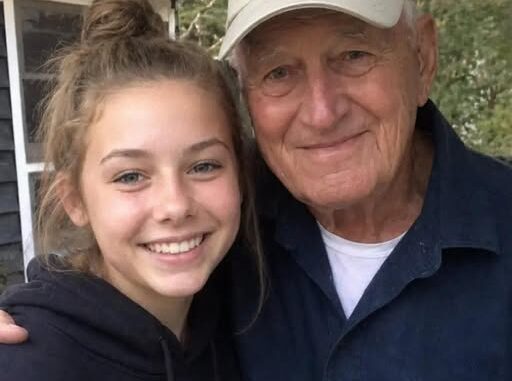
The distance between my daughter Hanna and me did not happen all at once.
At first, it was small. Short answers. Quiet dinners. Less laughter in the kitchen. Fewer conversations about school, friends, and her future.
I told myself it was normal teenage behavior.
Hanna was fifteen, and teenagers often need space. But deep down, I knew something was different. There was sadness behind her silence.
Whenever I asked what was wrong, she always gave the same answer.
“I’m just going to Grandpa Stuart’s.”
At first, that comforted me.
After my husband Pete passed away unexpectedly eight years earlier, Stuart became an important part of Hanna’s life. She was only seven when she lost her father, and Stuart stepped in with patience, love, and quiet support.
He taught her to ride a bike.
He attended school events.
He cheered for her at recitals.
He made her feel safe during one of the hardest chapters of her childhood.
So when Hanna started spending more time at his house, I tried to be grateful.
But soon, I became worried.
At home, she was distant. She barely spoke. If I asked about her time with Stuart, she became defensive.
One evening, I suggested visiting him together and bringing dessert.
Hanna reacted sharply.
“Just leave it alone,” she said.
Then she left the table and went to her room.
That night, I called Stuart. He sounded calm at first, but when I mentioned Hanna’s behavior, there was a pause that made my stomach tighten.
He said they were gardening together and that everything was fine.
I wanted to believe him.
But something felt unfinished.
The next afternoon, I drove to Stuart’s neighborhood and parked a few houses away. I felt guilty, but I needed to understand what was happening.
From a distance, I saw Hanna in the backyard.
She was smiling.
Not a polite smile. A real one.
She laughed while Stuart handed her flower pots and gardening tools. They looked peaceful together, as if they shared a world I no longer belonged to.
For a moment, I was relieved.
Then I felt hurt.
Why could she be herself with him but not with me?
A few days later, Stuart came to my door early in the morning. His face looked tired, and I knew immediately something was wrong.
He asked if we could walk to the park.
We sat on a bench beneath the trees, and after a long silence, he finally told me the truth.
Months earlier, Hanna had found medical papers in one of his drawers.
Stuart had cancer.
He had not wanted me to know because he knew how much loss our family had already carried after Pete’s death. Hanna had promised to keep his secret because she thought she was protecting me.
My heart broke.
My daughter had been carrying that fear alone.
Suddenly, everything made sense.
She was not pulling away because she was angry.
She was not trying to hurt me.
She was scared. She was grieving before the loss had even happened. She was afraid that if she stayed too close to me, she would accidentally tell the truth.
When I got home, Hanna was in the kitchen preparing to bake a blueberry pie for Stuart.
I gently told her I knew.
At first, she was upset. Then her anger turned into tears.
She told me she had been overwhelmed for months. She was angry at the illness, angry at life, and afraid of losing another person she loved.
She had been spending so much time with Stuart because she wanted his days to feel peaceful, full, and meaningful.
“I didn’t want you to hurt yet,” she whispered.
We cried together in the kitchen, surrounded by flour, sugar, and blueberries.
For the first time in months, I finally understood her silence.
Before we finished baking, the phone rang.
A neighbor had found Stuart collapsed in his garden near the white lilies he planted every year in memory of his late wife.
We rushed to the hospital.
Doctors explained gently that his time was limited.
For the next two weeks, Hanna stayed close to him. She held his hand, talked to him, and showed a quiet strength I had never seen in her before.
Stuart passed away peacefully.
At his funeral, white lilies filled the room. Hanna stood beside me, holding my hand tightly. She was still my daughter, but I could see how much she had grown through her grief.
Later, she told me she only wanted his final months to feel happy.
Today, we visit Stuart’s garden together.
On Sunday mornings, we pull weeds, plant flowers, and care for the lilies side by side. While we work, Hanna talks again — about school, her dreams, and the lessons Stuart taught her about kindness and courage.
Looking back, I understand something I could not see at the time.
Love does not always look obvious.
Sometimes it looks like silence.
Sometimes it looks like distance.
Sometimes it looks like a child carrying pain because she thinks she is protecting someone else.
Hanna’s secret broke my heart, but it also showed me who she was becoming.
Compassionate. Brave. Loving.
And in Stuart’s garden, surrounded by flowers, I am reminded that even after loss, love can still grow.
Leave a Reply