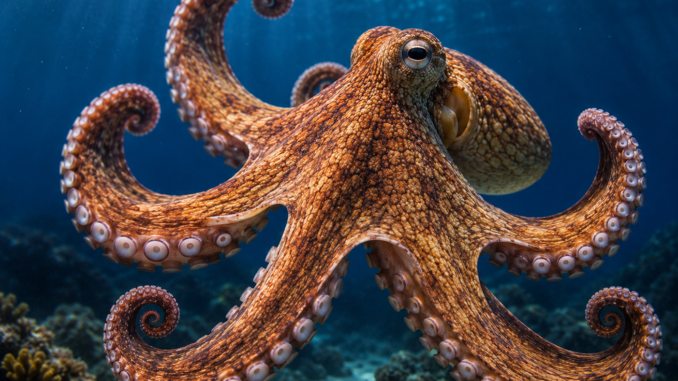
The ocean is home to countless fascinating creatures, but few are as mysterious and intelligent as the octopus. With eight flexible arms, remarkable camouflage abilities, and problem-solving skills that rival some mammals, the octopus continues to amaze scientists around the world.
Although many people recognize an octopus by its unusual appearance, few realize just how extraordinary its body truly is. From having three hearts to blue blood and an incredible nervous system, almost every part of an octopus is uniquely adapted for survival.
Let’s explore what makes this remarkable sea creature one of nature’s greatest wonders.
Three Hearts Working Together
One of the most surprising facts about an octopus is that it has three separate hearts.
Each heart has its own important role.
Two of the hearts pump blood to the gills, where oxygen is absorbed from the water. The third heart pumps oxygen-rich blood to the rest of the body, supplying muscles, organs, and the brain.
Interestingly, when an octopus swims, the heart responsible for pumping blood throughout the body temporarily stops beating. Because of this, swimming requires a great deal of energy, which is why octopuses often prefer crawling across the ocean floor using their arms rather than swimming for long distances.
This unusual circulatory system allows the octopus to survive in underwater environments where oxygen levels may be much lower than on land.
Why Is an Octopus’s Blood Blue?
Unlike humans, whose blood is red because it contains iron-rich hemoglobin, octopus blood appears blue.
This is because it contains hemocyanin, a copper-based protein responsible for transporting oxygen.
Hemocyanin performs much better than hemoglobin in cold water and in environments where oxygen is limited.
Since many octopus species live deep beneath the ocean surface, where temperatures are low and oxygen can be scarce, blue blood provides an important survival advantage.
Although the color may seem unusual, it is a perfect example of how evolution has adapted different animals to thrive in their natural habitats.
Eight Arms with Independent Control
The octopus’s eight arms are among the most versatile limbs in the animal kingdom.
Each arm contains hundreds of powerful suction cups that help the animal grip rocks, capture prey, manipulate objects, and even taste what it touches.
Perhaps even more astonishing is the way the octopus controls its arms.
Scientists estimate that an octopus has around 500 million neurons, and nearly two-thirds of those neurons are located in its arms rather than its brain.
This means each arm can process information and perform certain movements independently while still working together with the central brain.
As a result, an octopus can use different arms for completely different tasks at the same time.
One arm might explore a small cave, another might collect food, while others help maintain balance on the seafloor.
Masters of Camouflage
If there is one ability that has made octopuses famous, it is their extraordinary camouflage.
Their skin contains specialized pigment cells called chromatophores, along with reflective cells that allow them to change both color and texture within seconds.
An octopus can instantly blend into coral reefs, rocks, sand, or seaweed, making it extremely difficult for predators to detect.
Some species can even imitate other marine animals, including venomous fish and sea snakes, to scare away potential threats.
This remarkable ability is one of the reasons octopuses have survived for millions of years.
Surprisingly Intelligent
Scientists consider octopuses to be among the smartest invertebrates on Earth.
Numerous studies have demonstrated their impressive problem-solving abilities.
Researchers have observed octopuses:
- Opening screw-top jars to reach food.
- Solving complex puzzles.
- Escaping from aquariums through tiny openings.
- Recognizing individual humans.
- Learning from experience.
- Remembering solutions to previous challenges.
Some aquariums have even reported octopuses escaping from their tanks during the night, exploring nearby exhibits, and returning before staff arrived the next morning.
Their curiosity and intelligence continue to surprise researchers.
Flexible Bodies Without Bones
Unlike most animals, octopuses have no internal skeleton.
Their only hard body part is a small beak located at the center of their arms.
Because of this, they can squeeze through incredibly small spaces.
If their beak can fit through an opening, the rest of the body can usually follow.
This flexibility allows them to hide inside narrow rock crevices, abandoned shells, bottles, and even tiny gaps that appear impossible to enter.
A Powerful Defense Mechanism
When threatened, many octopus species release a cloud of dark ink into the water.
This ink serves two purposes.
First, it creates a visual screen that confuses predators.
Second, certain chemicals in the ink can temporarily interfere with a predator’s sense of smell, giving the octopus valuable time to escape.
Combined with its camouflage and speed, this defense system makes the octopus one of the ocean’s most successful survivors.
Short Lives Despite Extraordinary Abilities
One surprising fact about octopuses is that most species live only one to five years.
Despite their remarkable intelligence and adaptability, their lifespan is relatively short.
Female octopuses dedicate themselves entirely to protecting their eggs.
Many stop eating while guarding them, ensuring they remain safe until they hatch.
After the young emerge, the mother usually dies shortly afterward, completing one of nature’s most remarkable life cycles.
Why Scientists Continue to Study Octopuses
Researchers are fascinated by octopuses because they challenge many assumptions about intelligence.
Their nervous system is unlike that of mammals.
Their bodies solve problems in unique ways.
Their ability to regenerate lost arms, camouflage instantly, and manipulate complex objects continues to inspire new discoveries in biology, medicine, robotics, and artificial intelligence.
Engineers have even designed flexible robotic arms based on the movement of octopus tentacles.
Final Thoughts
The octopus is far more than an unusual sea creature.
It is a remarkable example of nature’s creativity and adaptability.
With three hearts, blue blood, extraordinary camouflage, flexible bodies, and impressive intelligence, octopuses remind us that life beneath the ocean surface is full of incredible surprises.
The next time you see an octopus in a documentary or aquarium, remember that you are looking at one of the most fascinating animals on our planet—an animal whose abilities continue to inspire scientists and amaze people around the world.
Leave a Reply