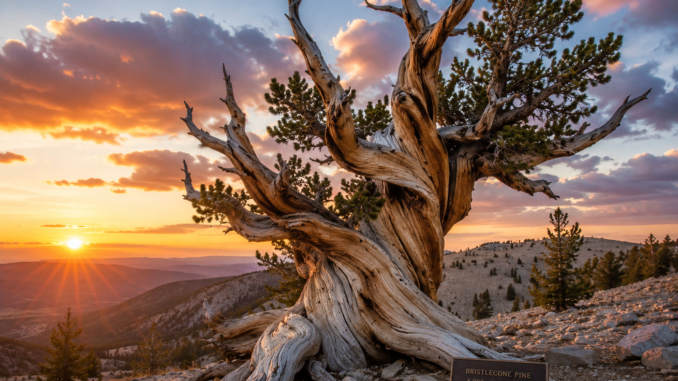
When most people think about ancient history, they picture pyramids, castles, or forgotten civilizations. Yet one of the oldest witnesses to human history is not a building at all—it’s a living tree.
Hidden among the rugged mountains of eastern California grows a remarkable Great Basin Bristlecone Pine, a species famous for its incredible lifespan and resilience. Some individual trees have survived for more than 4,800 years, making them among the oldest living organisms ever discovered.
To put that into perspective, these trees were already growing long before the Roman Empire existed. They were alive while Stonehenge was still under construction and when the first Egyptian pyramids were being built.
The thought that a single tree has quietly witnessed nearly five thousand years of Earth’s history is truly astonishing.
A Harsh Place to Call Home
One reason these trees have survived for so long is the environment where they grow.
Bristlecone pines are found at elevations between 9,000 and 11,000 feet (2,700–3,400 meters) in the White Mountains of California, Nevada, and Utah.
Life at these altitudes is far from easy.
Winters bring freezing temperatures and heavy snowfall.
Strong mountain winds blow almost constantly.
The rocky soil contains very few nutrients, and rainfall is extremely limited.
Most plants would struggle to survive under such conditions.
Yet the bristlecone pine has adapted perfectly.
Rather than growing quickly, it grows slowly—sometimes adding only a tiny fraction of an inch each year.
This slow development is one of the keys to its extraordinary longevity.
Slow Growth Creates Strong Wood
Unlike fast-growing trees, bristlecone pines produce extremely dense wood.
Dense wood resists insects, fungi, and decay far better than softer timber.
Even when parts of the tree die, the remaining living sections continue transporting water and nutrients.
As a result, a tree may lose most of its bark and branches while still remaining alive for centuries.
Many ancient bristlecone pines appear twisted, weathered, and partially dead.
Yet hidden beneath their rugged appearance, a narrow strip of living tissue continues supporting the tree year after year.
Nature’s Master of Survival
Scientists believe several unique characteristics help these trees survive for thousands of years:
- Extremely slow growth
- Dense, resin-rich wood
- High resistance to insects and disease
- Ability to survive with only small sections of living tissue
- Adaptation to poor, rocky soil
- Exceptional tolerance for drought and freezing temperatures
Together, these traits create one of the most resilient tree species on Earth.
Why Their Exact Location Is Protected
The oldest known individual bristlecone pine is often referred to as “Methuselah.”
Researchers estimate its age to be over 4,800 years.
However, its precise location is intentionally kept secret.
This isn’t to create mystery.
It’s to protect the tree.
Over the years, famous natural landmarks have sometimes suffered damage from visitors who carved names into them, removed branches, or accidentally harmed fragile environments.
Keeping the oldest trees anonymous helps ensure they remain healthy for future generations.
Visitors can still explore the surrounding forests and admire many other ancient bristlecone pines without knowing which one holds the longevity record.
Living Through Human History
Imagine everything these trees have silently witnessed.
When one of today’s oldest bristlecone pines first began growing:
- The first Egyptian pyramids had not yet been completed.
- Bronze tools were still transforming ancient civilizations.
- The Roman Empire did not exist.
- Paper had not yet been invented.
- Electricity, cars, airplanes, and computers were thousands of years in the future.
Generation after generation of humans have come and gone while these remarkable trees remained rooted in the same mountains.
Few living things on Earth can tell such an incredible story.
What Scientists Learn From Ancient Trees
Bristlecone pines are more than natural wonders.
They also serve as valuable scientific records.
Each year, trees produce a new growth ring.
By studying these rings, researchers can learn about:
- Past droughts
- Changes in rainfall
- Wildfire history
- Volcanic eruptions
- Long-term climate patterns
- Environmental changes over thousands of years
Because bristlecone pines live for such extraordinary lengths of time, they provide one of the longest continuous climate records available anywhere in the world.
Lessons From One Remarkable Tree
Perhaps the greatest lesson these ancient trees teach has nothing to do with biology.
In a world that often celebrates speed and rapid growth, the bristlecone pine reminds us that endurance can be even more powerful.
It doesn’t grow quickly.
It doesn’t seek perfect conditions.
Instead, it adapts, survives, and continues growing little by little, year after year.
Its strength comes from patience rather than speed.
Final Thoughts
Standing quietly among the mountains of the American West, the Great Basin Bristlecone Pine is one of nature’s greatest achievements.
For nearly five millennia, it has endured storms, freezing winters, droughts, and the passage of countless generations.
While civilizations have risen and fallen, this remarkable tree continues reaching toward the sky, reminding us that resilience often grows slowly.
The next time you see an old tree, take a moment to appreciate its story.
It may have witnessed far more history than any book could ever tell—and perhaps, like the ancient bristlecone pine, it still has many centuries left to share.
Leave a Reply