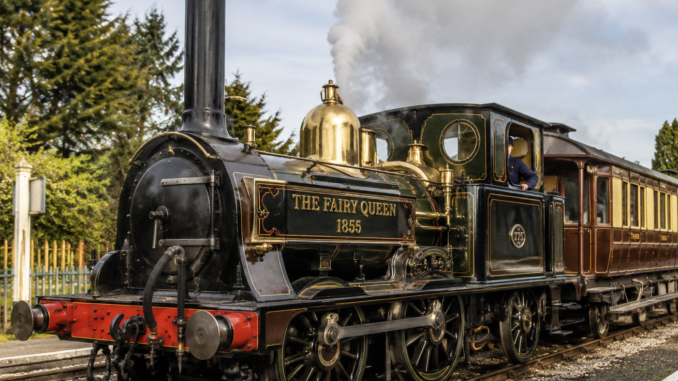
When people think about trains today, they often imagine sleek high-speed rail systems that travel hundreds of kilometers per hour. Modern trains are fast, comfortable, and powered by advanced technology that would have seemed impossible just a century ago.
However, long before electric and diesel engines transformed rail travel, another invention changed the world forever—the steam locomotive.
Among all the historic steam engines ever built, one stands out as a remarkable symbol of engineering and history: the Fairy Queen.
Constructed in 1855, this extraordinary locomotive is recognized as one of the oldest operational steam locomotives in the world. More than 170 years after it first rolled along the tracks, it continues to capture the imagination of railway enthusiasts, historians, and visitors from around the globe.
The Birth of Steam Railways
The 19th century was a time of incredible innovation.
Factories were expanding, cities were growing, and countries needed faster ways to move people and goods across long distances.
Before railways became common, transportation depended mainly on horses, wagons, and boats. Long journeys often took days or even weeks.
The invention of the steam locomotive changed everything.
Powered by steam generated from boiling water, these engines allowed trains to travel much farther and much faster than any previous form of land transportation.
The railway quickly became one of the most important inventions of the Industrial Revolution.
The Story of the Fairy Queen
The Fairy Queen was built in 1855 by the famous engineering company Kitson, Thompson & Hewitson in Leeds, England.
Soon after its construction, it was transported to India, where it entered service on the expanding railway network.
At the time, railways were transforming trade and travel across the country.
The locomotive carried both passengers and freight, helping connect towns and cities that had previously been separated by long and difficult journeys.
Although many steam engines from that era were eventually retired and scrapped, the Fairy Queen survived.
Instead of being forgotten, it was carefully preserved, allowing future generations to experience a remarkable piece of engineering history.
How Does a Steam Locomotive Work?
Unlike modern trains, steam locomotives rely on a surprisingly simple but powerful process.
First, coal is burned inside a firebox.
The heat from the fire boils water inside a large boiler, creating high-pressure steam.
This steam is then directed into cylinders, where it pushes pistons back and forth.
The pistons turn large driving wheels, allowing the locomotive to move along the railway tracks.
As the train travels, clouds of white steam escape through the chimney, creating one of the most iconic sights in railway history.
Although today’s trains use electricity or diesel fuel, steam locomotives remain fascinating examples of mechanical engineering.
Why Is the Fairy Queen So Special?
Many old locomotives survive only as museum exhibits.
The Fairy Queen is different.
It has been restored and maintained so that it can still operate on special heritage railway journeys.
Watching this locomotive move under its own power is like stepping back into the nineteenth century.
The sound of the whistle, the rhythmic movement of the wheels, and the clouds of steam create an unforgettable experience that modern trains simply cannot replicate.
Because of its historical importance, the Fairy Queen has earned recognition as one of the oldest working steam locomotives in existence.
Preserving Railway History
Keeping a locomotive that is more than 170 years old in operating condition is no easy task.
Engineers and restoration specialists regularly inspect every component.
Replacement parts often have to be custom-made because original pieces are no longer manufactured.
The boiler, wheels, pistons, and braking systems all require careful maintenance to ensure the locomotive remains safe for operation.
Preservation is about more than keeping an old machine running.
It is about protecting an important chapter of human history.
Steam Locomotives Changed the World
During the nineteenth century, railways transformed everyday life.
Farmers could transport crops to markets much more quickly.
Factories received raw materials faster.
Families could travel greater distances than ever before.
Entire towns grew around railway stations.
Steam locomotives also played an important role in expanding commerce, improving communication, and supporting economic development around the world.
Many historians consider the railway one of the greatest technological achievements of its time.
A Living Museum
Unlike many historical artifacts that remain behind glass displays, the Fairy Queen still demonstrates how nineteenth-century engineering worked in real life.
Visitors who see it in operation experience much more than an old train.
They witness history in motion.
The smell of coal smoke, the sound of steam escaping under pressure, and the slow, powerful movement of the locomotive provide a unique glimpse into the past.
For railway enthusiasts, it is an unforgettable experience.
Lessons From the Past
The Fairy Queen reminds us that true craftsmanship can stand the test of time.
Built using tools and technology available in the mid-1800s, this locomotive continues to impress engineers even today.
Its survival shows the importance of preserving historical inventions rather than allowing them to disappear.
Every old machine tells a story—not only about engineering, but also about the people who designed, built, operated, and maintained it throughout generations.
Final Thoughts
The Fairy Queen is far more than an old steam locomotive.
It is a living reminder of an era that transformed transportation forever.
More than 170 years after its construction, it continues to inspire visitors with its remarkable engineering, historical importance, and enduring legacy.
As modern technology continues to evolve, machines like the Fairy Queen remind us how far humanity has come—and how the greatest innovations of the past continue to shape the world we live in today.
Sometimes, the oldest machines are also the greatest storytellers.
Leave a Reply