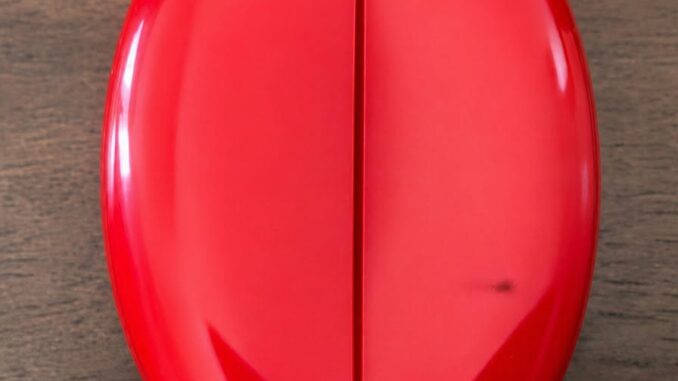
In our hyper-digitized world of contactless smartphone taps, digital wallets, and blockchain transactions, the tactile weight of physical currency has become increasingly rare. Most of us navigate our daily routines without ever touching a metal coin. Yet, if you were to stumble across a seamless, brightly colored, oval-shaped object tucked into the back of a vintage drawer or thrift store bin, you might find yourself momentarily pausing in curiosity.
At first glance, this smooth, vibrant red object is a delightful mystery. Depending on who you ask, it might easily be mistaken for a modern wireless earbud case, a vintage makeup compact, a tactile fidget toy, or a protective lens filter holder.
In reality, you are holding a genuine piece of mid-century design genius: the classic rubber squeeze coin purse, historically known across generations as a Quikey or an Oval Squeeze Purse.
The Physics of Simplicity: How the Squeeze Purse Works
What makes the rubber squeeze coin purse such a enduring marvel of everyday engineering is its absolute avoidance of complicated mechanics. There are no finicky zippers that jam, no metal snaps that wear out, no stubborn buttons, and no Velcro that loses its grip over time.
Instead, the design relies entirely on the elegant physics of flexible materials. A narrow, self-sealing slit runs directly along the center of the molded rubber or soft vinyl body. When the purse sits undisturbed on a table or in a pocket, the natural tension of the material keeps this central slit squeezed tightly, securely shut.
To open it, the user employs a wonderfully intuitive one-handed motion: simply take both narrow ends of the oval between your thumb and forefinger and squeeze inward. That lateral pressure forces the flexible walls to arch outward like a vault door, causing the central slit to part wide open. Inside, your coins or small treasures are instantly accessible.
The moment you release the pressure, the resilient rubber naturally springs back to its original shape, snapping the slit closed. It is a brilliant, self-sealing mechanism that requires zero maintenance, features zero moving parts, and offers maximum utility with minimal effort.
A Mid-Century Staple: From Payphones to Parking Meters
While the design is deceptively simple, its cultural footprint is immense. Squeeze coin purses skyrocketed in popularity throughout North America and Europe from the 1950s through the 1980s, becoming an absolute staple of daily life.
During this era, physical coins were not merely pocket clutter—they were absolute essentials for navigating modern society. Coins were required for virtually every routine transaction and public service:
-
Public Telephones: Making a call while away from home meant feeding quarters into a payphone.
-
Public Transit: Exact change was mandatory for boarding city buses and streetcars.
-
Parking Meters: Feeding the meter was a constant, race-against-the-clock requirement for drivers.
-
Vending Machines and Laundromats: Grabbing a snack, a soda, or washing a load of clothes required a steady supply of dimes, nickels, and quarters.
Because loose change was heavy, noisy, and prone to scattering at the bottom of a pocket or handbag, the rubber squeeze purse offered the ultimate lightweight, silent, and accessible storage solution.
The Ultimate Promotional Giveaway: Marketing in Your Pocket
Beyond their personal utility, squeeze coin purses played a fascinating role in mid-century advertising and corporate branding.
Their durable surface and low production cost made them the premier promotional product for decades. Local banks, neighborhood gas stations, insurance agencies, hardware stores, and car dealerships quickly realized the marketing power of the little red oval. Businesses would screen-print their company names, logos, phone numbers, and addresses directly onto the rubber surface.
Handed out freely to customers, these branded purses acted as miniature, mobile billboards. Because the objects were virtually indestructible and endlessly useful, a customer might carry a local bank’s logo in their pocket for ten or fifteen years, ensuring unbeatable brand longevity.
Modern Utility: Finding New Life for the Little Red Oval
Although the shift toward digital payments has largely eliminated the daily need to carry heavy pocket change, rubber squeeze purses have far from outlived their usefulness. In the modern era, they have found a second wind as versatile organizers for a new set of tiny everyday carry items.
Today, people repurpose vintage and newly manufactured squeeze purses to hold:
-
Guitar Picks: Keeping picks safe, dry, and easy for musicians to grab on the go.
-
Earbuds and Charging Cords: Taming tangled wired headphones or small adapters.
-
Small Hardware: Storing loose screws, washers, or specialty keys.
-
Stash Containers: Protecting tokens, folded bills, or small keepsakes.
A Timeless Symbol of Ingenuity
Today, vintage squeeze purses are collected and appreciated not just for their practical utility, but for the waves of pure nostalgia they evoke. Their striking, saturated colors, faded retro advertising graphics, and ingenious opening mechanism capture a golden era of industrial design—a time when everyday objects were deliberately built to be durable, endlessly functional, and delightfully clever.
The classic rubber squeeze coin purse proves that you do not need complex technology to create something enduring. Sometimes, the most brilliant designs are the ones that fit effortlessly in the palm of your hand, solve a daily frustration with a simple squeeze, and bring a quiet smile to your face every time you use them.
Leave a Reply