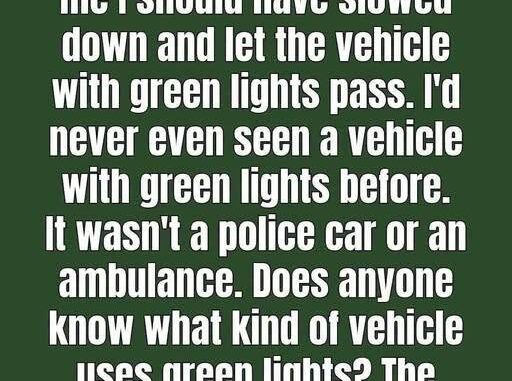
Most drivers immediately recognize the meaning of red and blue emergency lights. They are commonly associated with police officers, ambulances, and other emergency responders.
But what happens when you see a flashing green light on a vehicle?
For many motorists, the sight can be confusing.
A green light isn’t something most people expect to see on an ordinary car, and it doesn’t carry the same universally recognized meaning as the lights used by police or ambulances.
In some locations, however, green flashing lights can be associated with medical transportation, volunteer responders, or other emergency-related services. The exact meaning depends on local laws and regulations, so drivers should not automatically assume that every vehicle displaying a green light has the same privileges.
Why Would a Vehicle Use a Green Light?
One reason these lights may be used is to draw attention to a vehicle that is involved in helping someone during a medical or emergency situation.
For example, a volunteer driver could be transporting a person to or from medical treatment. The passenger may be elderly, recovering from a procedure, experiencing a health problem, or otherwise require additional assistance.
The vehicle may not look anything like an ambulance.
There may be no siren.
There may be no large emergency markings.
Instead, a small flashing light can serve as a way of telling surrounding motorists that there may be a reason the driver needs a little extra consideration.
This is particularly important in congested traffic, where even a short delay can make a difficult journey more stressful.
Does a Green Light Mean You Have to Move Over?
Not necessarily.
This is one of the most important points for drivers to understand.
The legal meaning of a green light varies by jurisdiction. In some places, certain green lights may be authorized for specific purposes, while in others they may have a completely different meaning.
A green light does not automatically mean the vehicle has the same legal priority as a police car or ambulance.
Drivers should therefore continue following normal traffic rules.
If the vehicle is attempting to change lanes, merge, or navigate through congestion, motorists can provide reasonable space when it is safe to do so. But nobody should suddenly brake, drive onto a shoulder, run a red light, or make another dangerous maneuver simply because they see a green light.
Safety should always come first.
Why Can These Lights Be Easy to Misunderstand?
Most drivers are trained to recognize a few familiar colors.
Red often signals danger or a requirement to stop.
Blue is commonly associated with law enforcement and emergency services.
Amber or yellow is frequently used for warning and roadside situations.
Green, on the other hand, is usually associated with permission or movement at traffic signals.
That makes a flashing green light on a car unusual.
A driver seeing one for the first time may wonder whether it is an emergency vehicle, a private vehicle, a volunteer responder, or something else entirely.
The confusion can become even greater at night or during bad weather when it is difficult to identify the vehicle itself.
What Should You Do If You See One?
The best response is simple: stay calm and pay attention.
Don’t assume the driver is doing something wrong simply because you don’t recognize the light.
At the same time, don’t assume the vehicle has unlimited emergency privileges.
Watch what the driver is actually doing.
If they are signaling to merge, allowing them enough space to enter the lane can be a courteous choice when conditions permit.
If traffic is moving slowly, avoiding unnecessary tailgating or aggressive behavior can also make the situation safer.
And if the vehicle is behaving like an ordinary car and isn’t requesting space, there may be no action required at all.
A Small Light Can Communicate a Bigger Story
One reason these lights can be meaningful is that drivers cannot see what is happening inside another vehicle.
A car may look completely ordinary from the outside while carrying someone who has just finished medical treatment or is struggling with a serious situation.
The driver may also be dealing with a stressful responsibility that other motorists know nothing about.
A small visual signal can therefore act as a reminder that there may be more to the situation than meets the eye.
That doesn’t mean every vehicle with a green light should be treated as an emergency vehicle.
It simply means drivers should avoid making assumptions.
Rules Can Differ From One Place to Another
It’s also important to remember that traffic-light rules are not identical everywhere.
The color green may have different authorized uses depending on the country, state, province, or municipality.
Some jurisdictions may restrict flashing lights to particular organizations or vehicles. Others may have specific requirements regarding when and where certain lights can be displayed.
Because of these differences, information that is correct in one location may not necessarily apply somewhere else.
If you’re unsure about the meaning of a particular vehicle light in your area, checking the local traffic regulations is the safest way to get an accurate answer.
The Main Lesson for Drivers
Seeing an unfamiliar green flashing light doesn’t necessarily mean something dramatic is happening.
But it is a good reason to pay closer attention.
Keep a safe following distance.
Watch the vehicle’s signals.
Avoid aggressive maneuvers.
Give the driver reasonable room when it is safe and lawful to do so.
And most importantly, never break traffic laws simply because another vehicle is displaying an unusual light.
A few seconds of patience can make the road safer for everyone.
The next time a flashing green light catches your attention, remember that the vehicle may be connected to a medical or volunteer service—or it may have another locally authorized purpose.
You may never know exactly what is happening inside.
But you can always choose to respond with caution, patience, and common sense.
Sometimes, the safest thing a driver can do is simply give another person a little more room.
Leave a Reply