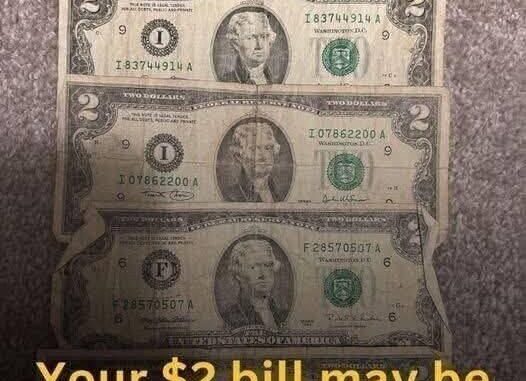
At first glance, a $2 bill doesn’t seem special. It’s real U.S. currency, but it’s rarely used in everyday transactions, so most people treat it like an oddity rather than something valuable. In most cases, it is simply worth two dollars.
However, in the world of collectors, certain $2 bills can be worth significantly more than their printed value. The difference usually isn’t obvious at first—it comes down to small details that many people overlook entirely.
What Makes a $2 Bill Valuable?
Collectors don’t just look at the denomination; they focus on specific traits that make a bill unique or rare.
One of the most important factors is the series year. Some years had lower print runs or design variations, which can make those notes more desirable to collectors.
Another detail is the Treasury seal and printing style. Subtle differences in ink, layout, or design changes across production batches can sometimes increase interest in certain bills.
But one of the biggest factors is the serial number printed on each note. Since every bill has a unique number, some combinations are far more attractive than others.
Examples that collectors often value include:
- Repeating numbers (like 88888888)
- Very low numbers (such as 00000012)
- Palindromes (numbers that read the same forward and backward)
- Patterned or symmetrical sequences
These patterns are rare by chance, which makes them more appealing in collector markets.
Condition Plays a Huge Role
Even if a bill has interesting features, its condition is just as important.
A well-preserved $2 bill is far more desirable than one that has been heavily used. Collectors typically prefer notes that are:
- Clean and free from stains
- Crisp with no folds or tears
- Properly centered in printing
- Visually sharp and intact
A bill in excellent condition can stand out dramatically compared to one that has been circulated for years. Even small imperfections can reduce its appeal.
Why the $2 Bill Feels Rare
The $2 bill already has a unique reputation in the United States. Although it is still printed and legal tender, it appears less frequently in circulation than other denominations.
Because of this, many people assume it is rare—even though it is not. Still, its uncommon use gives it a certain novelty that sets it apart.
Interestingly, many people choose to keep $2 bills instead of spending them. This habit reduces how often they appear in daily transactions, which can make them feel even more unusual over time.
The Shift Toward Digital Money
As society increasingly moves toward digital payments, physical cash is becoming less common overall. Credit cards, mobile apps, and online transfers are now the norm.
In this environment, physical currency naturally becomes more interesting—especially uncommon denominations like the $2 bill. Instead of being seen purely as money for spending, it is often viewed as something collectible or symbolic.
This shift has helped increase curiosity around older or less frequently seen paper money.
Hidden Value in Everyday Currency
One of the most fascinating aspects of $2 bills is that they highlight how something ordinary can sometimes hold hidden value.
Most $2 bills are still worth exactly what they say—two dollars. But a small number can be worth more due to rarity, condition, or unique printing characteristics.
This creates a simple but interesting idea: value isn’t always obvious at first glance.
How Collectors View Currency Differently
Collectors tend to look at money in a very different way than everyday users.
While most people see currency as a tool for buying things, collectors see it as:
- A piece of history
- A product of printing variation
- A combination of design and rarity
Small details that seem meaningless—like a unique number pattern or slight printing difference—can become important in determining value.
Over time, this mindset turns ordinary bills into items worth examining more carefully.
Should You Check Your Wallet?
It’s unlikely that every $2 bill you come across will be valuable. Most are still worth their face value.
However, it can still be interesting to take a closer look when you find one. A quick check might include:
- Looking at the serial number
- Checking the series year
- Observing the overall condition
- Noting any unusual printing features
Even if the bill isn’t rare, it offers a small insight into how currency is produced and how collectors evaluate it.
A Simple Lesson About Value
The story of the $2 bill is really about perspective. Something that appears ordinary may still have details worth noticing if you take the time to look more closely.
In a world dominated by digital payments, physical currency carries a subtle reminder of design, history, and craftsmanship. Each note has its own journey, even if most of them look identical at first glance.
Most $2 bills will never be worth more than their printed value—and that’s perfectly normal. But a few, because of rare characteristics or exceptional condition, can become surprisingly interesting to collectors.
What makes them special isn’t just potential value—it’s the reminder that even everyday objects can hold hidden details worth noticing.
Sometimes, the real value isn’t in the money itself, but in what you discover when you take a closer look.
Why Certain Notes Become Collector Favorites
Not all “rare” money becomes valuable for the same reason. In fact, most collectible currency doesn’t gain attention because it is ancient or damaged, but because it carries small, unusual traits that make it stand out from millions of identical prints.
For $2 bills in particular, collectors often focus on patterns of scarcity rather than age alone. A bill doesn’t need to be decades old to be interesting. Instead, it might simply belong to a limited print batch, or it may have been preserved in unusually good condition since the day it was issued.
This is why two $2 bills from the same year can have completely different values in the collector market. One might remain worth face value, while the other becomes something people actively search for.
Printing Quirks That Add Interest
Currency production is a highly controlled process, but like any large-scale manufacturing system, small variations can occur. These variations are not considered errors in most cases, but they can still influence how collectors view a note.
Some examples include:
- Slight misalignment of printing
- Ink variations between batches
- Differences in paper texture due to production changes
- Minor spacing inconsistencies in serial numbers or seals
While these details do not affect the bill’s ability to be used as money, they can make it more appealing to collectors who focus on uniqueness.
In some cases, notes with printing errors become especially sought after. However, even subtle variations that are not technically “errors” can still attract attention if they are uncommon enough.
The Psychology Behind Collecting Currency
Part of what drives interest in $2 bills is psychological rather than financial. Humans are naturally drawn to rarity and patterns. When something is uncommon—even if it is still officially in circulation—it feels more valuable.
The $2 bill fits this perfectly. It is legal tender, but rarely seen in daily use, which creates a sense of curiosity around it. People often hold onto them, show them to others, or save them simply because they feel different from standard currency.
Collectors take that instinct a step further by analyzing details most people overlook. What begins as curiosity can turn into a structured hobby based on condition, rarity, and historical context.
Misconceptions About $2 Bill Value
A common misunderstanding is that all $2 bills are automatically worth more because they are uncommon in everyday life. This is not accurate.
Most $2 bills:
- Are still in active circulation
- Were printed in large enough quantities to remain common
- Hold no special collector premium
Their perceived rarity often comes from how rarely people personally encounter them, not from actual scarcity.
However, selective examples—especially those with unique serial numbers or pristine condition—can still exceed face value in collector markets. The key difference is that value depends on specific traits, not general appearance.
Why People Still Hold Onto Them
Even when there is no financial premium, many people choose to keep $2 bills rather than spend them. This behavior contributes to their mystique.
Some keep them as:
- Souvenirs from travel or special events
- Conversation pieces
- Small collectibles passed down through families
- Symbols of luck or novelty
Over time, this tendency to save rather than spend reduces circulation even further, reinforcing the idea that they are “rare,” even if they technically are not.
A Simple Habit That Can Be Interesting
Checking your wallet for interesting bills doesn’t require expertise. It’s a simple habit that only takes a few seconds, but it can make everyday money feel a little more engaging.
Even if you never find a valuable note, you may start noticing:
- How serial numbers are structured
- How printing changes over time
- How condition affects appearance
- How uncommon certain designs feel in circulation
This small shift in awareness is often what keeps people interested in currency collecting as a hobby.
Final Reflection
At its core, the $2 bill is a reminder that value is not always obvious. Most of the time, it is just another piece of currency used for everyday transactions. But occasionally, small details—like a rare number pattern or exceptional preservation—can transform it into something worth more than expected.
What makes it interesting is not just the possibility of profit, but the perspective it offers. It encourages people to slow down for a moment and look at something familiar with fresh attention.
And sometimes, that’s all it takes to turn something ordinary into something worth noticing.
Leave a Reply